North Carolina Driver License: Signals, Signs and Markings
30 questions with the correct answer and an explanation for each.
Topic: Signals, Signs and Markings. Free, no account needed.
Take this test interactively
1. A traffic light turns from green to yellow just as a driver reaches an intersection, too close to stop safely. What should the driver do?
- Reverse back from the intersection
- Speed up to clear the intersection before it turns red
- Continue through the intersection without speeding up
- Stop immediately wherever the vehicle happens to be
Answer: C — Continue through the intersection without speeding up
The circular yellow signal means stop unless too close to stop safely, but a driver in that position should never speed up to beat the light.
2. After stopping completely at a red light, a driver turning right fails to yield to a pedestrian who has already stepped into the crosswalk. What fine does this carry?
- $500 to $2,000
- $250 to $1,000
- $100 to $500
- $50 to $250
Answer: C — $100 to $500
Failing to yield to a pedestrian in or entering the crosswalk during a right turn on red carries a fine of $100 to $500.
3. A driver making a U-turn and an oncoming driver turning right both face green arrows at the same time. Who must yield?
- The right-turning driver yields to the U-turning traffic
- The U-turning driver yields to the right-turning traffic
- Neither yields, since both arrows are protected
- Whichever driver arrived first has the right of way
Answer: B — The U-turning driver yields to the right-turning traffic
Even though both movements have a green arrow, the U-turning driver must yield to opposing right-turning traffic.
4. A traffic signal at an intersection has completely failed and shows no light in any direction, with no officer present. How should drivers treat the intersection?
- Slow and proceed with caution, as if a warning sign were posted
- Wait where stopped until an officer arrives
- The road with more lanes has the right of way
- Stop, as if a stop sign were posted on every approach
Answer: D — Stop, as if a stop sign were posted on every approach
A dark, failed signal is treated as a stop sign on every approach.
5. A left-turn signal shows a flashing yellow arrow. What must a driver do to complete the turn?
- Turn immediately, since the movement is fully protected
- Turn only after yielding to oncoming traffic and pedestrians
- The turn is not allowed until the arrow becomes solid yellow
- Stop and wait for a solid green arrow before turning
Answer: B — Turn only after yielding to oncoming traffic and pedestrians
A flashing yellow arrow permits the turn only after yielding to oncoming traffic and pedestrians, unlike a solid green arrow which needs no yielding.
6. Approaching an intersection, at roughly what distance before it should a driver expect a stop sign to be posted?
- 50 to 100 feet
- 1 to 5 feet
- 100 to 200 feet
- 6 to 50 feet
Answer: D — 6 to 50 feet
Stop signs are usually posted 6 to 50 feet before the intersection they control.
7. Traffic ahead is backed up right at a railroad crossing and there is not enough room to clear the tracks. What must a driver do?
- Wait before the tracks until there is room to clear them completely
- Move onto the tracks and wait there for the traffic ahead to clear
- Reverse away from the crossing to find another route
- Follow the vehicle ahead onto the crossing as long as no train is in sight
Answer: A — Wait before the tracks until there is room to clear them completely
A driver must never stop on a railroad crossing, so they should hold back until there is room to clear the tracks entirely.
8. A diamond-shaped sign shows a black symbol on an orange background. What does it warn of?
- A school zone ahead
- Construction or maintenance work ahead
- A general road hazard, such as a curve or crossing
- A railroad crossing ahead
Answer: B — Construction or maintenance work ahead
Diamond warning signs are normally black on yellow for general hazards, but black on orange specifically warns of construction or maintenance.
9. A highway is identified by an odd route number. Which direction does it generally run?
- North and south
- It depends on whether it is an interstate or a U.S. route
- East and west
- Odd numbers mark a secondary road, not a direction
Answer: A — North and south
Odd-numbered highways generally run north and south, while even-numbered highways run east and west.
10. A two-lane road has a double solid yellow center line. Can a driver cross it to pass another vehicle?
- No, passing is not allowed in either direction
- Yes, but only when passing a slower vehicle
- Only the driver with better visibility of oncoming traffic may cross
- Yes, from either side, as long as the way is clear
Answer: A — No, passing is not allowed in either direction
Double solid yellow lines may not be crossed to pass in either direction.
11. At night, a driver notices a reflective pavement marker glowing red. What does that indicate?
- The driver is approaching a railroad crossing
- The driver is approaching a fire hydrant or water supply
- The driver is nearing the edge of a divided highway
- The driver is traveling the wrong way
Answer: D — The driver is traveling the wrong way
Red reflective markers face wrong-way drivers, warning them they are traveling against traffic.
12. A traffic officer raises a hand, palm toward oncoming drivers, and gives a long whistle blast. What does this mean?
- Proceed with caution, yielding to cross traffic
- Stop
- Go or keep moving
- Slow down and prepare to stop
Answer: B — Stop
A raised hand with a long whistle blast from a traffic officer means stop; a waving motion with short blasts means go.
13. What must a driver do when reaching this sign?
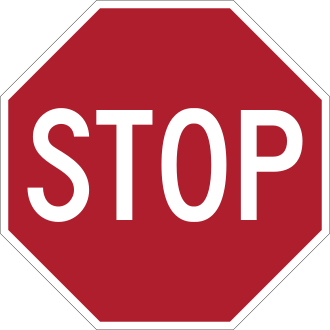
- Slow to the posted limit and proceed if clear
- Slow down and yield to cross traffic, stopping only if necessary
- Come to a full stop and go only when the way is clear
- Stop only if another vehicle is approaching
Answer: C — Come to a full stop and go only when the way is clear
This is the stop sign: come to a full stop at the marked line and go only when the way is clear.
14. What does this sign tell a driver?
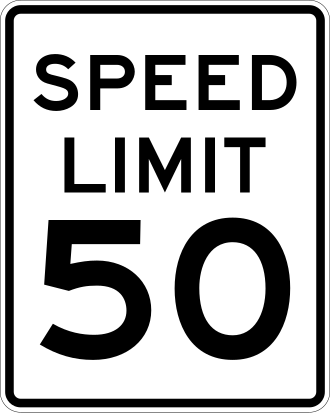
- The minimum speed required on this road
- The recommended safe speed for an upcoming curve
- A reduced speed that applies only while lights are flashing
- The maximum legal speed on this road
Answer: D — The maximum legal speed on this road
This sign posts the maximum legal speed for that stretch of road.
15. A driver is in a lane marked with this sign. What must they do at the intersection?
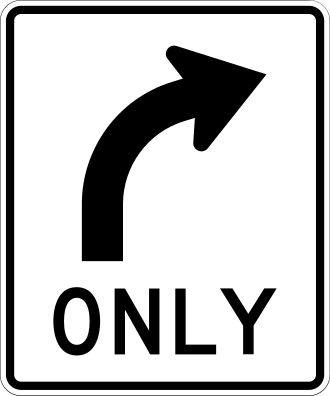
- Turn right only if no other sign says otherwise farther ahead
- Yield to traffic already in the right lane before turning
- Merge right before the lane ends ahead
- Turn right; going straight or left from this lane is not allowed
Answer: D — Turn right; going straight or left from this lane is not allowed
This lane is marked right-turn-only, so the driver must turn right.
16. A driver is in the center lane of a road marked with this sign. What is that lane for?
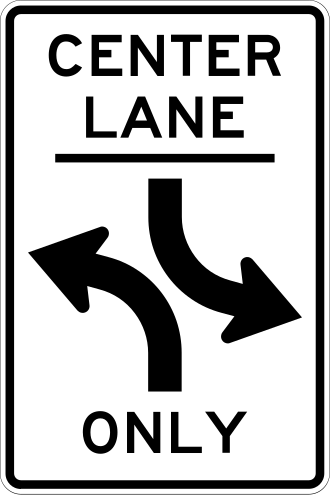
- Through traffic only, when the outer lanes are congested
- Passing slower traffic before returning to the right lane
- Left turns only, from either direction of travel
- Left turns from one direction only; oncoming traffic uses another lane
Answer: C — Left turns only, from either direction of travel
This center lane is reserved only for left turns made from either direction of travel, never for passing or merging.
17. What does this sign tell a driver approaching a road or ramp?
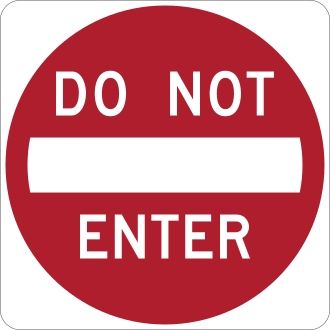
- No trucks may enter this road
- The road ahead is closed for construction
- Enter only if turning right immediately
- Do not enter; entering here would put you against the flow of traffic
Answer: D — Do not enter; entering here would put you against the flow of traffic
This sign forbids entry because entering would mean driving the wrong way against traffic.
18. What does this sign indicate about the road ahead?
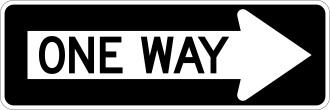
- The road divides ahead into two one-way roads
- Two-way traffic resumes ahead
- Traffic on this road moves only in the direction shown
- Traffic may not enter this road at all
Answer: C — Traffic on this road moves only in the direction shown
This sign marks a one-way road, where traffic moves only in the direction of the arrow.
19. What must a driver do at this sign?
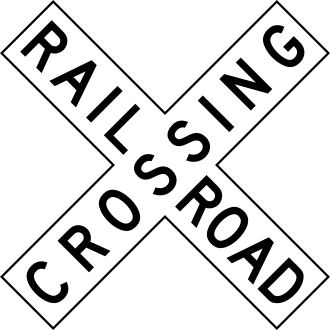
- Proceed if no gate is present, regardless of any signal
- Yield to any train, stopping if a signal, gate or flagger shows one is coming
- Slow down and listen, since this sign only warns of a crossing ahead
- Stop only if a train can already be seen approaching
Answer: B — Yield to any train, stopping if a signal, gate or flagger shows one is coming
At the crossbuck itself, a driver yields to any train and stops whenever a signal, gate or flagger indicates one is coming.
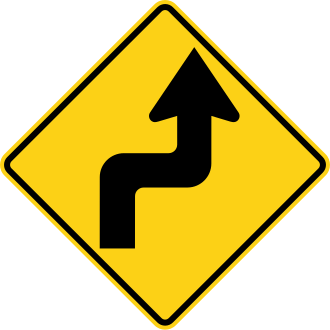
20. What does this sign warn a driver to expect?
- A single sharp turn to the right only
- A sharp turn to the right, followed by a sharp turn to the left
- The road ends ahead, requiring a turn in either direction
- A series of curves in alternating directions
Answer: B — A sharp turn to the right, followed by a sharp turn to the left
This sign warns that the road turns sharply right, then sharply left.
21. What does this sign tell a driver about the road ahead?
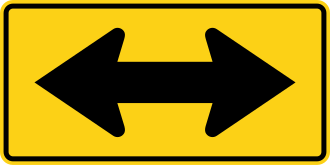
- The road ends ahead; the driver must turn left or right
- The road splits into two directions ahead
- The road curves sharply in the direction shown
- Traffic merges from both directions ahead
Answer: A — The road ends ahead; the driver must turn left or right
This large two-direction arrow marks a road that ends ahead, forcing a turn left or right.
22. What does this sign warn a driver of?
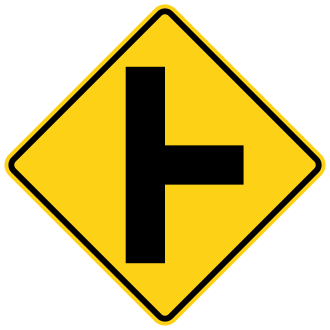
- Another road crosses straight through ahead
- The road ahead ends in a T-intersection
- Traffic merging from the right lane ahead
- A road entering from the right ahead
Answer: D — A road entering from the right ahead
This side road sign warns that another road enters from the right ahead.
23. What should a driver do on seeing this sign?
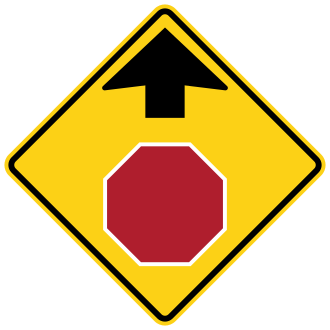
- Yield to cross traffic at the next intersection
- Slow down and prepare to stop for a stop sign ahead
- Come to a complete stop at this sign itself
- Slow down for a traffic signal ahead
Answer: B — Slow down and prepare to stop for a stop sign ahead
This sign warns of a stop sign ahead, often hidden by a curve or obstruction, so the driver should slow and prepare to stop.
24. A driver is in the right lane of a highway marked with this sign. What must they do?
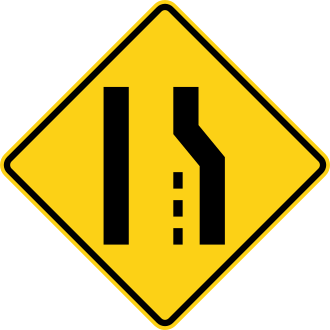
- Continue in the right lane, since a lane is being added
- Prepare to exit the highway
- Merge left, since the right lane ends ahead
- Move right to let merging traffic in
Answer: C — Merge left, since the right lane ends ahead
This sign warns that the right lane ends ahead, so traffic in it must merge left.
25. What does this sign tell a driver about the road ahead?
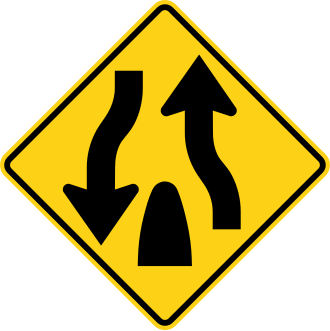
- Two-way traffic resumes; keep right of the center line
- The road narrows to a single lane ahead
- A divided highway begins; keep right of the divider
- The road splits into two separate highways
Answer: A — Two-way traffic resumes; keep right of the center line
This sign marks the end of a divided highway, where two-way traffic resumes and drivers must keep right of the center line.
26. A driver's tire drops off the pavement onto the shoulder where this sign was posted. What should they do?
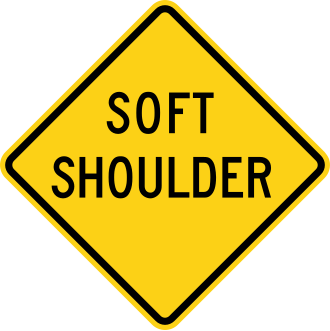
- Brake hard and pull fully off the road before the shoulder gives way
- Steer sharply to return to the pavement as quickly as possible
- Avoid braking hard or jerking the wheel while easing back onto the road
- Come to a complete stop before attempting to return to the road
Answer: C — Avoid braking hard or jerking the wheel while easing back onto the road
This sign warns of a soft shoulder, where a driver whose tire drops off should avoid braking hard or jerking the wheel.
27. What does this sign warn a driver of?
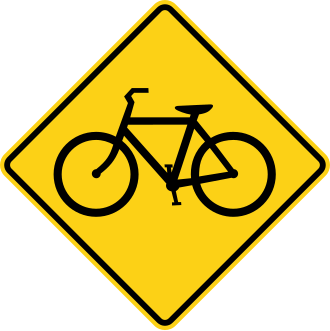
- Pedestrians may cross the road ahead
- Bicycles may cross the road ahead
- A shared-use path runs alongside the road ahead
- Deer frequently cross the road ahead
Answer: B — Bicycles may cross the road ahead
This sign warns that bicycles may cross the road ahead.
28. What must a driver do on seeing this sign?
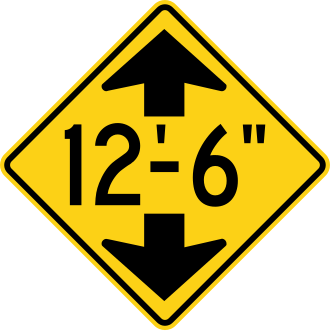
- Not enter if the vehicle is wider than the width shown
- Reduce speed because the bridge ahead is narrow
- Not enter if the vehicle is taller than the height shown
- Not enter if the vehicle is heavier than the weight shown
Answer: C — Not enter if the vehicle is taller than the height shown
This low clearance sign warns not to enter if the vehicle is taller than the posted height.
29. What does this sign mark, and what should a driver watch for?
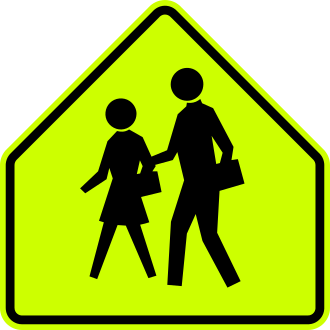
- A pedestrian crossing with no reduced speed limit
- A school zone or crossing; watch for children and reduced speed limits
- A playground with no vehicle access
- A speed limit that applies only while lights are flashing
Answer: B — A school zone or crossing; watch for children and reduced speed limits
This pentagon-shaped sign marks a school zone or crossing, where drivers should watch for children and reduced limits.
30. A driver is in a highway lane marked with this sign. What does it mean?
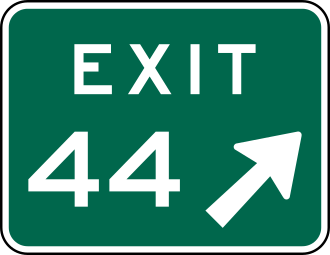
- This lane leaves the highway at the upcoming exit
- This lane is an added lane merging onto the highway
- This lane requires a toll to continue
- This lane continues on the highway; the exit is in another lane
Answer: A — This lane leaves the highway at the upcoming exit
An Exit Only sign marks a lane that leaves the highway at the exit ahead, rather than continuing on the mainline.
Take this test interactively
More North Carolina Driver License practice tests
- North Carolina Driver License: Alcohol, Points and Suspensions — 30 questions
- North Carolina Driver License: Driver Safety, Seat Belts and Child Safety — 28 questions
- North Carolina Driver License: Equipment, Defensive Driving, Weather and Emergencies — 30 questions
- North Carolina Driver License: Pedestrians, School Buses, Emergency Vehicles and Police Stops — 28 questions
- North Carolina Driver License: Sharing the Road and DMV Services — 28 questions
- North Carolina Driver License: Speed, Passing, Parking, Intersections and Railroads — 30 questions
- North Carolina Driver License: Your License, Permits and Graduated Licensing — 30 questions