Michigan Driver License: Signs, Markings and Signals
30 questions with the correct answer and an explanation for each.
Topic: Signs, Markings and Signals. Free, no account needed.
Take this test interactively
1. What must you do when you see this sign?
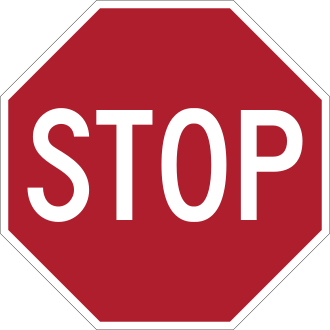
- Stop only if other vehicles are present
- Come to a complete stop and yield to traffic and pedestrians before proceeding
- Reduce speed and proceed with caution
- Slow down and let crossing vehicles go by
Answer: B — Come to a complete stop and yield to traffic and pedestrians before proceeding
The octagon requires a full stop and yielding to traffic and pedestrians before moving on.
2. What must you do when you see this sign?
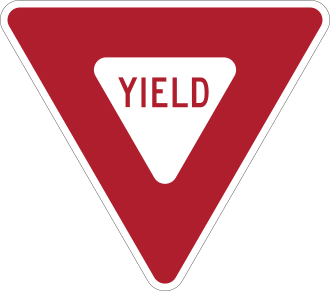
- Stop only if a train is approaching
- Come to a complete stop and yield to traffic and pedestrians before proceeding
- Merge immediately into the left lane
- Slow down and let vehicles crossing your path go by
Answer: D — Slow down and let vehicles crossing your path go by
A yield sign means slow down and let crossing vehicles go rather than come to a full stop.
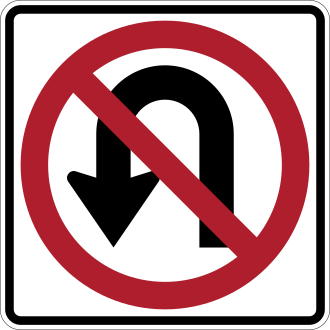
3. What does this sign tell you?
- You may not enter this road
- U-turns are prohibited here
- Left turns are prohibited here
- Passing is prohibited here
Answer: B — U-turns are prohibited here
This sign prohibits making a U-turn at this location.
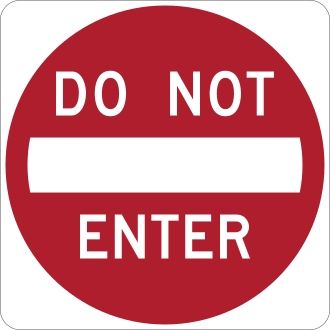
4. What does this sign mean?
- You have entered a lane of oncoming traffic
- This road is closed for construction
- Trucks are not allowed on this road
- You are not allowed to enter here
Answer: D — You are not allowed to enter here
This sign blocks entry into the roadway or lane it faces.
5. What does this sign indicate about the road ahead?
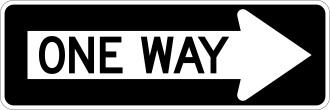
- Traffic must merge left ahead
- Traffic in every lane flows in the direction of the arrow
- The road ahead splits into two directions
- Two-way traffic begins ahead
Answer: B — Traffic in every lane flows in the direction of the arrow
This sign marks a one-way roadway where every lane moves in the arrow's direction.
6. What should you do when you reach this sign and a train is coming?
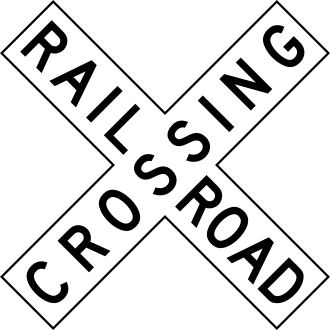
- Stop, because a railroad crossing is here and a train is coming
- Yield only if a crossing guard is present
- Stop only if the plaque below shows more than one track
- Slow down and look both ways, then proceed without stopping
Answer: A — Stop, because a railroad crossing is here and a train is coming
The crossbuck marks the crossing itself, and you must stop when a train is coming.
7. What does this sign warn you to do?
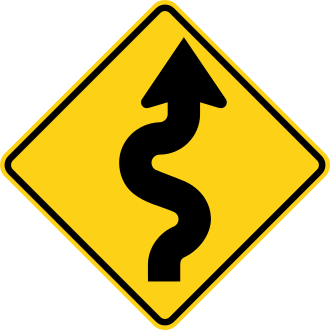
- Watch for a single sharp curve ahead
- Prepare to stop for a traffic signal ahead
- Limit your speed for a winding road ahead
- Expect the road to end ahead
Answer: C — Limit your speed for a winding road ahead
This sign warns of a winding road and advises limiting speed.
8. What must you do at the intersection this sign warns of?
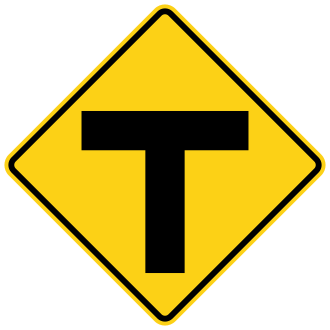
- Watch for cross traffic on a road that intersects yours
- Yield to the through road and turn, because the road ends ahead
- Slow and yield to circulating traffic
- Watch for a road splitting into two ahead
Answer: B — Yield to the through road and turn, because the road ends ahead
At a T intersection the road ends, so you must yield to the through road and turn.
9. What should you do when you see this sign?
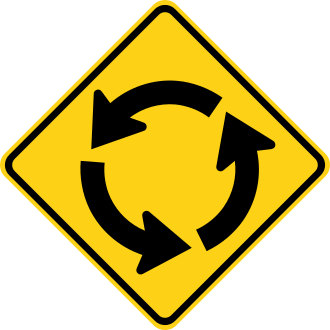
- Slow down and yield to circulating traffic ahead
- Prepare to stop at a T intersection ahead
- Expect the road to split into two ahead
- Expect a divided highway to begin ahead
Answer: A — Slow down and yield to circulating traffic ahead
This sign warns of a roundabout, requiring you to slow and yield to circulating traffic.
10. What does this sign warn you to expect?
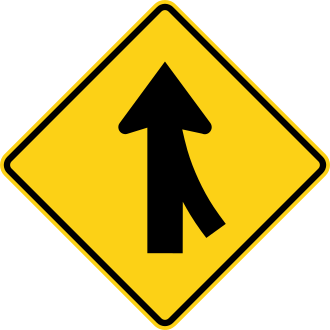
- Two-way traffic is beginning ahead
- The right lane is ending; merge left and yield to left-lane traffic
- An added lane is joining, with no merge needed
- Traffic is merging in from the right; adjust your speed to let it in
Answer: D — Traffic is merging in from the right; adjust your speed to let it in
This sign warns that traffic is merging in from the right, so you should adjust speed to let it in.
11. What must you do when you see this sign?
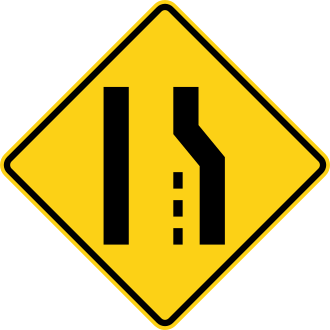
- Merge left and yield to traffic already in the left lane, because the right lane is ending
- Adjust your speed to let merging traffic in from the right
- Keep right, because a divided highway is ending
- Continue in your lane, since an added lane is joining with no merge needed
Answer: A — Merge left and yield to traffic already in the left lane, because the right lane is ending
This sign warns that the right lane is ending, so you must merge left and yield to left-lane traffic.
12. What should you do when you see this sign?
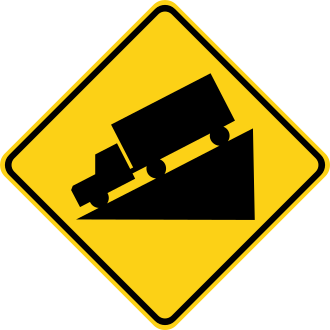
- Slow down because the road becomes slippery in wet weather
- Watch for a narrow bridge ahead and slow down
- Prepare to stop for a stop sign posted ahead
- Check your brakes and downshift for a steep downslope ahead
Answer: D — Check your brakes and downshift for a steep downslope ahead
This sign warns of a steep downgrade, so you should check your brakes and gear down.
13. What does this sign warn you about?
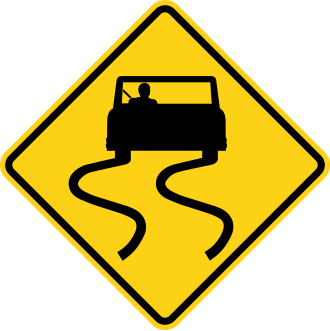
- The shoulder is soft; stay on the pavement
- The road becomes slippery in bad weather; drive carefully
- A steep downslope requires checking your brakes
- There is a drop from the pavement to the shoulder
Answer: B — The road becomes slippery in bad weather; drive carefully
This sign warns that the pavement becomes slippery in bad weather.
14. What should you do when you see this sign?
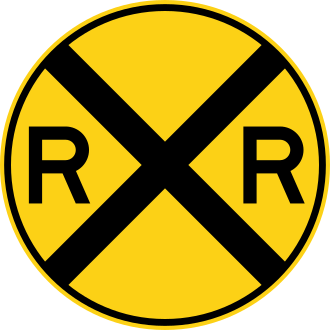
- Come to a complete stop because a train is at the crossing
- Slow down and look both ways for a railroad crossing ahead
- Yield to circulating traffic ahead
- Watch for a road that splits ahead
Answer: B — Slow down and look both ways for a railroad crossing ahead
This round advance-warning sign means a railroad crossing is ahead, so slow down and look both ways.
15. What does this sign warn you to do?
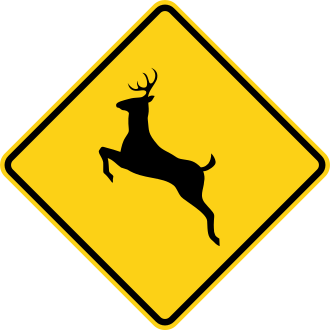
- Drive carefully because pedestrians may be in the area
- Drive carefully because bicyclists may be in the area
- Slow down, especially at dawn and dusk, because deer cross here
- Watch for cross traffic at an intersection ahead
Answer: C — Slow down, especially at dawn and dusk, because deer cross here
This sign warns of deer crossing the road, with dawn and dusk being higher-risk times.
16. What does this sign indicate?
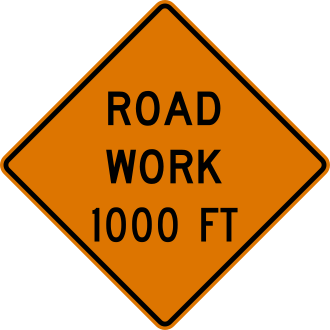
- A traffic signal is posted ahead
- Passing is hazardous on the left side of the road ahead
- Construction or maintenance crews are working ahead; drive with care
- A narrow bridge is ahead; slow down
Answer: C — Construction or maintenance crews are working ahead; drive with care
This orange sign warns that construction or maintenance crews are working ahead.
17. What must you do when you see this sign?
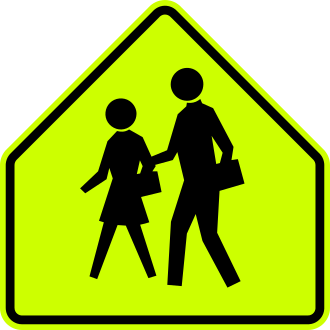
- Reduce speed only while the zone lights are flashing
- Drive carefully and obey the crossing guard at the school crossing or zone
- Yield to circulating traffic ahead
- Slow down because deer cross here
Answer: B — Drive carefully and obey the crossing guard at the school crossing or zone
The pentagon marks a school crossing or zone, requiring care and obedience to the crossing guard.
18. What does this marker tell a driver about the road they're on?
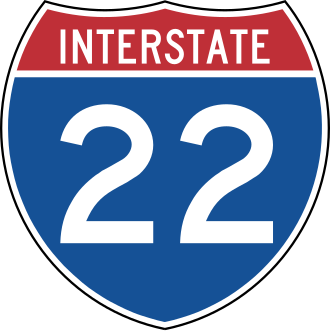
- It is a county route
- It is an interstate freeway
- It is a Michigan state highway
- It is a U.S. highway
Answer: B — It is an interstate freeway
The document identifies this marker as the shield of an interstate freeway.
19. What shape identifies a school zone or school crossing sign?
- Pentagon
- Diamond
- Round
- Crossbuck
Answer: A — Pentagon
Michigan reserves the five-sided pentagon shape for school signs, distinct from the diamond (warning) or round (railroad) shapes.
20. A roadside sign is printed in fluorescent pink. What is it alerting you to?
- A school, pedestrian or bicycle caution zone
- An incident, emergency or unplanned event
- Construction or maintenance work
- A recreation or cultural point of interest
Answer: B — An incident, emergency or unplanned event
Fluorescent pink is reserved for signs marking an incident, emergency, or unplanned event.
21. A sign is printed in brown. What does it indicate?
- Caution for construction or maintenance
- Recreation or cultural interest
- Directions and guidance
- Service and hospitality
Answer: B — Recreation or cultural interest
Brown signs point out places of recreational or cultural interest, unlike blue (service) or green (directional) signs.
22. A driver on a freeway wants to turn around by using a marked median crossover. What is true?
- Any driver may use it to turn around when traffic is light
- It may be used to turn around if no other vehicles are nearby
- It may be used to turn around only during daylight hours
- Only authorized police, emergency and maintenance vehicles may use that crossover, and never to turn around
Answer: D — Only authorized police, emergency and maintenance vehicles may use that crossover, and never to turn around
An Authorized Vehicles Only crossover is restricted to police, emergency and maintenance vehicles, and never for turning around.
23. You come up behind a horse-drawn buggy displaying an orange triangular emblem on the back. What does that emblem tell you about the vehicle?
- It is authorized to use the shoulder at any time
- It cannot travel faster than 25 mph
- It must yield to all other traffic at intersections
- It is exempt from stopping at railroad crossings
Answer: B — It cannot travel faster than 25 mph
The orange slow-moving vehicle emblem marks vehicles, such as buggies and combines, that cannot exceed 25 mph.
24. You are driving on a two-lane road with a double solid yellow center line. When, if ever, may you cross it?
- Never, under any circumstance
- Freely, as long as no oncoming traffic is visible
- Only to pass a slow-moving vehicle
- Only to turn left into a driveway, onto a crossroad, or into a parking spot
Answer: D — Only to turn left into a driveway, onto a crossroad, or into a parking spot
A double solid yellow line bans passing in both directions, but you may still cross it to turn into a driveway, crossroad, or parking spot.
25. You need to pull over briefly and the only open space is a marked bicycle lane. What does the law say about doing this?
- It is allowed if no bicyclist is currently in the lane
- It is illegal to drive, pass, turn right, park or pull over in a bike lane
- It is allowed only to make a right turn
- It is allowed for less than five minutes
Answer: B — It is illegal to drive, pass, turn right, park or pull over in a bike lane
Driving, passing, turning right, parking or pulling over in a bicycle lane is illegal regardless of whether a bicyclist is present.
26. You want to use a center two-way left-turn lane to pass a slower vehicle ahead of you. Is this allowed?
- Yes, but only for less than 100 feet
- Yes, if the lane is empty in both directions
- No, using it to pass or merge is illegal
- Yes, as long as you signal first
Answer: C — No, using it to pass or merge is illegal
The center left-turn lane is only for making left turns from either direction; using it to pass or merge is illegal.
27. At an intersection where direct left turns are not allowed, what is the correct way to turn left onto the highway using the median crossover?
- Turn left directly from the through lane
- Stop at the intersection and wait for a gap to turn left directly
- Turn right, then make an immediate U-turn at the intersection
- Drive through the intersection, turn left into the median crossover, then turn left back onto the highway
Answer: D — Drive through the intersection, turn left into the median crossover, then turn left back onto the highway
A Michigan Left requires driving through the intersection first, then turning left into the median crossover to reverse direction.
28. The signal ahead turns yellow just as you approach, and you are too close to stop safely. What should you do?
- Not speed up, and drive through cautiously
- Speed up to clear the intersection before it turns red
- Treat it the same as a flashing red and come to a full stop
- Stop immediately regardless of your distance
Answer: A — Not speed up, and drive through cautiously
If you cannot stop safely for a yellow light, you should not speed up but instead drive through cautiously.
29. You are in a left-turn lane and the signal head shows a flashing yellow arrow. What does that mean?
- You may turn left once oncoming traffic and pedestrians are clear
- The left-turn signal is ending; stop unless already inside the intersection
- Oncoming traffic is stopped, so turn with caution
- Stop; turning left is prohibited
Answer: A — You may turn left once oncoming traffic and pedestrians are clear
A flashing yellow arrow permits a left turn once oncoming traffic, pedestrians, and bicyclists are clear.
30. A Pedestrian Hybrid Beacon ahead is showing alternating flashing red. What are you permitted to do?
- Stop and wait for the light to turn green
- Treat it as a malfunctioning signal and go around
- Proceed after a complete stop, once the crosswalk is clear
- Continue at normal speed without stopping
Answer: C — Proceed after a complete stop, once the crosswalk is clear
During the alternating flashing red phase of a Pedestrian Hybrid Beacon, you may proceed only after a complete stop once the crosswalk is clear.
Take this test interactively
More Michigan Driver License practice tests