Washington Driver License: Signals, Signs and Markings
30 questions with the correct answer and an explanation for each.
Topic: Signals, Signs and Markings. Free, no account needed.
Take this test interactively
1. A driver wants to pass a slower vehicle on a two-lane road and there is a carpool lane to the left. Can the carpool lane be used to make the pass?
- Only outside of peak commute hours
- Yes, carpool lanes may be used freely for passing
- No, carpool lanes are not passing lanes
- Only if the driver has the required occupancy
Answer: C — No, carpool lanes are not passing lanes
Carpool lanes are reserved for their intended users and are explicitly not for passing maneuvers.
2. A traffic signal at a busy intersection loses power and goes completely dark. How should drivers handle the intersection?
- Only cross traffic must stop
- Treat it as uncontrolled with no yielding required
- Whoever arrives first has the right-of-way regardless of direction
- Treat it as a four-way stop, yielding to the vehicle on the right
Answer: D — Treat it as a four-way stop, yielding to the vehicle on the right
A dead signal is treated exactly like a four-way stop sign, requiring a full stop and yielding to the right.
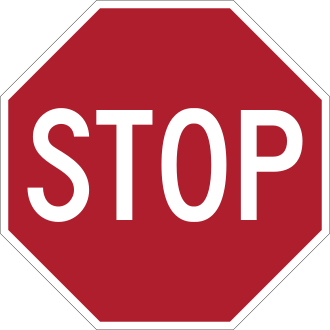
3. What must you do when you see this sign?
- Merge carefully with oncoming traffic
- Slow down and yield to traffic already in the intersection
- Stop only if pedestrians are present
- Come to a complete stop, then proceed when it's clear
Answer: D — Come to a complete stop, then proceed when it's clear
This sign requires a full stop at the line, crosswalk, or corner before proceeding.
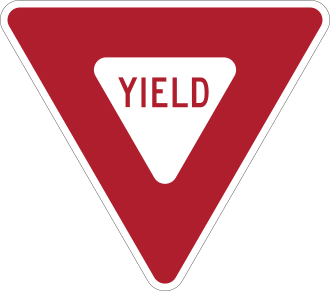
4. What must a driver do upon seeing this sign?
- Stop only when a vehicle is directly in your path
- Maintain speed since you have the right-of-way
- Slow down and let traffic with the right-of-way go first, stopping if necessary
- Come to a complete stop before proceeding
Answer: C — Slow down and let traffic with the right-of-way go first, stopping if necessary
This sign calls for slowing and yielding to traffic, pedestrians, and bicyclists with the right-of-way, not a mandatory full stop.
5. A driver is stopped at a red light facing a two-way street and there is no sign restricting turns. After a complete stop, may they turn left on red?
- No, left turns on red are never allowed
- Yes, if the driver first yields to all oncoming traffic
- Yes, left turns on red are always allowed after stopping
- No, turning left on red is only allowed onto a one-way street
Answer: D — No, turning left on red is only allowed onto a one-way street
Left on red is restricted to turning onto a one-way street; turning left onto a two-way street on red is not permitted.
6. What should a driver do when approaching an intersection controlled by a flashing yellow signal?
- Treat it like a yield sign and proceed when it's safe
- Continue at normal speed since it functions like a green light
- Come to a complete stop and wait for it to turn green
- Stop fully, then take turns with other traffic
Answer: A — Treat it like a yield sign and proceed when it's safe
A flashing yellow signal carries the same meaning as a yield sign, so the intersection is treated as uncontrolled.
7. A sign is posted in orange along a stretch of highway. What is it meant to warn drivers about?
- Construction and maintenance activity
- A school or pedestrian zone
- A regulatory restriction with legal force
- A general or unexpected road hazard
Answer: A — Construction and maintenance activity
Orange is specifically used for construction and maintenance warnings.
8. A driver travels at exactly the posted speed limit during a heavy downpour and is pulled over. Can they still be ticketed?
- Yes, driving too fast for conditions can be ticketed even under the limit
- Yes, but only inside a marked work zone
- No, driving at or under the posted limit is always legal
- No, only exceeding the posted number is ticketable
Answer: A — Yes, driving too fast for conditions can be ticketed even under the limit
The posted number is a maximum for ideal conditions; drivers can still be cited for going too fast for actual conditions.
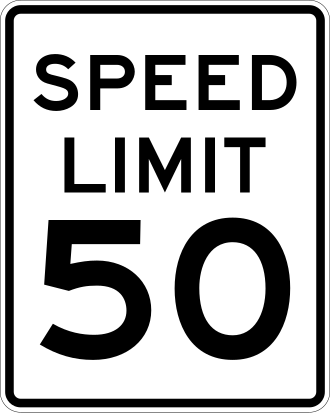
9. What does this sign indicate to drivers?
- The recommended safe speed for an upcoming curve
- The minimum speed required in the left lane
- The maximum legal speed allowed under good conditions
- The speed at which an automated camera issues tickets
Answer: C — The maximum legal speed allowed under good conditions
This sign posts the maximum legal speed for ideal conditions.
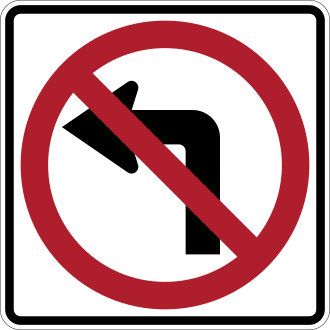
10. What must a driver do upon seeing this sign?
- Merge into the left lane immediately
- Come to a complete stop before going straight
- Avoid turning right only
- Avoid turning left or making a U-turn at this location
Answer: D — Avoid turning left or making a U-turn at this location
This sign bans left turns, and U-turns are also prohibited since they count as two left turns.
11. What does this sign require of a driver?
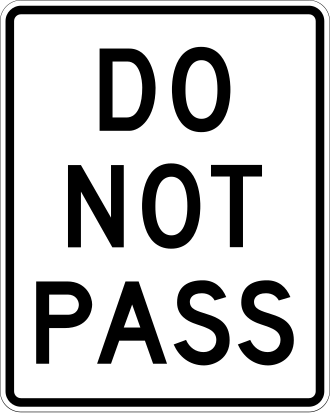
- Yield to oncoming traffic before attempting to pass
- Not pass other vehicles, even if the road ahead looks clear
- Merge right because the current lane is ending
- Slow down because a passing lane is ending ahead
Answer: B — Not pass other vehicles, even if the road ahead looks clear
This sign marks the start of a no-passing zone, where passing is prohibited regardless of visibility.
12. What does this sign mean for a driver facing it?
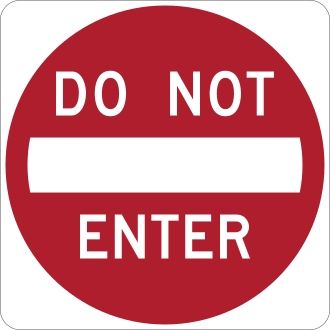
- Parking is not permitted in this area
- Trucks are prohibited from using this road
- You are traveling the wrong way and should turn around immediately
- You cannot drive into this road or lane from this direction
Answer: D — You cannot drive into this road or lane from this direction
This sign marks a roadway that cannot be entered from that direction.
13. What should a driver do upon seeing this sign?
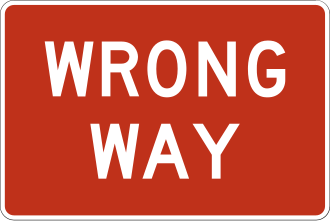
- Recognize they are going the wrong way, slow down, pull over and turn around carefully
- Yield to any oncoming traffic and keep going forward
- Proceed with caution since it only applies to trucks
- Stop and wait for a traffic officer's direction
Answer: A — Recognize they are going the wrong way, slow down, pull over and turn around carefully
This sign signals that the driver is going against the flow of traffic and must safely turn around.
14. What does this sign tell a driver about the road ahead?
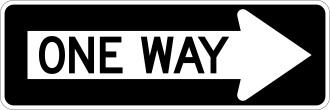
- Traffic flows only in the direction shown by the arrow
- You may not enter the road from this direction
- The road ahead splits into two one-way roadways
- The road ahead ends and you must turn
Answer: A — Traffic flows only in the direction shown by the arrow
This sign marks a street where traffic moves only in the direction of the arrow.
15. Fines for a driving offense committed in a construction zone while workers are present are affected in what way?
- They are reduced to encourage compliance
- They are unchanged from normal fines
- They are doubled
- They are waived unless someone is injured
Answer: C — They are doubled
Fines are doubled for violations committed in construction areas when workers are present.
16. What does this sign indicate about a parking space?
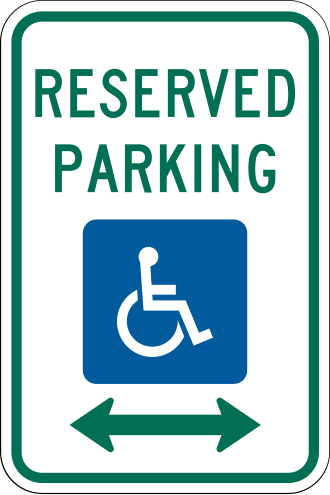
- Parking is limited to a short time only
- The space is reserved for disabled parking permit holders
- The space is reserved for emergency vehicles only
- Parking is prohibited entirely in this space
Answer: B — The space is reserved for disabled parking permit holders
This sign marks a space reserved specifically for holders of a disabled parking permit.
17. What must a driver do upon seeing this sign at a red light?
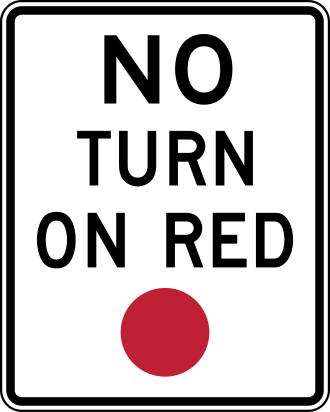
- Turn left only onto a one-way street
- Wait for a green light before turning
- Proceed straight through without stopping
- Turn right only after coming to a complete stop
Answer: B — Wait for a green light before turning
This sign overrides the normal right-on-red allowance, requiring the driver to wait for green.
18. What should a driver do upon seeing this sign at a crossing?
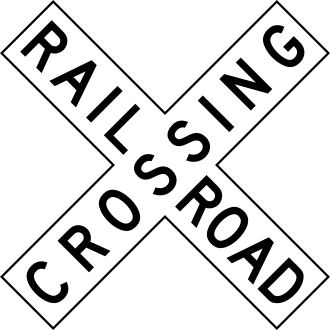
- Stop only if a train is visibly approaching
- Proceed at normal speed since a train has already passed
- Look, listen, slow down and be ready to stop for trains from either direction
- Slow down because an advance warning of a crossing is ahead
Answer: C — Look, listen, slow down and be ready to stop for trains from either direction
This sign marks the crossing itself, requiring the driver to watch and listen for trains from both directions.
19. What does this sign warn a driver about?
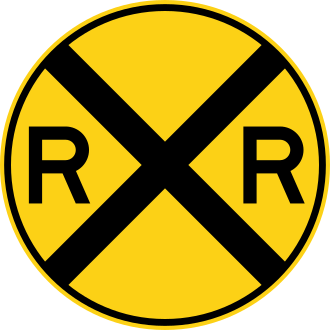
- A crossing they are currently at, requiring an immediate stop
- A low bridge clearance ahead
- An upcoming railroad crossing where they should look, listen and be ready to stop
- A bicycle crossing ahead
Answer: C — An upcoming railroad crossing where they should look, listen and be ready to stop
This is an advance warning sign placed before the actual railroad crossing.
20. A driver approaches a single dashed yellow center line with no oncoming vehicles in sight. May they use the oncoming lane to pass?
- No, passing is only allowed where the line on your side is solid yellow
- No, dashed yellow lines never allow passing
- Yes, a dashed yellow center line allows passing into the oncoming lane when it's safe
- Only if the line were white instead of yellow
Answer: C — Yes, a dashed yellow center line allows passing into the oncoming lane when it's safe
A dashed yellow center line permits using the oncoming lane to pass when it is safe to do so.
21. A driver enters a shared center left-turn lane to prepare for a left turn a half-mile further ahead. Is this allowed?
- No, the lane can only be used to make a U-turn
- Yes, as long as no oncoming driver is using the lane
- Yes, there is no distance limit for using the lane
- No, the lane may not be traveled in for more than 300 feet
Answer: D — No, the lane may not be traveled in for more than 300 feet
The shared center left-turn lane is meant only for the turn itself and may not be traveled in for more than 300 feet.
22. What should a driver do upon seeing this sign?
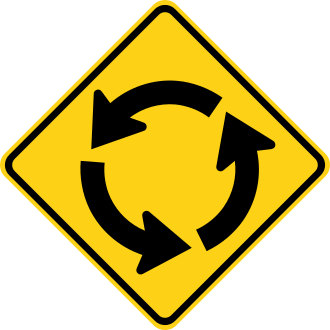
- Prepare to stop at a four-way intersection ahead
- Prepare to merge because two lanes are becoming one
- Prepare to yield to traffic in an upcoming roundabout and go counterclockwise
- Prepare to bear right or left as the road splits
Answer: C — Prepare to yield to traffic in an upcoming roundabout and go counterclockwise
This sign warns of a roundabout ahead, where drivers must yield to traffic already circulating and travel counterclockwise.
23. What does this sign indicate to a driver?
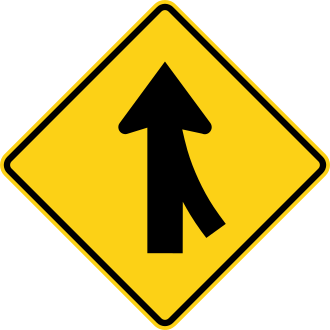
- The right lane is ending and its drivers must merge left
- A divided highway is beginning ahead
- Two lanes are becoming one and drivers in both must merge safely
- An added lane is joining and no merge is needed
Answer: C — Two lanes are becoming one and drivers in both must merge safely
This sign warns that two lanes are combining into one, requiring drivers from both lanes to merge.
24. What should a driver do upon seeing this sign?
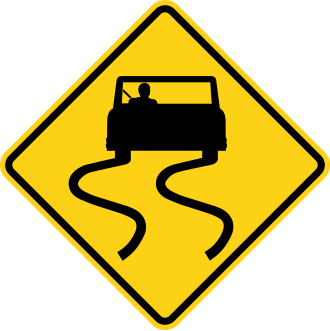
- Stay on the pavement because the shoulder is soft
- Watch for a drop-off between the pavement and the shoulder
- Reduce speed on wet pavement and avoid hard braking or sudden turns
- Slow down because a bridge ahead is narrow
Answer: C — Reduce speed on wet pavement and avoid hard braking or sudden turns
This sign warns that the pavement becomes slippery when wet, calling for reduced speed and gentle inputs.
25. What should a driver do upon seeing this sign?
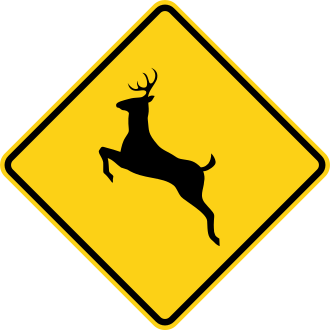
- Watch for people entering a crosswalk ahead
- Watch for bicycles crossing or riding beside traffic
- Slow down, be alert and be ready to stop for animals crossing
- Slow down for a sharp curve ahead
Answer: C — Slow down, be alert and be ready to stop for animals crossing
This sign warns of deer crossing the road, requiring alertness and readiness to stop.
26. A solo driver with no passengers wants to use an express toll lane. Are they permitted to, and under what condition?
- No, solo drivers must use a general purpose lane instead
- Yes, but only during off-peak hours
- No, express toll lanes are restricted to carpools and buses only
- Yes, solo drivers may use it if they pay the toll
Answer: D — Yes, solo drivers may use it if they pay the toll
Express toll lanes are free for carpools, vanpools, buses and motorcycles, and open to solo drivers who pay.
27. A driver stops at a red light behind a marked bicycle box with cyclists waiting inside it. May the driver turn right on red?
- No, turning right on red is not allowed at a bicycle box
- Yes, after honking to alert the cyclists
- No, the driver must back up to let the cyclists pass
- Yes, as long as no cyclist is currently moving
Answer: A — No, turning right on red is not allowed at a bicycle box
At a bicycle box, right turns on red are prohibited so bicyclists can cross first on green.
28. A driver is on a road marked with sharrows and sees a bicyclist riding in the lane ahead. What must the driver do when passing?
- Pass closely but quickly to minimize time beside the cyclist
- Refuse to pass and match the cyclist's speed for the whole lane
- Honk to signal the cyclist toward the shoulder
- Slow down and leave at least 3 feet when passing
Answer: D — Slow down and leave at least 3 feet when passing
Sharrows mark a lane shared with bicycles, and drivers must slow down and leave 3 feet when passing a rider.
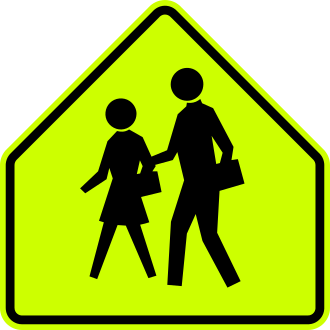
29. What should a driver do upon seeing this sign?
- Reduce speed only when flashing lights are active
- Expect a crosswalk with no children present
- Watch for children and obey any crossing guards, since a school zone is ahead
- Prepare to stop for a bus loading zone
Answer: C — Watch for children and obey any crossing guards, since a school zone is ahead
This pentagon-shaped sign marks a school zone or crossing, requiring drivers to watch for children and obey crossing guards.
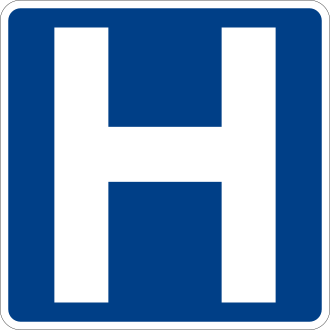
30. What does this sign indicate to a driver?
- A rest area is ahead
- An exit-only lane is approaching
- Fuel is available nearby
- A hospital is nearby
Answer: D — A hospital is nearby
This blue service sign directs drivers to a nearby hospital.
Take this test interactively
More Washington Driver License practice tests