Arizona Driver License: Signals, Signs and Markings
30 questions with the correct answer and an explanation for each.
Topic: Signals, Signs and Markings. Free, no account needed.
Take this test interactively
1. You are approaching an intersection and the light turns yellow while you still have room to stop safely before the stop line. What should you do?
- Stop safely before the intersection
- Continue at the same speed since yellow only means caution
- Speed up slightly to clear the intersection before it turns red
- Treat it like a flashing yellow light and proceed with caution
Answer: A — Stop safely before the intersection
A steady yellow warns the light is about to turn red, so a driver who has not yet entered should stop safely rather than speeding up or continuing through.
2. You are turning left at an intersection and the signal shows a flashing yellow arrow. What should you do?
- Proceed with your turn without yielding, since the arrow gives you priority
- Turn with caution after yielding to oncoming traffic and pedestrians
- Treat it the same as a red arrow and wait
- Stop completely and wait for a green arrow
Answer: B — Turn with caution after yielding to oncoming traffic and pedestrians
A flashing yellow arrow allows a cautious turn once oncoming vehicles and pedestrians have been yielded to; it does not require stopping or grant unconditional priority.
3. The traffic light at an intersection has lost power and is completely dark. Two vehicles arrive at the intersection from crossing directions at the same moment. Who has to yield?
- Whoever arrived a split second earlier, regardless of side
- The driver on the right
- The driver going straight always has priority over one turning
- The driver on the left
Answer: D — The driver on the left
A dead signal is treated as a four-way stop, and when two vehicles reach it together, the driver on the left yields to the one on the right.
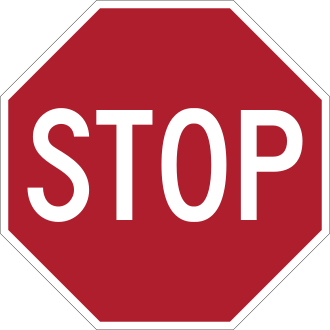
4. What must you do when you see this sign?
- Slow down because a stop sign is ahead
- Slow down and yield to cross traffic if necessary
- Stop only if other vehicles are approaching
- Come to a complete stop at the sign, stop line, or crosswalk and wait for vehicles and pedestrians to clear
Answer: D — Come to a complete stop at the sign, stop line, or crosswalk and wait for vehicles and pedestrians to clear
This sign requires a complete stop at the sign, stop line, or crosswalk and waiting for vehicles and pedestrians to clear, not just a cautious slowdown.
5. What does this sign mean?
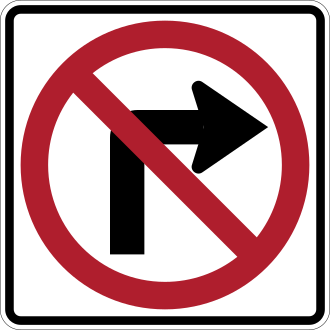
- Right turns are illegal here
- This lane may turn right only
- Left turns are illegal here
- Merge to the right ahead
Answer: A — Right turns are illegal here
This sign prohibits right turns at that location; it does not restrict left turns or direct lane use.
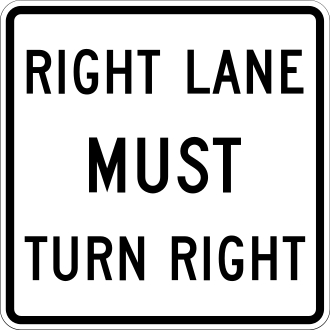
6. What must traffic in the right lane do at this sign?
- Turn as the arrow above each lane shows
- Merge left because the lane is ending
- Continue straight only
- Turn right
Answer: D — Turn right
This sign requires traffic in the right lane specifically to turn right, unlike a lane-ending merge or a general lane-use-control sign.
7. You are driving on a rural freeway with no speed limit posted. What is the speed limit?
- 55 mph
- 75 mph
- 25 mph
- 65 mph
Answer: B — 75 mph
Where no limit is posted, rural freeways carry a 75 mph limit, higher than open highways or designated open highways.
8. You are approaching a curve with an orange sign showing a suggested speed number. What does that number represent?
- The speed limit that applies only at night
- The legal maximum speed limit for that road
- The recommended safe speed for the curve
- The minimum speed required through the curve
Answer: C — The recommended safe speed for the curve
Orange signs give a recommended safe speed for curves, grades, or special conditions, while the legal maximum is shown on white regulatory signs.
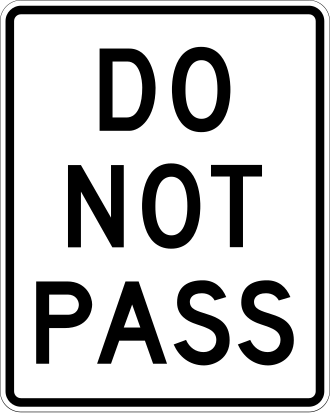
9. What does this sign mean?
- A no-passing zone is ending ahead
- You are entering a no-passing zone and must not pass, even if the road looks clear
- You may pass only on the left
- Slower traffic must move to the right lane
Answer: B — You are entering a no-passing zone and must not pass, even if the road looks clear
This sign marks the start of a no-passing zone, so passing is prohibited even when the road appears clear.
10. Dust in the air makes it hard to read an upcoming sign, but you can tell it is triangle-shaped. What must you do?
- Slow down and be ready to yield to cross or merging traffic
- Stop completely
- Watch for a railroad crossing ahead
- Watch for a no-passing zone ahead
Answer: A — Slow down and be ready to yield to cross or merging traffic
A triangular sign shape by itself signals a yield requirement, distinct from the octagon (stop), circle (railroad), or pennant (no-passing zone).
11. You see this sign facing you as you drive. What should you do?
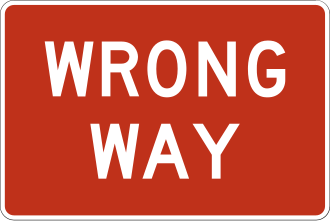
- You are driving against traffic; slow down, pull over safely, and turn around
- You may not enter this road under any circumstances
- Trucks are prohibited on this road ahead
- You are on a one-way street; move to the correct lane
Answer: A — You are driving against traffic; slow down, pull over safely, and turn around
This sign warns that you are traveling the wrong way against traffic, calling for slowing down, pulling over, and turning around.
12. What does this sign indicate?
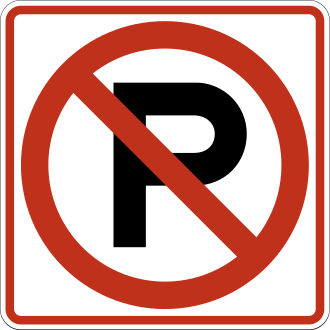
- Parking is reserved for disabled permit holders
- You may stop briefly to load or unload passengers
- Parking is prohibited here
- No stopping, standing, or parking is allowed at any time
Answer: C — Parking is prohibited here
This sign simply prohibits parking; reserved-permit parking and the stricter no-stopping-or-standing rule belong to other signs and curb markings.
13. You approach a railroad crossing where the red lights are flashing and the barricade is lowered. How close to the nearest rail may you stop?
- No closer than 15 feet
- No closer than 50 feet
- No closer than 25 feet
- No closer than 5 feet
Answer: A — No closer than 15 feet
The rule sets the stopping point at no closer than 15 feet from the nearest rail when the crossing is active.
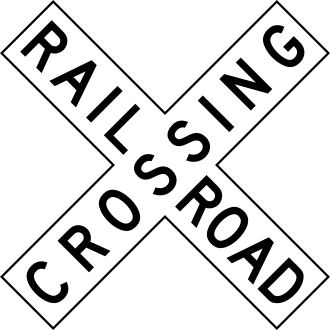
14. What should you do at this sign?
- Watch only for pedestrians crossing the tracks
- Proceed at normal speed since gates will warn you in time
- Look and listen for a train from either direction, slow down, and be ready to stop
- Come to a complete stop even if no train is visible or audible
Answer: C — Look and listen for a train from either direction, slow down, and be ready to stop
This sign marks a railroad crossing, calling for looking and listening for a train from either direction and being ready to stop, not an automatic full stop or normal-speed pass-through.
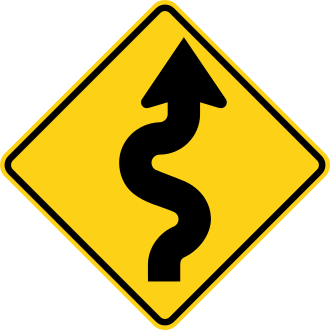
15. What does this sign mean?
- A single sharp curve is ahead, then the road straightens
- A series of curves lies ahead; slow down through all of them
- The road ahead forks into two separate roads
- Road construction is ahead
Answer: B — A series of curves lies ahead; slow down through all of them
This sign warns of a series of curves rather than a single curve, a fork, or construction.
16. What should you do when you see this sign?
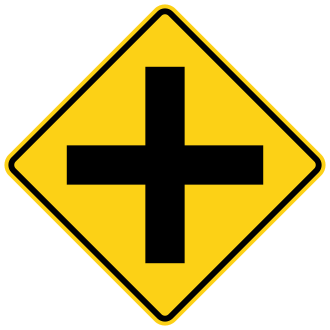
- Prepare to stop at a road that ends ahead
- Yield to traffic already circulating in a roundabout ahead
- Merge left because your lane is ending
- Watch for vehicles entering your road from a crossroad ahead
Answer: D — Watch for vehicles entering your road from a crossroad ahead
This sign warns of an intersection ahead where another road crosses yours, distinct from a dead-end T intersection or a roundabout.
17. What does this sign mean?
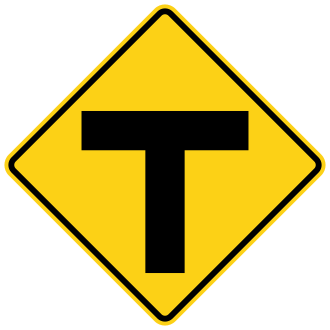
- An intersection crosses your road ahead; watch for entering vehicles
- A roundabout is ahead; yield to circulating traffic
- The road ends ahead at a stop sign; you must turn after yielding
- The road forks ahead and you must bear left or right
Answer: C — The road ends ahead at a stop sign; you must turn after yielding
This sign warns that the road you are on ends ahead, requiring a turn after yielding, unlike a crossroad, roundabout, or fork.
18. What must you do at this sign?
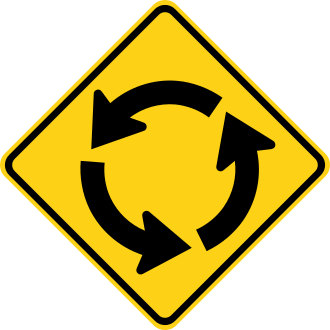
- A roundabout is ahead; yield to traffic already in the circle and travel counterclockwise
- The road narrows ahead; merge carefully
- An intersection is ahead; watch for crossing vehicles
- The road ends ahead at a stop sign; turn after yielding
Answer: A — A roundabout is ahead; yield to traffic already in the circle and travel counterclockwise
This sign warns of a roundabout, where drivers must yield to traffic already circulating and travel counterclockwise.
19. What should drivers in the affected lane do at this sign?
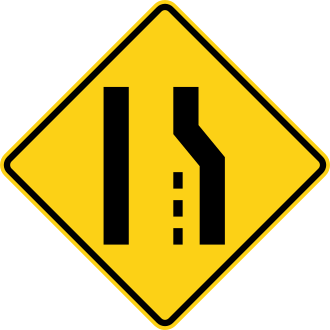
- The road narrows to a single-lane bridge ahead
- Two lanes are merging together and both must yield to merge safely
- A new lane is being added; no merge is needed
- The right lane is ending; merge left when it is safe
Answer: D — The right lane is ending; merge left when it is safe
This sign warns that the lane is ending and its traffic must merge left, unlike a mutual merge, an added lane, or a narrow bridge.
20. What must you do at this sign?
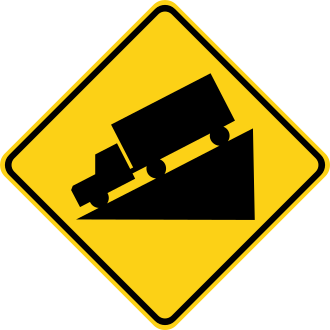
- The pavement ahead drops off to the shoulder
- A narrow bridge is ahead; slow down
- A steep grade is ahead; check your brakes
- The shoulder ahead is soft; stay on the pavement
Answer: C — A steep grade is ahead; check your brakes
This sign warns of a steep grade, calling for checking your brakes, not a soft shoulder, drop-off, or narrow bridge.
21. What does this sign warn you to do?
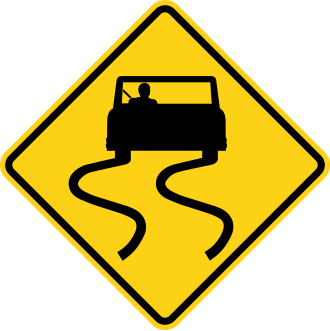
- Check your brakes for the steep grade ahead
- Stay on the pavement because the shoulder is soft
- Reduce speed on wet pavement and avoid hard braking or sudden turns
- Merge carefully because the road narrows ahead
Answer: C — Reduce speed on wet pavement and avoid hard braking or sudden turns
This sign warns that the pavement becomes slippery when wet, calling for reduced speed and avoiding hard braking or sudden turns.
22. You are caught speeding inside a marked Arizona work zone. What happens to the fine?
- It is replaced by an automatic license suspension
- It doubles
- It is reduced if no workers are present
- It is unchanged from the normal fine
Answer: B — It doubles
Fines for traffic violations double inside Arizona work zones.
23. What should you do at this sign?
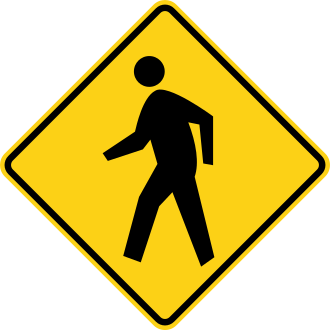
- Watch for people entering a crosswalk; slow down and be ready to stop
- Watch for deer crossing the road
- Slow down for a school zone ahead
- Watch for bicyclists crossing or riding beside traffic
Answer: A — Watch for people entering a crosswalk; slow down and be ready to stop
This sign warns of pedestrians who may enter a crosswalk, calling for slowing down and readiness to stop, not bicycles, deer, or a school zone.
24. What does this sign mark?
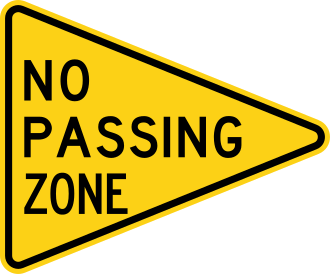
- A railroad crossing ahead
- A work zone ahead
- The end of a no-passing zone
- The start of a no-passing zone; you may not pass here
Answer: D — The start of a no-passing zone; you may not pass here
This sign marks the beginning of a no-passing zone, not its end, a work zone, or a railroad crossing.
25. You are driving through a school crossing zone where portable signs are posted in the center of the road, between the first sign and the crossing itself. What are the rules here?
- 15 mph maximum, and passing is allowed with caution
- 15 mph maximum, and passing is prohibited
- 25 mph maximum, and passing is allowed if the road is clear
- 25 mph maximum, and passing is prohibited
Answer: B — 15 mph maximum, and passing is prohibited
Inside an active school crossing zone, the maximum speed is 15 mph and passing is prohibited for the entire stretch from the first sign through the crossing.
26. What should you do when you see this sign?
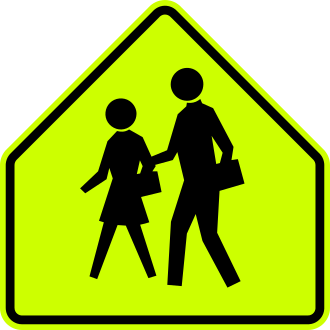
- The school-zone speed limit applies only while lights are flashing
- Watch for a pedestrian crosswalk ahead and be ready to stop
- You are near a school zone or crossing; watch for children and obey crossing guards
- A hospital is nearby
Answer: C — You are near a school zone or crossing; watch for children and obey crossing guards
This sign marks a school zone or crossing, calling for watching for children and obeying crossing guards.
27. You are driving on a two-lane road where your side of the center line is a broken yellow line next to a solid yellow line on the oncoming side. Can you pass?
- Yes, you may pass from either side
- Yes, you may pass from the broken-line side
- You may pass only if turning left immediately afterward
- No, passing is prohibited from either side
Answer: B — Yes, you may pass from the broken-line side
When a broken yellow line runs beside a solid one, passing is allowed only from the side with the broken line.
28. You pull up to a curb painted yellow to drop off a delivery. What are you allowed to do?
- Stop only to pick up or drop off passengers
- No stopping, standing, or parking at all
- Load or unload while staying with your vehicle
- Park for as long as you like with no restriction
Answer: C — Load or unload while staying with your vehicle
A yellow curb permits loading or unloading only while the driver stays with the vehicle, unlike white curbs (passenger pick-up/drop-off) or red curbs (no stopping at all).
29. What does this sign indicate?
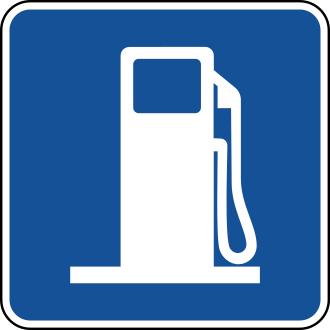
- A hospital is nearby
- Fuel is available nearby
- Food services are available nearby
- An exit lane leaves the highway ahead
Answer: B — Fuel is available nearby
This blue service sign indicates that fuel is available nearby, not a hospital, an exit lane, or food.
30. What does this marker tell drivers?
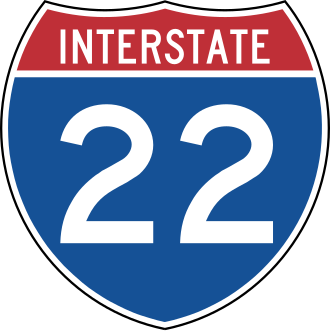
- It marks a mile post showing distance
- It identifies an interstate highway route
- It marks a rest area on a state highway
- It identifies a U.S. route
Answer: B — It identifies an interstate highway route
This marker is the shield used to identify an interstate highway route, distinct from a U.S. route marker or a mile post.
Take this test interactively
More Arizona Driver License practice tests