Tennessee Driver License: Signs, Signals and Markings
30 questions with the correct answer and an explanation for each.
Topic: Signs, Signals and Markings. Free, no account needed.
Take this test interactively
1. A sign has a red background but is not shaped like an octagon or triangle. What is it most likely warning about?
- A school zone ahead
- A recreational area
- A construction zone
- Do not enter or wrong way
Answer: D — Do not enter or wrong way
Red backgrounds are reserved for stop, yield, do not enter, wrong way, the ALL WAY plate and interstate markers.
2. A sign's background is fluorescent yellow-green. What does that colour mark?
- Construction and maintenance zones
- Incident management around crashes and spills
- Recreation and cultural sites
- School zones, crosswalks and pedestrian areas
Answer: D — School zones, crosswalks and pedestrian areas
Fluorescent yellow-green is specifically used for school zones, crosswalks and pedestrian areas.
3. A driver stops at a stop sign, but a large truck blocks the view of cross traffic. What should the driver do?
- Proceed since the stop has already been made
- Back up a few feet to open a wider view of the cross street
- Honk and proceed immediately
- Creep forward slowly until the view is clear
Answer: D — Creep forward slowly until the view is clear
A driver whose view is blocked should ease forward until they can see, rather than pulling out blindly or waiting forever.
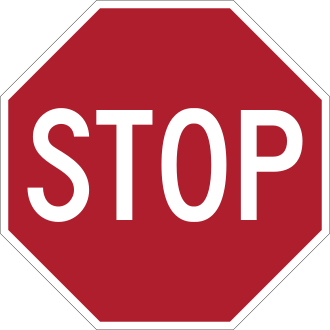
4. What must a driver do at this sign?
- Stop only if other vehicles are present
- Slow to the posted speed and continue
- Come to a complete stop and proceed when it is clear
- Slow down and yield to cross traffic
Answer: C — Come to a complete stop and proceed when it is clear
The octagon requires a full stop at the sign, stop line or crosswalk before proceeding.
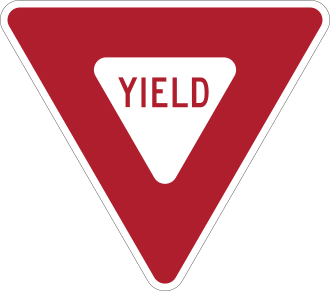
5. What must a driver do when they see this sign?
- Maintain speed but watch for pedestrians
- Come to a complete stop regardless of traffic
- Merge left immediately
- Slow down and stop if vehicles are approaching from the right or left
Answer: D — Slow down and stop if vehicles are approaching from the right or left
The triangle calls for slowing and stopping only when needed to let crossing traffic or pedestrians pass, not an automatic full stop.
6. On a multilane road with a sign requiring drivers to use the far right lane, when may a driver legally move out of that lane?
- Only to pass or turn left
- To maintain a constant cruising speed
- Anytime, as long as the driver signals first
- Whenever traffic in the right lane is moving slowly
Answer: A — Only to pass or turn left
The keep-right rule limits use of other lanes to passing or turning left, and forbids straddling lanes or crawling in the center lane.
7. A yellow triangular pennant-shaped sign marks the start of a no-passing zone. On which side of the road is it posted?
- On the shoulder opposite the direction of travel
- Directly over the center line
- The left side
- The right side
Answer: C — The left side
The no-passing pennant is posted on the left side of the road, matching the side a passing driver would cross into.
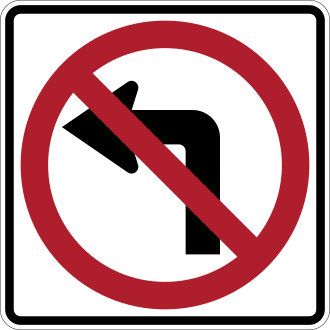
8. What does this sign prohibit?
- Right turns only
- Left turns and U-turns
- Parking on the left side of the road
- Passing on the left
Answer: B — Left turns and U-turns
A U-turn counts as two left turns, so a no-left-turn sign also bans U-turns.
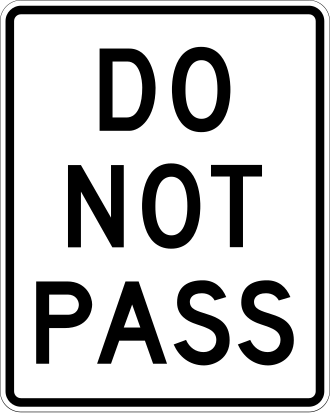
9. What must a driver do upon seeing this sign?
- Move to the left lane to prepare for a merge
- Reduce speed but passing is still allowed
- Pass only when no oncoming traffic is visible
- Not pass, even if the road ahead looks clear
Answer: D — Not pass, even if the road ahead looks clear
This sign marks the start of a no-passing zone set by sight distance, so passing is prohibited even when the road looks clear.
10. What does this sign mean?
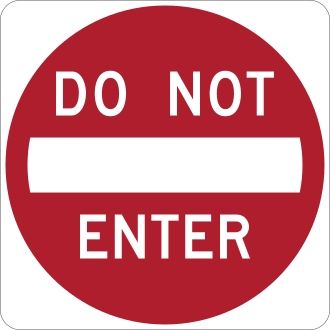
- Trucks are prohibited from entering
- The road ahead is closed for construction
- You cannot drive in this direction on this roadway
- You are driving the wrong way and must turn around
Answer: C — You cannot drive in this direction on this roadway
This sign blocks entry to a roadway going that direction, such as an exit ramp, rather than warning a driver already going the wrong way.
11. What should a driver do upon seeing this sign?
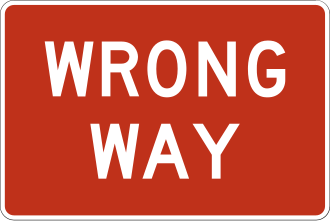
- Turn on hazard lights and proceed at reduced speed
- Slow down, pull over and turn around carefully
- Stop immediately in the travel lane
- Continue, since it only warns of one-way traffic ahead
Answer: B — Slow down, pull over and turn around carefully
This sign tells a driver they are already going the wrong way and must slow, pull over and turn around, not stop in the lane or keep driving.
12. Who may legally park in a space marked with this sign?
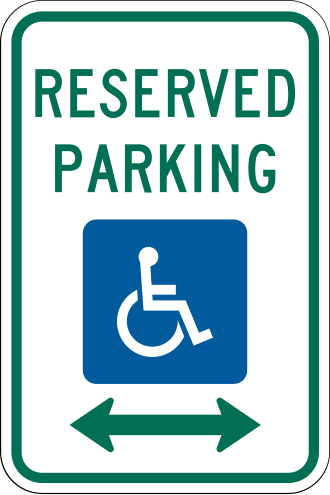
- Delivery vehicles making a brief stop
- Only vehicles displaying a disabled parking permit, placard or plate
- Any vehicle during off-peak hours
- Vehicles carrying more than one occupant, similar to HOV rules
Answer: B — Only vehicles displaying a disabled parking permit, placard or plate
These spaces are reserved for vehicles with disabled plates, placards or decals, and using them otherwise is illegal.
13. What must a driver in this lane do at a red light?
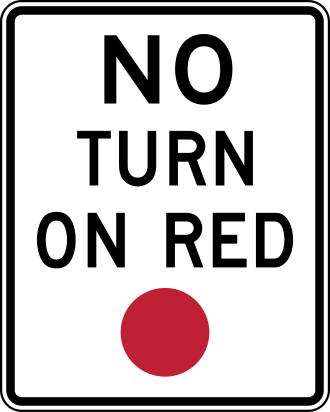
- Proceed straight through but not turn left
- Wait for a green signal before turning
- Turn right only when no pedestrians are present
- Turn only after coming to a complete stop
Answer: B — Wait for a green signal before turning
This sign overrides the normal right-on-red allowance, so the driver must wait for green rather than stopping and turning.
14. What must a driver do at this marker?
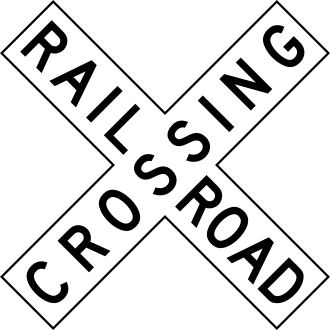
- Look, listen, slow down and be ready to stop for trains from either direction
- Sound the horn before crossing
- Stop only if a train is visibly approaching
- Proceed at normal speed since the tracks are unused
Answer: A — Look, listen, slow down and be ready to stop for trains from either direction
A railroad crossbuck requires checking both directions and being ready to stop, since one train can hide another.
15. A sign warns of two turns in opposite directions with very little straight road between them. About how far apart are such turns?
- Between 600 and 1,000 feet
- About a quarter mile
- More than a mile
- Less than 600 feet
Answer: D — Less than 600 feet
The reverse turn sign specifically marks two opposite turns less than 600 feet apart.
16. What does this sign indicate about the road ahead?
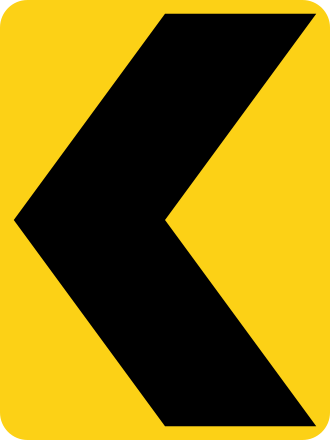
- A sharp change of direction
- A T-intersection where the road ends
- A divided highway beginning
- A series of gentle curves
Answer: A — A sharp change of direction
Chevrons mark a sharp change of direction in the road.
17. What must a driver do at the road feature this sign warns of?
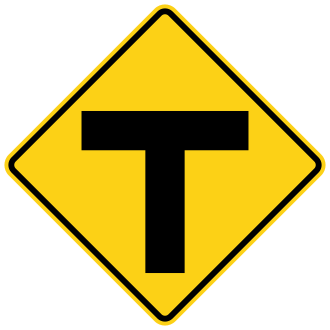
- Prepare to turn right or left and yield at the road's end
- Prepare to stop for a railroad crossing
- Prepare to merge with traffic entering from the right
- Continue straight, since the road continues past the intersection
Answer: A — Prepare to turn right or left and yield at the road's end
A T-intersection sign warns that the road ends ahead, requiring a turn right or left after yielding.
18. What must a driver do upon reaching the road feature this sign warns of?
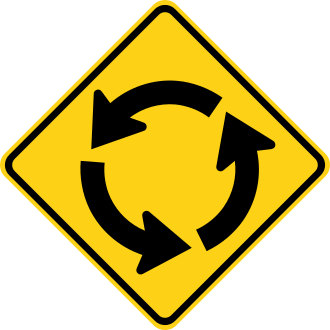
- Yield to traffic already in the circle and travel counterclockwise
- Travel clockwise and yield to traffic entering the circle
- Take the rightmost exit only
- Stop completely before entering regardless of other traffic
Answer: A — Yield to traffic already in the circle and travel counterclockwise
At a roundabout, entering drivers yield to traffic already circulating and travel counterclockwise around it.
19. What should a driver do on the road this sign warns about?
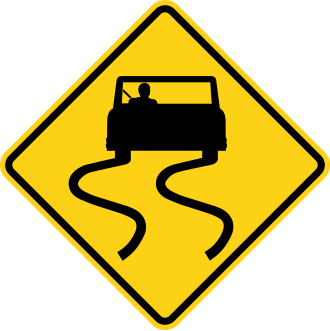
- Shift to a lower gear and accelerate through the area
- Maintain normal speed but increase following distance
- Stop and wait for the pavement to dry
- Reduce speed and avoid hard braking or sudden turns
Answer: D — Reduce speed and avoid hard braking or sudden turns
On slippery pavement, drivers should slow down and avoid hard braking or sudden turns that could cause a skid.
20. What should a driver do upon seeing this sign?
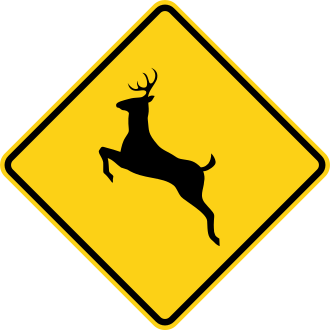
- Maintain speed, since deer avoid roads during the day
- Pull over and wait for animals to pass before continuing
- Sound the horn to scatter animals from the roadway
- Slow down, stay alert and be ready to stop for animals crossing
Answer: D — Slow down, stay alert and be ready to stop for animals crossing
This sign warns that deer may cross, so drivers should slow down, stay alert and be ready to stop.
21. A driver's vehicle is taller than the height posted on this sign. What must the driver do?
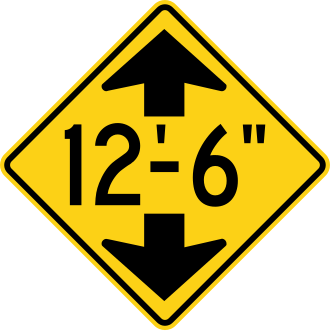
- Stop and wait for a pilot vehicle
- Proceed slowly with hazard lights flashing
- Merge into the left lane before continuing
- Not proceed onto the roadway or under the structure
Answer: D — Not proceed onto the roadway or under the structure
A vehicle taller than the posted clearance must not proceed, since it will not fit under the structure.
22. A worker in a work zone is directing traffic by hand instead of with a sign. What must drivers do?
- Stop only if the worker is holding a red flag
- Obey the worker's directions
- Follow the posted speed limit and ignore hand signals
- Proceed normally, since only official signs are enforceable
Answer: B — Obey the worker's directions
A person controlling traffic with a sign or flag in a work zone must be obeyed.
23. What should a driver do upon seeing this sign?
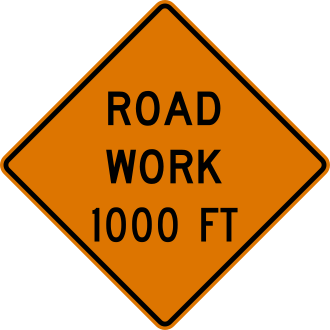
- Maintain normal speed, since work zones are only active on weekdays
- Slow down, stay alert and obey the posted work-zone speed limit
- Move immediately into the left lane regardless of traffic
- Stop and wait for a flagger before proceeding under any circumstances
Answer: B — Slow down, stay alert and obey the posted work-zone speed limit
An orange road work sign calls for slowing down, staying alert and obeying the posted work-zone limit, not necessarily stopping or changing lanes immediately.
24. A shield-shaped sign displays black numerals on a white background. What kind of route does it mark?
- A state or U.S. route
- A scenic byway
- A recreational trail
- An interstate highway
Answer: A — A state or U.S. route
State and U.S. route shields use black numerals on a white shield, distinct from the blue-and-red interstate shield.
25. A driver breaks down on an urban interstate in Memphis and wants to give an exact location to a dispatcher. What roadside marker provides the route, direction and precise mileage needed?
- The emergency reference marker
- The route shield at the next interchange
- The object marker beside a bridge
- The mile marker at each highway exit
Answer: A — The emergency reference marker
Emergency reference markers stand every 1,000 feet on the median of urban interstates and show route, direction and log mile so a caller can pinpoint an incident.
26. What should a driver do upon seeing this sign?
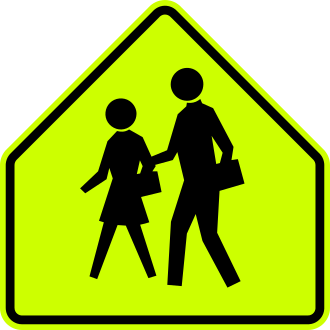
- Watch for children and obey crossing guards
- Stop completely regardless of the presence of children
- Proceed at the speed limit shown on a plaque below
- Sound the horn to alert children in the area
Answer: A — Watch for children and obey crossing guards
The pentagon-shaped school sign calls for watching for children and obeying crossing guards, not an automatic stop.
27. What must a driver in the lane marked by this sign do?
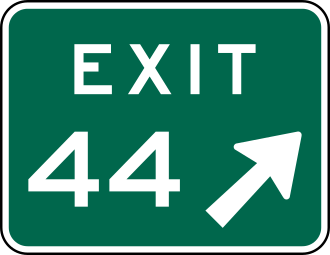
- Merge left before the exit to remain on the highway
- Exit the highway; the lane does not continue onto the main roadway
- Use the lane only during posted HOV hours
- Reduce speed, but continuing straight is still permitted
Answer: B — Exit the highway; the lane does not continue onto the main roadway
An EXIT ONLY panel means every vehicle in that lane must exit, since the lane leaves the highway.
28. A driver speeds up to try to beat a yellow light before it turns red. Why is this dangerous?
- A driver must always come to a complete stop the instant a light turns yellow
- Accelerating on yellow is legal only outside intersections
- Yellow lights in Tennessee do not guarantee any minimum duration
- The red follows immediately, and drivers who "jump the green" may already be entering the intersection
Answer: D — The red follows immediately, and drivers who "jump the green" may already be entering the intersection
Yellow is followed immediately by red, and the manual blames drivers who "jump the green" for making an attempt to beat the yellow deadly.
29. A driver wants to turn left at an intersection where the signal shows a flashing yellow arrow. What must the driver do?
- Turn only after yielding to oncoming traffic, bicyclists and pedestrians
- Turn immediately, since the arrow grants the right-of-way
- Treat it the same as a red arrow and not turn at all
- Wait for a solid green arrow before turning
Answer: A — Turn only after yielding to oncoming traffic, bicyclists and pedestrians
A flashing yellow arrow is permissive, allowing a left turn only after yielding to oncoming traffic, bicyclists and pedestrians.
30. A driver on a two-lane road wants to pass a slow-moving vehicle where the center line consists of two solid yellow lines. What is allowed?
- Nothing; crossing to pass is not allowed from either direction
- Passing is allowed if the oncoming lane is clear
- Passing is allowed if the vehicle being passed is going less than half the speed limit
- Passing is allowed only during daylight hours
Answer: A — Nothing; crossing to pass is not allowed from either direction
Two solid yellow lines forbid crossing to pass from either direction, though crossing to turn into a driveway or side road is still allowed.
Take this test interactively
More Tennessee Driver License practice tests