Massachusetts Driver License: Speed, Signals, Signs and Markings
30 questions with the correct answer and an explanation for each.
Topic: Speed, Signals, Signs and Markings. Free, no account needed.
Take this test interactively
1. A pedestrian is struck by a car traveling 30 mph. About how likely are they to be seriously injured or killed?
- 90 percent
- 73 percent
- 13 percent
- 40 percent
Answer: D — 40 percent
At 30 mph the serious injury or death rate for a struck pedestrian is 40 percent, compared with 13 percent at 20 mph and 73 percent at 40 mph.
2. A driver travels 40 mph on a highway posted for 50 mph during a heavy rainstorm and still gets a speeding ticket. Why is this valid?
- Only limited-access highways enforce speed in bad weather
- Driving faster than is safe for conditions is illegal even when under the posted limit
- The posted limit is only a suggestion and can be ignored
- Rain automatically lowers every posted limit by 10 mph
Answer: B — Driving faster than is safe for conditions is illegal even when under the posted limit
The fundamental rule requires driving no faster than is safe for conditions such as weather, regardless of the posted limit, which assumes ideal conditions.
3. No speed limit is posted on a road running through a business district. What is the fastest a driver may reasonably go?
- 50 mph
- 30 mph
- 20 mph
- 40 mph
Answer: B — 30 mph
Absent a posted limit, 30 mph is the maximum reasonable speed in a thickly settled or business district (25 mph where a community has adopted and posted that limit).
4. What is the minimum speed a driver must maintain on the Massachusetts Turnpike?
- 50 mph
- 20 mph
- 30 mph
- 40 mph
Answer: D — 40 mph
The Massachusetts Turnpike has a posted minimum of 40 mph, while the Boston Harbor tunnels require 20 mph.
5. A driver wants to turn left onto a one-way street from another one-way street while facing a steady red light. Is this allowed?
- Yes, but only when turning from a one-way street onto another one-way street
- No, left turns on red are never allowed
- Only if a NO TURN ON RED sign is posted
- Yes, left on red is allowed from any street
Answer: A — Yes, but only when turning from a one-way street onto another one-way street
Massachusetts permits a left turn on red only when moving from one one-way street onto another one-way street; right on red is otherwise the general rule.
6. A traffic light at an intersection is flashing red in all directions. How should a driver treat it?
- Wait for the light to turn solid green before moving
- Treat it as a yield sign and proceed if the way looks clear
- Treat it as a stop sign: stop, then proceed when safe
- Treat it as a malfunction and drive through with caution
Answer: C — Treat it as a stop sign: stop, then proceed when safe
A flashing red circle is equivalent to a stop sign — stop, then go when it is safe.
7. A pedestrian hybrid beacon that a driver is approaching shows two flashing red lights. What should the driver do?
- Stop, then proceed once the crossing is clear
- Stop and remain stopped until the beacon goes dark
- Slow down but do not stop
- Proceed with caution since flashing means the beacon is not active
Answer: A — Stop, then proceed once the crossing is clear
On a pedestrian hybrid beacon, two flashing reds mean stop, then go if the crossing is clear, unlike the two solid reds which require a full stop and wait.
8. A pedestrian is still in the crosswalk when the countdown signal reaches zero. Who has the right-of-way?
- Drivers waiting to turn, since the countdown has expired
- Whoever entered the intersection first
- The pedestrian, who keeps the right-of-way until finishing the crossing
- No one; both must stop and wait for the next cycle
Answer: C — The pedestrian, who keeps the right-of-way until finishing the crossing
Anyone already in the crosswalk when the countdown hits zero keeps the right-of-way to finish crossing.
9. A sign is colored purple. What does it relate to?
- Electronic toll collection
- Construction and maintenance
- Incident management
- Recreation and historic sites
Answer: A — Electronic toll collection
Purple is used specifically for electronic toll collection signage; brown covers recreation/historic sites and orange covers construction.
10. A driver wants to cross a double solid yellow center line to pass a slow vehicle when the road ahead is clear. Is this allowed?
- Yes, but only at night
- Yes, whenever the road ahead is clear
- No, except to make a left turn when safe
- No, under no circumstances whatsoever
Answer: C — No, except to make a left turn when safe
Double solid yellow lines may not be crossed except to turn left when it is safe to do so; they may not be crossed to pass.
11. A civil flagger in a work zone is directing traffic in a way that contradicts a posted stop sign. Which instruction should a driver follow?
- Neither; the driver should stop and wait for both to agree
- Whichever instruction came first
- The flagger's directions, since flaggers overrule signs, signals and markings
- The posted stop sign, since signs always take precedence
Answer: C — The flagger's directions, since flaggers overrule signs, signals and markings
A police officer or civil flagger in a work zone overrules signs, signals and markings.
12. How wide is a standard bicycle lane marked with solid white lines?
- Eight feet
- Ten feet
- Three feet
- Five feet
Answer: D — Five feet
Bicycle lanes are marked five feet wide with solid white lines, and vehicles may enter them only to turn on or off the road.
13. What must a driver do when reaching this sign?
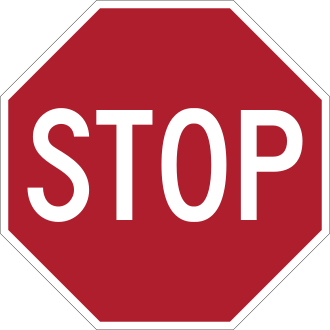
- Stop only if another vehicle is already at the intersection
- Come to a complete stop before the crosswalk or stop line and proceed when safe
- Slow down and proceed if the intersection looks clear
- Yield only to pedestrians, not to other vehicles
Answer: B — Come to a complete stop before the crosswalk or stop line and proceed when safe
An octagonal stop sign requires every vehicle to come to a complete stop before any crosswalk or stop line; slowing down is not enough.
14. What must a driver do on seeing this sign?
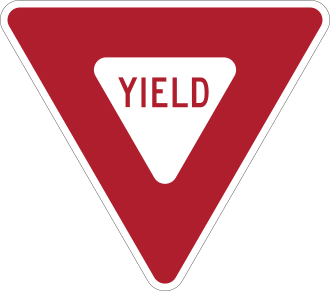
- Come to a complete stop regardless of traffic
- Slow down, be ready to stop, and let vehicles, bicyclists and pedestrians go first
- Stop only if a pedestrian is present
- Speed up to merge before other traffic arrives
Answer: B — Slow down, be ready to stop, and let vehicles, bicyclists and pedestrians go first
A yield sign means slow down, be ready to stop, and let others go first, stopping completely only if traffic requires it.
15. This plaque is posted beneath a stop sign at an intersection. What does it mean?
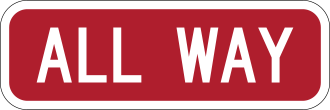
- Only cross traffic must stop
- Every approach must stop, and the first vehicle to arrive goes first
- Only vehicles turning left must stop
- Traffic signals are ahead
Answer: B — Every approach must stop, and the first vehicle to arrive goes first
A 4-WAY or ALL WAY plate means every approach to the intersection stops, and the first vehicle to arrive proceeds first.
16. What does this sign prohibit?
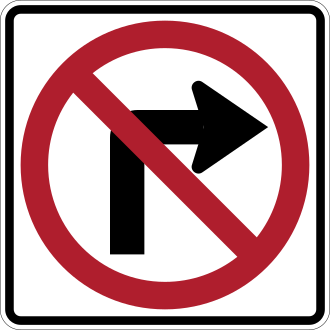
- Turning right at this location
- Parking at this location
- Passing other vehicles
- Turning left at this location
Answer: A — Turning right at this location
This regulatory sign, showing a red circle-and-slash over a right-turn arrow, prohibits right turns at the location.
17. A driver is in a lane marked with this sign. What must they do?
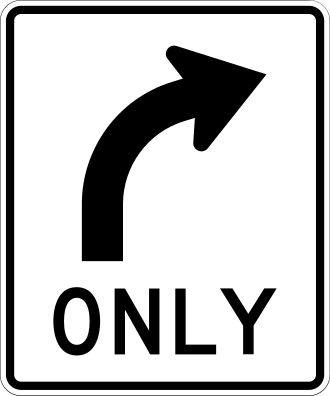
- Merge out of this lane before the intersection
- Continue straight through the intersection
- Turn right from this lane
- Turn left only
Answer: C — Turn right from this lane
This sign requires a driver in that lane to turn right; it is a mandatory-movement regulatory sign.
18. What does this sign tell a driver about the center lane?
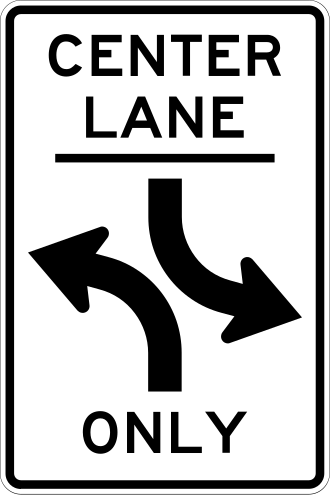
- It may be used for left turns from either direction of travel, but not for through travel
- It is a bicycle-only lane
- It is reserved for passing slower traffic
- It is reserved for right turns only
Answer: A — It may be used for left turns from either direction of travel, but not for through travel
This sign marks a center lane reserved for left turns from either direction of travel; you may not drive through in it.
19. What does this sign mean?
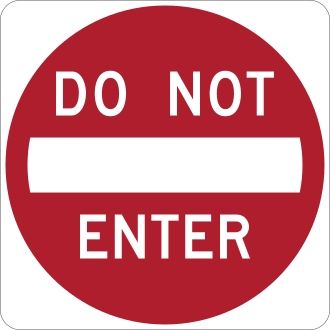
- One-way traffic flows in this direction
- Trucks are prohibited on this road
- You cannot drive in this direction
- The road ahead is closed for construction
Answer: C — You cannot drive in this direction
This regulatory sign forbids driving in that direction; it marks a roadway or ramp closed to entering traffic.
20. A driver realizes this sign applies to them. What should they do?
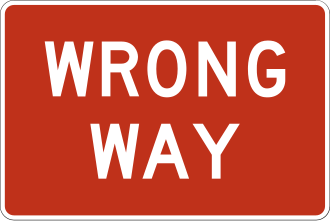
- Slow down, pull over, and turn around carefully
- Turn right immediately without checking traffic
- Speed up to reach the correct roadway quickly
- Ignore it, since it applies only to oncoming traffic
Answer: A — Slow down, pull over, and turn around carefully
This sign tells a driver they are going the wrong way: slow down, pull over and turn around carefully.
21. What must a driver do at this sign?
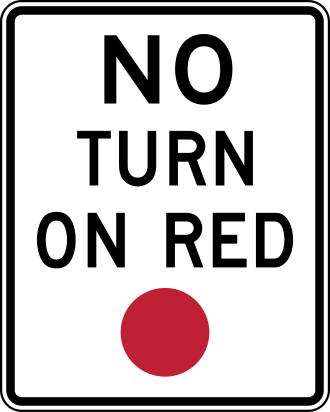
- Wait for a green light; turning on red is not allowed here
- Turn left only, never right
- Turn on red as usual after stopping and yielding
- Turn only after coming to a stop
Answer: A — Wait for a green light; turning on red is not allowed here
This sign overrides the normal right-on-red rule, requiring drivers to wait for a green signal before turning.
22. What does this sign mark, and what should a driver do?
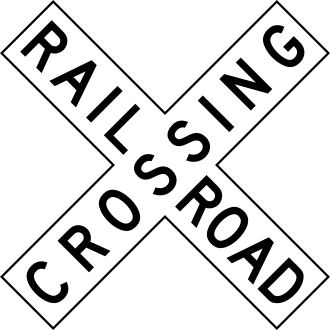
- A railroad crossing; look, listen, slow down and be ready to stop for trains from either direction
- A pedestrian crosswalk; yield to walkers
- A bicycle crossing; watch for riders
- A narrow bridge; slow down before crossing
Answer: A — A railroad crossing; look, listen, slow down and be ready to stop for trains from either direction
This crossbuck marks railroad tracks; drivers must look, listen, slow down and be ready to stop for a train from either direction.
23. What does this sign warn of?
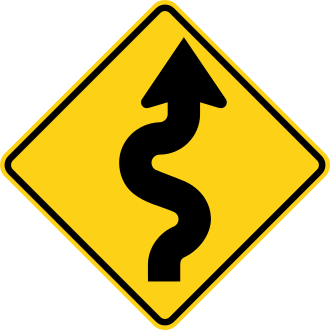
- The road ending ahead
- A steep downgrade ahead
- A single sharp curve ahead
- A series of curves ahead requiring reduced speed throughout
Answer: D — A series of curves ahead requiring reduced speed throughout
This warning sign indicates a winding road with a series of curves, calling for reduced speed through all of them.
24. What does this sign warn of?
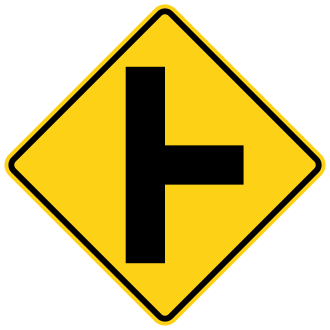
- The road ending in a T intersection
- A divided highway beginning ahead
- A side road entering from the right ahead
- An intersection requiring a stop ahead
Answer: C — A side road entering from the right ahead
This warning sign indicates that a side road enters the main road from the right up ahead.
25. What must a driver do on seeing this warning sign?
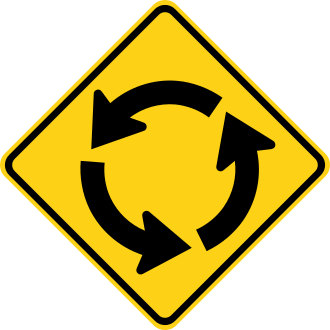
- Proceed straight through without slowing
- Merge left immediately without slowing
- Yield to traffic already in the circle and travel counterclockwise
- Come to a complete stop before entering
Answer: C — Yield to traffic already in the circle and travel counterclockwise
This sign warns of a roundabout ahead; drivers must yield to traffic already circulating and travel counterclockwise.
26. What should a driver do on seeing this sign?
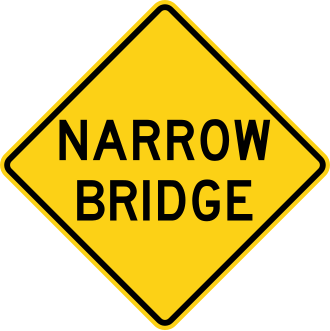
- Slow down, because the bridge ahead is narrow
- Stop and wait for a flagger to wave them through
- Change lanes immediately to avoid the bridge
- Speed up to cross before oncoming traffic arrives
Answer: A — Slow down, because the bridge ahead is narrow
This warning sign indicates a narrow bridge ahead and calls for reduced speed before crossing it.
27. What should a driver do on seeing this sign?
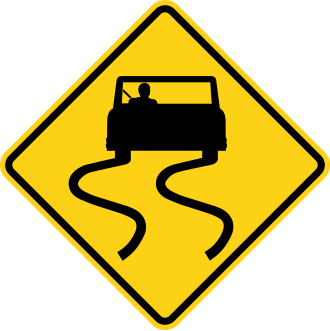
- Speed up to clear the slick area quickly
- Stop completely whenever pavement looks wet
- Ignore it unless it is currently raining
- Reduce speed and avoid hard braking or sudden turns
Answer: D — Reduce speed and avoid hard braking or sudden turns
This sign warns that pavement is slippery when wet, so drivers should reduce speed and avoid hard braking or sudden turns.
28. What does this sign warn of?
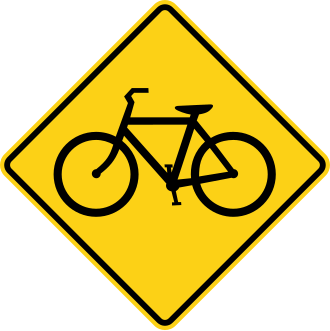
- A lane reserved only for cyclists ahead
- A school zone ahead
- A pedestrian crosswalk ahead
- Bicycles crossing or riding beside traffic
Answer: D — Bicycles crossing or riding beside traffic
This warning sign alerts drivers that bicycles cross or travel alongside traffic at this location, requiring extra caution.
29. What does this sign mark?
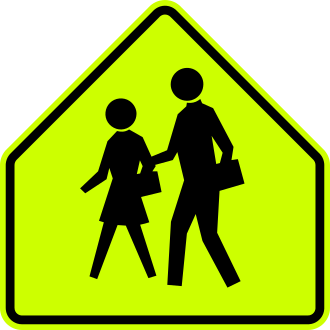
- A pedestrian crosswalk unrelated to a school
- A school zone or crossing; watch for children and obey crossing guards
- A hospital zone ahead
- A playground with no traffic restrictions
Answer: B — A school zone or crossing; watch for children and obey crossing guards
The pentagon shape marks a school zone or school crossing, where drivers must watch for children and obey crossing guards.
30. What does this sign mean?
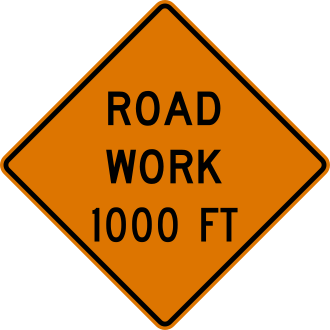
- A detour is required immediately
- The road ahead is permanently closed
- A work zone ahead; slow down, stay alert and obey the posted limit
- A railroad crossing is ahead
Answer: C — A work zone ahead; slow down, stay alert and obey the posted limit
This orange sign marks the start of a work zone, warning drivers to slow down, stay alert and obey the posted limit.
Take this test interactively
More Massachusetts Driver License practice tests
- Massachusetts Driver License: Emergency Vehicles, Police Stops, Emergencies and Crashes — 28 questions
- Massachusetts Driver License: Equipment, Belts, Distraction and Defensive Driving — 30 questions
- Massachusetts Driver License: Licenses, Permits, Junior Operators and the Road Test — 30 questions
- Massachusetts Driver License: Turns, Right-of-Way, Rotaries, Passing and Parking — 29 questions
- Massachusetts Driver License: Violations, Suspensions, Alcohol and Drugs — 30 questions