Maryland Driver License: Signs, Signals and Markings
30 questions with the correct answer and an explanation for each.
Topic: Signs, Signals and Markings. Free, no account needed.
Take this test interactively
1. The traffic signal at an intersection is dark because of a power outage. What must a driver do?
- Stop, yield to vehicles and pedestrians in the intersection, and go only when it is safe
- Wait for a police officer to arrive before proceeding
- Treat it as a flashing yellow and slow down only
- Proceed through immediately since no signal applies
Answer: A — Stop, yield to vehicles and pedestrians in the intersection, and go only when it is safe
A signal that is not working requires a stop at the stop line, crosswalk or intersection, yielding to vehicles and pedestrians in the intersection, and staying stopped until it is safe to go through.
2. Who besides a police officer may lawfully direct a driver to disregard a stop sign?
- A uniformed school crossing guard near a school
- A tow truck driver directing traffic around a crash
- A flagger in a work zone
- A crossing guard volunteer without a uniform
Answer: A — A uniformed school crossing guard near a school
Only police, other emergency personnel, or a uniformed school crossing guard near a school may override a traffic control device.
3. A driver wants to turn left at an intersection where the left-turn signal shows a steady red arrow. What must the driver do?
- Proceed with caution since red arrows only apply to through traffic
- Treat it the same as a flashing red arrow and turn when clear
- Turn left after yielding to pedestrians
- Stop completely and wait until the arrow changes
Answer: D — Stop completely and wait until the arrow changes
A steady red arrow requires a full stop in that direction and staying stopped while it remains red.
4. A driver is already too close to an intersection to stop safely when the signal turns steady yellow. What should the driver do?
- Stop inside the intersection and wait for the next green
- Brake hard to stop at the stop line even though the stop is abrupt
- Carefully continue through the intersection
- Stop and let the vehicles already in the intersection clear first
Answer: C — Carefully continue through the intersection
Steady yellow gives time to stop safely, but a driver already too close should carefully continue through rather than stop abruptly.
5. A flashing red signal at a railroad crossing is active but no train is visible. What must a driver do?
- Stop only if a train whistle is heard
- Come to a complete stop and wait until the flashing stops and the way is clear
- Slow down but continue rolling through
- Proceed slowly since no train is in sight
Answer: B — Come to a complete stop and wait until the flashing stops and the way is clear
A flashing red at a railroad crossing always requires a complete stop, even with no train visible, until it stops flashing.
6. A driver approaches a reversible lane displaying a steady red X overhead. What must the driver do?
- Use the lane only for a left turn
- Never drive in that lane
- Drive under it only if turning right
- Leave the lane as soon as it is safe
Answer: B — Never drive in that lane
A steady red X over a lane means that lane must never be entered.
7. A pedestrian crosswalk beacon is flashing red as a driver approaches. What does this require of the driver?
- Stop, then proceed with caution
- Come to a complete stop and wait for it to turn solid green
- Treat it as dark and proceed normally
- Slow down but do not stop
Answer: A — Stop, then proceed with caution
For drivers a flashing red crosswalk beacon works like a stop sign: stop, then proceed carefully.
8. A sign along the roadway is orange. What does the orange color indicate?
- A school, pedestrian or bicycle zone
- A service such as food or gas
- A construction or maintenance area
- A recreation or cultural area
Answer: C — A construction or maintenance area
Orange is reserved for construction and maintenance signs.
9. A sign is fluorescent pink. What does it indicate?
- An emergency traffic incident
- A bicycle route
- A school zone
- A construction zone
Answer: A — An emergency traffic incident
Fluorescent pink is used specifically for emergency traffic incident signs.
10. A road sign is shaped like a trapezoid. What does it mark?
- A no-passing zone
- A recreation area or National Forest route
- A railroad crossing
- A school zone
Answer: B — A recreation area or National Forest route
The trapezoid shape is used for recreation area and National Forest route signs.
11. A sign marks a lane for HOV use. Who may legally drive in that lane?
- Any vehicle during rush hour
- Only vehicles with a disability parking permit
- Only buses and taxis
- Only vehicles carrying the number of occupants shown on the sign
Answer: D — Only vehicles carrying the number of occupants shown on the sign
An HOV lane may be used only with the number of occupants posted on the sign.
12. A driver wants to turn left into a driveway, crossing a double solid yellow line to do so. Is this allowed?
- Only at intersections, never at driveways
- Only if a broken yellow line is on the near side
- No, double solid yellow lines prohibit crossing for any reason
- Yes, turning left across them into a driveway is allowed
Answer: D — Yes, turning left across them into a driveway is allowed
Double solid yellow lines prohibit passing, but a left turn across them into a driveway is specifically permitted.
13. What must a driver do upon seeing this sign?
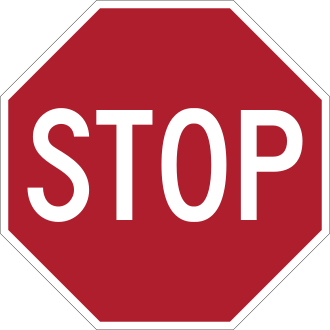
- Slow down and proceed with caution
- Stop only if other vehicles are present
- Slow down and yield to cross traffic
- Stop completely and wait until it is safe to proceed
Answer: D — Stop completely and wait until it is safe to proceed
This sign requires a complete stop and yielding to everyone before proceeding.
14. What does this sign require a driver to do?
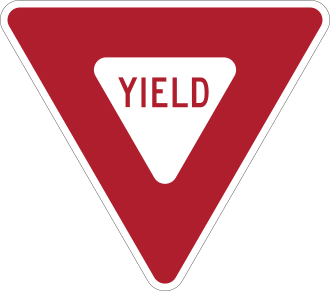
- Stop completely before proceeding
- Slow down, be ready to stop, and let others pass
- Merge left immediately
- Reduce speed only if pedestrians are visible
Answer: B — Slow down, be ready to stop, and let others pass
This sign means slow down and yield to pedestrians, bicyclists and vehicles, stopping if necessary.
15. What does this sign tell a driver?
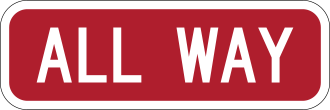
- Only cross traffic must stop
- The intersection has a traffic signal ahead
- Right turns are prohibited at this stop
- Every approach to the intersection has a stop sign
Answer: D — Every approach to the intersection has a stop sign
This plaque tells drivers that all approaches stop, and vehicles arriving together yield to the driver on the right.
16. What must a driver do upon seeing this sign?
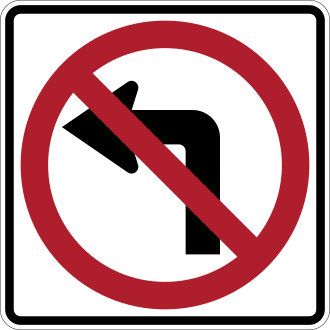
- Merge into the left lane
- Come to a complete stop before proceeding straight
- Avoid turning right only
- Avoid turning left, including U-turns
Answer: D — Avoid turning left, including U-turns
Left turns are prohibited by this sign, and U-turns count as two left turns so they are also prohibited.
17. What does this sign mean for a driver?
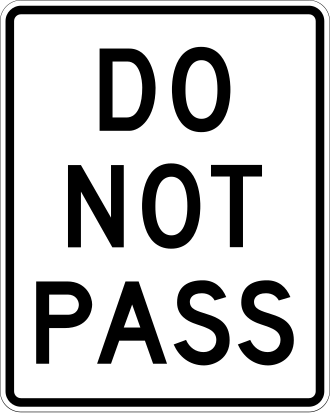
- The speed limit is reduced ahead
- Passing is allowed only on the left
- A no-passing zone begins, even if the road ahead looks clear
- A merge is coming and passing should be avoided temporarily
Answer: C — A no-passing zone begins, even if the road ahead looks clear
This sign marks the start of a no-passing zone; drivers must not pass even with a clear road.
18. What does this sign mean?
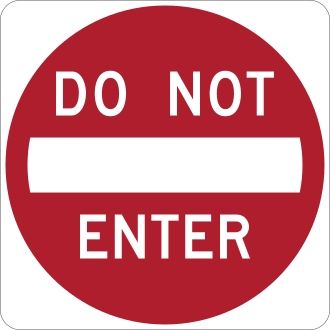
- Traffic may not drive into the roadway in this direction
- Parking is prohibited beyond this point
- Trucks are prohibited from entering
- The road ahead is closed for construction
Answer: A — Traffic may not drive into the roadway in this direction
This sign forbids entering the roadway from that direction.
19. A driver sees this sign while driving. What should the driver do?
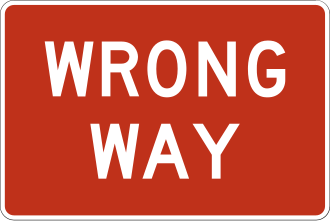
- Slow down, pull over and carefully turn around
- Continue driving; it applies only to oncoming traffic
- Keep driving to the next intersection and turn around there
- Make a U-turn immediately from the travel lane
Answer: A — Slow down, pull over and carefully turn around
This sign warns the driver is traveling the wrong way and should slow, pull over, and turn around carefully.
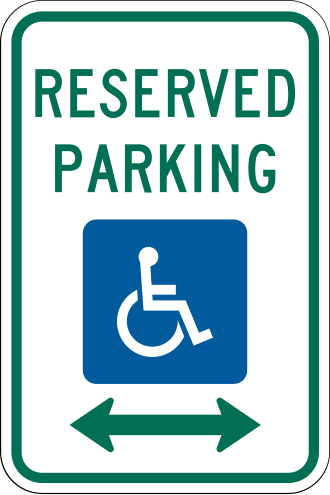
20. What does this sign indicate about a parking space?
- Parking is limited to fifteen minutes
- Parking is reserved for government vehicles
- Parking is prohibited entirely
- Parking is reserved for holders of a disability parking permit
Answer: D — Parking is reserved for holders of a disability parking permit
This sign marks parking reserved for disabled parking permit holders.
21. A driver stopped at a red light sees this sign. What must the driver do?
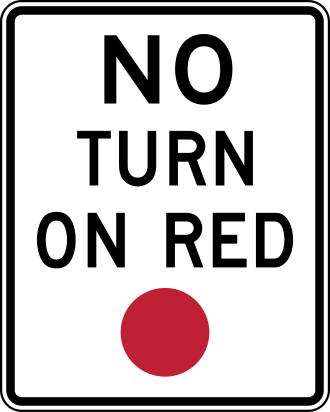
- Proceed straight through on red if no traffic is coming
- Turn right after a complete stop, as usual
- Wait for a green light before turning
- Turn left only, not right
Answer: C — Wait for a green light before turning
This sign prohibits turning on red, so the driver must wait for a green light.
22. What must a driver do at this sign?
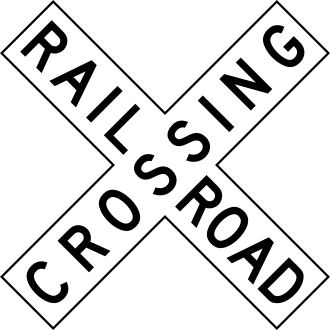
- Stop only if a train is visible
- Proceed at normal speed since trains sound a warning
- Yield only to pedestrians crossing the tracks
- Look, listen, slow down and be ready to stop for trains from either direction
Answer: D — Look, listen, slow down and be ready to stop for trains from either direction
This sign marks a railroad crossing where a driver must look, listen, slow down and be ready to stop for trains from either direction.
23. What must a driver do when approaching this sign?
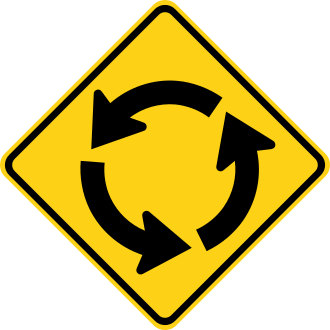
- Travel clockwise around the circle
- Yield only to traffic entering from the right
- Stop completely before entering
- Yield to traffic already in the circle and travel counterclockwise
Answer: D — Yield to traffic already in the circle and travel counterclockwise
This sign warns of a roundabout, where drivers yield to traffic already circulating and travel counterclockwise.
24. What should a driver in the right lane do upon seeing this sign?
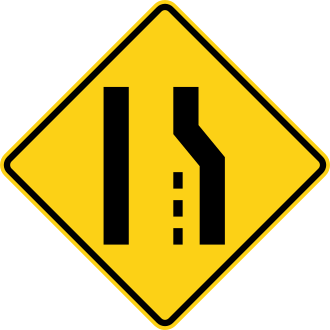
- Stop and wait for oncoming traffic to clear
- Speed up to pass merging traffic
- Merge left when a safe gap opens, since the right lane ends
- Continue in the right lane; it becomes a turn lane
Answer: C — Merge left when a safe gap opens, since the right lane ends
This sign warns the right lane is ending, so drivers in it must merge left when it is safe.
25. What does this sign tell a driver?
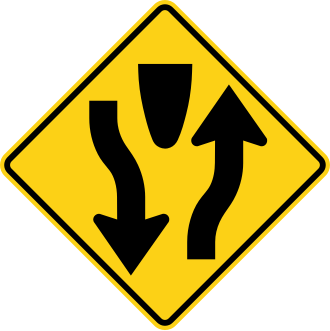
- The highway ahead splits into two one-way roadways; keep right
- A narrow bridge is ahead
- The road ahead is being repaved
- The median ends and two-way traffic resumes
Answer: A — The highway ahead splits into two one-way roadways; keep right
This sign warns that the highway is about to divide into two one-way roadways separated by a median.
26. What should a driver do upon seeing this sign?
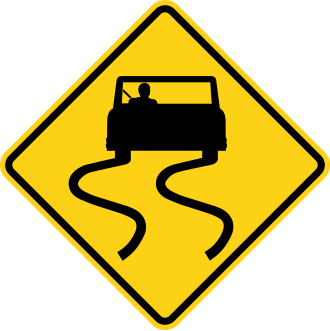
- Maintain normal speed since it only warns of ice
- Turn on hazard lights and stop
- Reduce speed and avoid hard braking or sudden turns
- Increase following distance but maintain speed
Answer: C — Reduce speed and avoid hard braking or sudden turns
This sign warns the pavement is slippery when wet, so a driver should reduce speed and avoid hard braking or sudden turns.
27. What should a driver do upon seeing this sign?
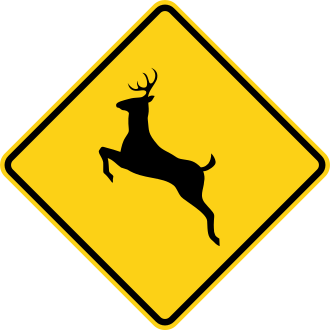
- Slow down only once a deer is visible on the road
- Watch for people entering a crosswalk and be ready to stop
- Slow down, stay alert and be ready to stop for animals
- Watch for bicycles crossing or riding beside traffic here
Answer: C — Slow down, stay alert and be ready to stop for animals
This sign warns that deer may cross the road, so drivers should slow down and be ready to stop.
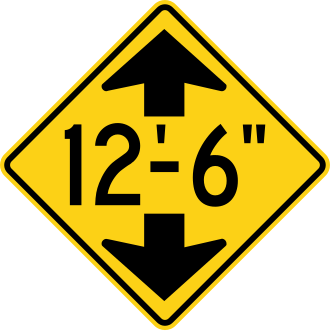
28. What does this sign warn a driver about?
- A steep downgrade ahead
- A narrow bridge ahead
- Not to proceed if the vehicle is taller than the height shown
- A soft shoulder ahead
Answer: C — Not to proceed if the vehicle is taller than the height shown
This sign warns of low clearance, so a vehicle taller than the posted height must not proceed.
29. What does this sign mark?
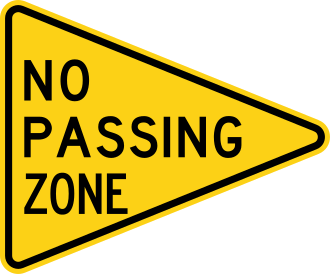
- An advisory speed for a curve
- The end of a no-passing zone
- The start of a no-passing zone
- A merging traffic area
Answer: C — The start of a no-passing zone
This pennant-shaped sign marks the start of a no-passing zone.
30. What does this sign warn a driver about?
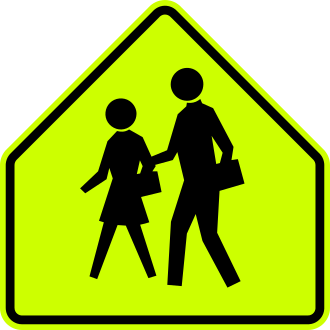
- A pedestrian crosswalk unrelated to a school
- A hospital zone ahead
- A school zone or crossing; watch for children and obey crossing guards
- A bicycle crossing ahead
Answer: C — A school zone or crossing; watch for children and obey crossing guards
This pentagon-shaped sign marks a school zone or crossing, so drivers should watch for children and obey crossing guards.
Take this test interactively
More Maryland Driver License practice tests