Oregon Driver License: Signs and Traffic Signals
30 questions with the correct answer and an explanation for each.
Topic: Signs and Traffic Signals. Free, no account needed.
Take this test interactively
1. What should a driver do about official signs, signals and markings on the road?
- Obey them only during daylight hours
- Follow them only when other traffic is present
- Obey them unless a police officer or road worker directs otherwise
- Obey the signs, but treat pavement markings as advisory
Answer: C — Obey them unless a police officer or road worker directs otherwise
Every official sign, signal and marking must be obeyed unless overridden by a police officer or road worker.
2. What must a driver do at this sign?
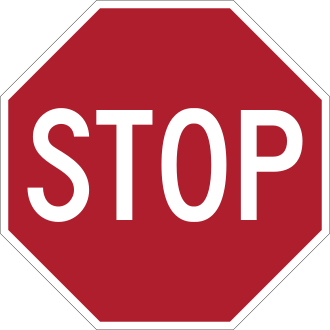
- Yield the right-of-way without stopping
- Stop only if another vehicle is already present
- Slow down and proceed if the way looks clear
- Come to a complete stop, yield to vehicles and pedestrians, then proceed when safe
Answer: D — Come to a complete stop, yield to vehicles and pedestrians, then proceed when safe
The octagonal stop sign requires a complete stop, yielding to vehicles and pedestrians, then proceeding when safe.
3. What does this sign require?
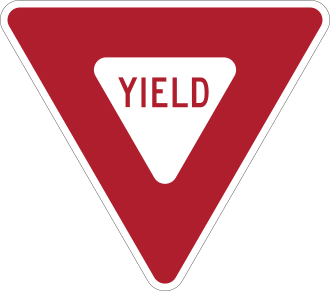
- Slow down and be ready to stop, letting other vehicles, pedestrians and bicyclists pass
- Yield to other vehicles, but pedestrians and bicyclists must wait for you
- Slow down only when cross traffic is visible; otherwise keep your speed
- Come to a complete stop at all times
Answer: A — Slow down and be ready to stop, letting other vehicles, pedestrians and bicyclists pass
The triangular yield sign means slow down and give the right-of-way, stopping only if needed.
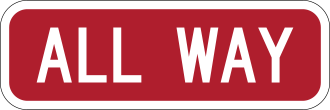
4. This plaque is posted below a stop sign. What does it mean?
- The intersection has four lanes in each direction
- Drivers on the main road may continue; only cross traffic must stop
- Only four vehicles may enter the intersection at once
- Every road at the intersection has a stop sign, and drivers arriving together yield to the driver on the right
Answer: D — Every road at the intersection has a stop sign, and drivers arriving together yield to the driver on the right
A 4-Way plaque means all approaches must stop, and drivers arriving together yield to the one on their right.
5. A stop sign has a sign below it reading "Right Turn Permitted Without Stopping." What may traffic do?
- Only bicycles may proceed without stopping
- Right-turning traffic must still stop but need not yield
- Right-turning traffic may continue while all other traffic stops and yields
- All traffic may proceed through without stopping
Answer: C — Right-turning traffic may continue while all other traffic stops and yields
The sign lets right-turning traffic continue while all other traffic stops and yields.
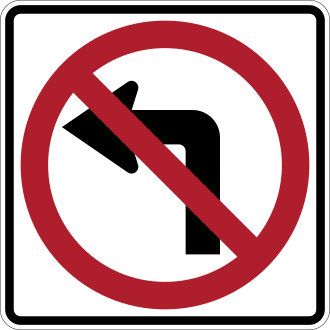
6. What does this sign prohibit?
- All turns except U-turns
- Left turns only at night
- Left turns and U-turns, since a U-turn counts as two left turns
- Right turns only
Answer: C — Left turns and U-turns, since a U-turn counts as two left turns
No Left Turn also forbids U-turns, which count as two left turns.
7. What does this sign prohibit?
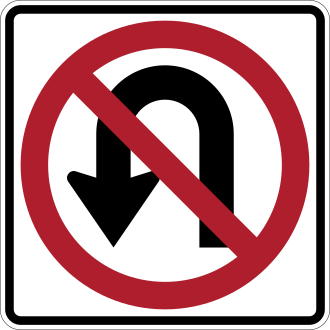
- Passing other vehicles
- Making a right turn
- Making a U-turn at this location
- Making a left turn
Answer: C — Making a U-turn at this location
A red circle with a slash over a U-turn arrow forbids U-turns at that location.
8. What does this sign mean?
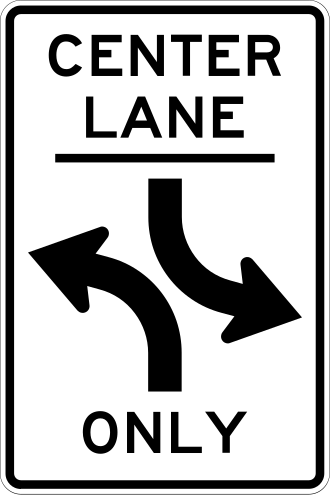
- The center lane is shared for left turns from both directions, and it is illegal to travel in it
- The center lane is reserved for buses and other transit vehicles
- The center lane is closed to all traffic
- The center lane is a passing lane for faster traffic
Answer: A — The center lane is shared for left turns from both directions, and it is illegal to travel in it
Center Lane Turn Only marks a lane shared for left turns from both directions; it is illegal to travel in it otherwise.
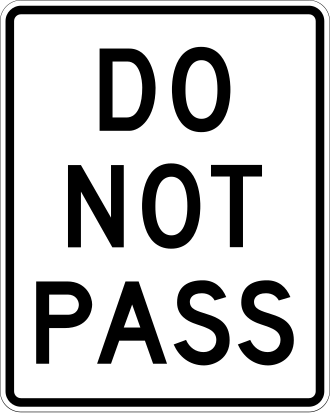
9. What does this sign require?
- Do not exceed the posted speed limit
- Do not turn left at this location
- Do not enter this road
- Do not pass other vehicles, even if the road ahead looks clear
Answer: D — Do not pass other vehicles, even if the road ahead looks clear
Do Not Pass marks the start of a no-passing zone, where passing is forbidden even with a clear road.
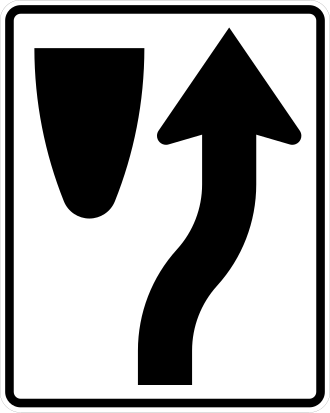
10. What does this sign indicate?
- Slower traffic must use the right lane
- A right-turn-only lane begins ahead
- The right lane is closed for construction
- A traffic island, median or obstruction is ahead; keep to the side shown
Answer: D — A traffic island, median or obstruction is ahead; keep to the side shown
Keep Right marks a traffic island, median or obstruction ahead, directing drivers to the side shown.
11. What does this sign mean?
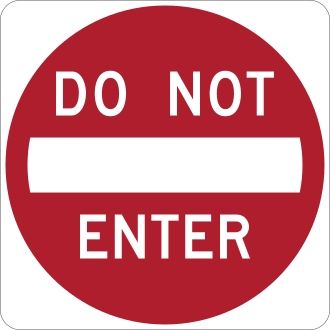
- The road ahead is closed for repairs
- Enter only if no other vehicles are present
- Drivers cannot go this direction; the road or freeway is closed to traffic entering this way
- Traffic flows only in the direction of travel
Answer: C — Drivers cannot go this direction; the road or freeway is closed to traffic entering this way
Do Not Enter warns drivers off a road or freeway and appears when they are going the wrong way.
12. What does this sign indicate?
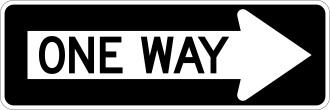
- A single lane merges ahead
- Traffic may travel in either direction
- The road is closed to entering traffic
- Traffic flows only in the direction of the arrow shown
Answer: D — Traffic flows only in the direction of the arrow shown
One Way means traffic flows only with the arrow shown.
13. What must a driver do at this sign?
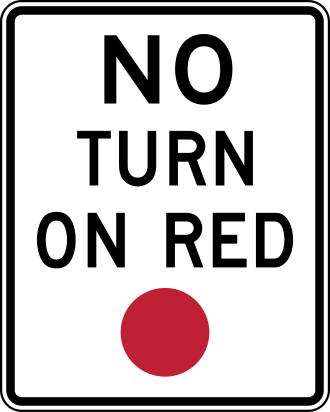
- Turn only during off-peak hours
- Turn only after coming to a complete stop
- Turn freely as long as the way is clear
- Wait for a green signal before turning; turning on red is not allowed
Answer: D — Wait for a green signal before turning; turning on red is not allowed
No Turn on Red means the driver must wait for green rather than turning on red.
14. What must a driver do at this sign?
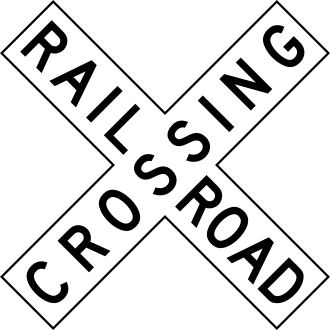
- Stop completely at the crossbuck before crossing, every time
- Stop only if a train is visibly approaching
- Look, listen, slow down and be ready to stop for trains from either direction
- Yield only to trains traveling in one specified direction
Answer: C — Look, listen, slow down and be ready to stop for trains from either direction
The railroad crossbuck requires looking, listening, slowing and being ready to stop for trains from either direction.
15. A right lane is marked for transit vehicles only, with a sign also reading "Right Turns Permitted." A driver wants to turn into a driveway on the right. What can they do?
- Use the lane freely for any driving purpose
- Turn from the transit lane and expect transit vehicles and bicycles to yield to you
- Briefly use the transit lane to turn, yielding to and merging behind transit vehicles and bicycles
- Never enter the transit lane for any reason
Answer: C — Briefly use the transit lane to turn, yielding to and merging behind transit vehicles and bicycles
Right Turns Permitted lets drivers briefly use the transit lane to turn, yielding to and merging behind transit vehicles and bicycles.
16. A lane reserved for High Occupancy Vehicles requires what of a vehicle using it?
- A permit sticker displayed on the windshield
- A minimum vehicle weight
- At least the number of people shown on the sign
- A minimum speed of 55 mph
Answer: C — At least the number of people shown on the sign
An HOV lane reserves the lane for vehicles carrying at least the number of people shown on the sign.
17. A driver turning left faces a circular green light under a sign reading "Left Turn Yield on Green." What must they do?
- Yield to oncoming traffic, but pedestrians in the crosswalk must wait for the turn
- Wait for a green arrow before turning
- Proceed immediately, since oncoming traffic must yield to them
- Yield to oncoming traffic and pedestrians before completing the turn
Answer: D — Yield to oncoming traffic and pedestrians before completing the turn
Left Turn Yield on Green means yielding to oncoming traffic and pedestrians on a circular green until the turn is safe.
18. What does this sign indicate?
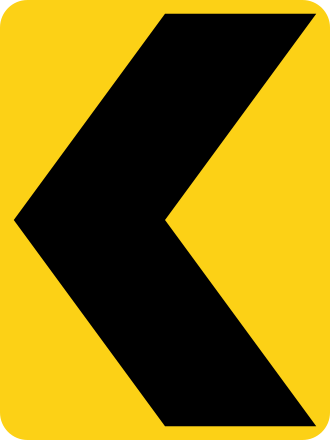
- A steep hill grade lies ahead
- An intersection with cross traffic lies ahead
- The road bends sharply in the direction shown
- Two lanes are merging into one
Answer: C — The road bends sharply in the direction shown
A chevron warns that the road bends sharply in the direction the arrow points.
19. A yellow flashing beacon accompanies a Pedestrian Crossing sign. What does the flashing beacon indicate?
- The crossing is for bicycles only
- Pedestrians must wait for a walk signal before crossing
- The lower school-zone speed limit is in effect while the beacon flashes
- Someone is crossing, has just crossed, or is about to cross
Answer: D — Someone is crossing, has just crossed, or is about to cross
The flashing yellow beacon on a Pedestrian Crossing sign means someone is crossing, has just crossed, or is about to cross.
20. What must a driver do at this sign?
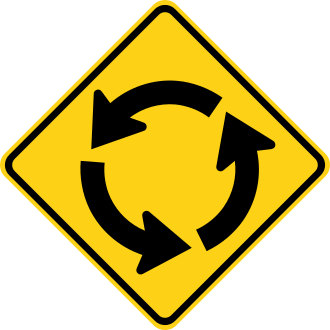
- Prepare for a roundabout, yield to traffic already in the circle, and go counterclockwise
- Come to a complete stop before entering the intersection
- Merge into a single lane ahead
- Prepare for a four-way stop
Answer: A — Prepare for a roundabout, yield to traffic already in the circle, and go counterclockwise
A Circular Intersection sign warns of a roundabout ahead, requiring yielding to circulating traffic and counterclockwise travel.
21. A driver sees a "Reduced Speed Limit Ahead" sign. What should they do?
- Keep your speed; the reduced limit ahead applies only to trucks
- Stop immediately at the sign
- Slow to the reduced limit at this sign, since the sign posts the new limit
- Prepare to slow down for a lower posted limit ahead
Answer: D — Prepare to slow down for a lower posted limit ahead
The Reduced Speed Limit Ahead sign warns drivers to prepare to slow for a lower posted limit ahead.
22. What does this sign indicate, and what should a driver do?
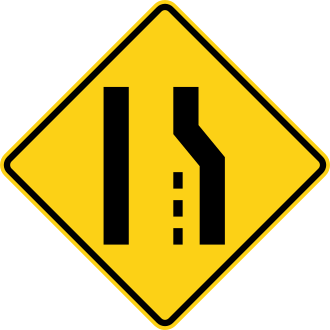
- The right lane ends ahead; right-lane drivers should merge left when space opens
- The highway is about to divide into two one-way roadways
- A new lane is being added on the right with no merge needed
- The road narrows to a single-lane bridge
Answer: A — The right lane ends ahead; right-lane drivers should merge left when space opens
Lane Reduction signs warn that a lane is ending and vehicles in it must merge into the through lane.
23. What does this sign indicate?
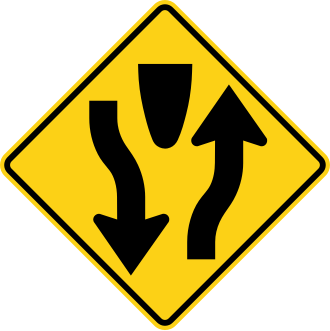
- The highway is about to split into two one-way roadways; keep right
- The median ahead ends and traffic will travel both ways
- A two-way road is joining the highway ahead
- The road narrows ahead
Answer: A — The highway is about to split into two one-way roadways; keep right
Divided Highway Begins warns that the road splits into two one-way roadways, so drivers should keep right.
24. What should a driver do upon seeing this sign?
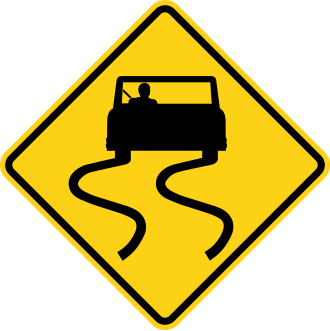
- Come to a complete stop if the road is wet
- Brake firmly and early on wet pavement to keep control
- Reduce speed on wet pavement and avoid hard braking or sudden turns
- Turn on headlights regardless of weather
Answer: C — Reduce speed on wet pavement and avoid hard braking or sudden turns
Slippery When Wet calls for reduced speed and avoiding hard braking or sudden turns on wet pavement.
25. What should a driver do upon seeing this sign?
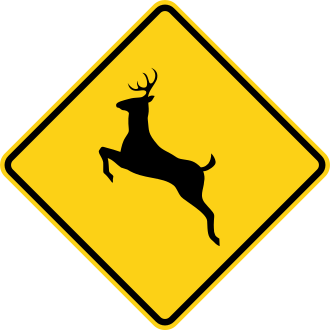
- Slow down, stay alert, and be ready to stop for wildlife crossing the road
- Keep your speed but drive with high beams on through the area
- Continue at the posted limit, since the sign only reports that deer live nearby
- Pull over and wait until all wildlife clears the road
Answer: A — Slow down, stay alert, and be ready to stop for wildlife crossing the road
A Deer sign calls for alertness and slowing down if wildlife is seen.
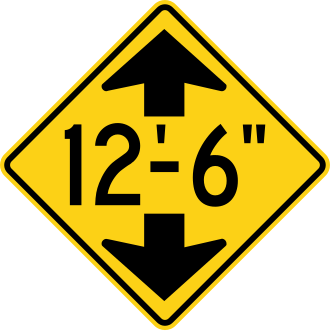
26. What does this sign warn a driver to do?
- Watch for a narrow bridge ahead
- Slow down for a steep downgrade ahead
- Reduce speed for a low-visibility curve
- Not proceed if the vehicle is taller than the height shown
Answer: D — Not proceed if the vehicle is taller than the height shown
Low Clearance warns not to proceed if the vehicle is too tall for the clearance shown.
27. A driver enters a stretch of road marked as a Safety Corridor. What should they do?
- Turn on their headlights, since the corridor has more fatal and serious-injury collisions than average
- Nothing more is required; the signs only report collision statistics
- Exit the roadway to bypass the corridor
- Turn on hazard lights and reduce speed by half
Answer: A — Turn on their headlights, since the corridor has more fatal and serious-injury collisions than average
Safety Corridor signs mark stretches with above-average fatal and serious-injury collisions, and drivers should turn on their lights.
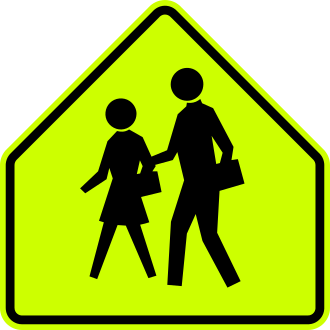
28. What does this sign indicate?
- A pedestrian crossing unrelated to a school
- A school zone or crossing; watch for children and obey crossing guards
- A playground with no crossing traffic
- A hospital zone requiring reduced noise
Answer: B — A school zone or crossing; watch for children and obey crossing guards
The pentagon-shaped School sign marks a school zone or crossing, requiring watchfulness for children and obedience to crossing guards.
29. A traffic signal is completely dark due to a power failure. How should drivers at the intersection treat it?
- As granting right-of-way to whoever arrives first regardless of direction
- As a four-way stop, stopping in all directions
- As a yield sign in all directions
- They may proceed without stopping since no signal is displayed
Answer: B — As a four-way stop, stopping in all directions
A dark signal from a power failure is treated as a stop sign in all directions.
30. A driver wants to turn left and the signal shows a flashing yellow arrow. What may they do?
- Make the turn after yielding to pedestrians and oncoming traffic, which has a steady green
- Turn immediately without yielding, since the arrow grants right-of-way
- Wait until oncoming traffic gets a red light before turning
- Wait for a steady green arrow before turning
Answer: A — Make the turn after yielding to pedestrians and oncoming traffic, which has a steady green
A flashing yellow arrow allows the turn after yielding to pedestrians and oncoming traffic, which has a steady green.
Take this test interactively
More Oregon Driver License practice tests
- Oregon Driver License: Belts, Hazardous Conditions, Distraction, Impaired Driving and Failures — 30 questions
- Oregon Driver License: Pedestrians, Bicycles, Motorcycles, Trucks, Buses and Emergency Vehicles — 30 questions
- Oregon Driver License: Speed, Markings, Space, Passing, Freeways and Towing — 30 questions
- Oregon Driver License: Tests, Applying, Insurance, Collisions and Losing Your Privileges — 30 questions
- Oregon Driver License: Turns, Intersections, Roundabouts and Parking — 30 questions
- Oregon Driver License: Work Zones, Railroad Crossings, Streetcars and Light Rail — 28 questions