Utah Driver License: Freeways, Intersections, Speed, Signals, Signs and Right-of-Way
30 questions with the correct answer and an explanation for each.
Topic: Freeways, Intersections, Speed, Signals, Signs and Right-of-Way. Free, no account needed.
Take this test interactively
1. While driving in a flex lane bordered by double dashed yellow lines, the overhead signal above your lane shows a red X. What must you do?
- You may not use the lane; move to another lane
- Continue driving; the X marks an emergency stopping area only
- Proceed only if you are turning left
- Slow to the posted advisory speed and continue
Answer: A — You may not use the lane; move to another lane
A red X over a flex lane means the lane is closed to you and you may not enter or continue in it.
2. What is the minimum following distance recommended behind the vehicle ahead on a freeway in good conditions?
- One second
- Four seconds
- Two seconds
- Three car lengths
Answer: C — Two seconds
Freeway driving calls for at least a two-second gap behind the vehicle ahead, more in adverse conditions.
3. A driver wants to use the I-15 express lanes without a transponder account or clean-fuel decal. How many total occupants must be in the vehicle to qualify for free use?
- Four or more
- Two or more
- One
- Three or more
Answer: B — Two or more
The express lanes are free for vehicles carrying two or more people, along with motorcycles, buses and C-decal vehicles.
4. What is the one-time fee to register a windshield C decal so a clean-fuel vehicle can use the express lanes toll-free?
- $50
- $5
- $25
- $10
Answer: D — $10
Eligible clean-fuel vehicles can use the express lanes toll-free after paying a one-time ten-dollar fee for the C decal.
5. Approaching a ramp meter that shows only alternating red and green lights, with no sign posted otherwise, how many vehicles may proceed on each green?
- Two
- As many as can clear before the light turns red
- Three
- One
Answer: D — One
Ramp meters let one vehicle go on each green unless a sign posts a different number.
6. The signals at a single-point urban interchange lose power during an outage. How should a driver treat the intersection?
- Treat it as a yield sign and continue without stopping
- Treat it as a four-way stop, taking turns in order of arrival
- Proceed with extreme caution and courtesy
- Wait for a police officer before entering under any circumstance
Answer: C — Proceed with extreme caution and courtesy
A powered-down single-point urban interchange is specifically not treated like a four-way stop; drivers proceed carefully, and most have battery backup anyway.
7. Two vehicles arrive at a four-way stop at the same time from different directions. Who has the right-of-way?
- The driver who arrived from the left
- The driver on the right
- Whichever vehicle is larger
- The vehicle going straight
Answer: B — The driver on the right
When drivers reach a four-way stop together, the driver on the right is yielded to.
8. How far before your turn may you enter a shared center left-turn lane to prepare for the turn?
- Only within 100 feet of the turn
- No more than 500 feet before the turn
- Any distance, as long as no other vehicle is using the lane
- At least 1,000 feet before the turn
Answer: B — No more than 500 feet before the turn
Drivers may not enter a shared center left-turn lane more than 500 feet before the turn, unless the last vehicle in line is farther than that.
9. A driver approaches a school building during recess where no sign posts a specific limit. What is the maximum legal speed?
- 20 mph
- 35 mph
- 25 mph
- 15 mph
Answer: A — 20 mph
Absent a posted sign, the default limit passing a school during recess or when children are present is 20 mph.
10. A signal shows a flashing yellow arrow for left turns. What does this mean?
- Left turns are prohibited until the arrow changes
- The turn is protected; oncoming traffic must stop
- Left turns are permitted after yielding to oncoming traffic and pedestrians
- Stop completely and wait for a green arrow before turning
Answer: C — Left turns are permitted after yielding to oncoming traffic and pedestrians
A flashing yellow arrow allows a left turn, but only after yielding to oncoming traffic (which has a green light) and pedestrians.
11. A left-turn signal is stuck on a red arrow and never changes. Under what condition may a driver still turn left?
- Never; the driver must wait for the signal to be repaired or for an officer to direct traffic
- When safe, turning left from a two-way street onto a street with a clear path
- When safe, after stopping and treating the red arrow as a flashing yellow arrow
- When safe, turning left from a one-way street onto a one-way street
Answer: D — When safe, turning left from a one-way street onto a one-way street
A driver stranded by a red arrow that never changes may, when safe, turn left from a one-way street onto a one-way street.
12. What happens to fines for speeding in a work zone?
- They are tripled
- They are waived if no workers are present
- They remain the same as elsewhere
- They are doubled
Answer: D — They are doubled
Speeding fines in work zones are doubled.
13. What must you do when you see this sign?
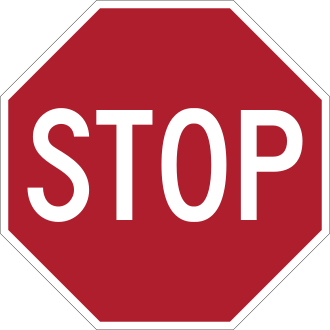
- Merge with caution into the next lane
- Slow down and yield only if other traffic is present
- Reduce speed and proceed if the way looks clear
- Come to a complete stop and wait for vehicles and pedestrians before proceeding
Answer: D — Come to a complete stop and wait for vehicles and pedestrians before proceeding
This octagon sign requires a full stop at the sign, stop line or crosswalk and waiting for vehicles and pedestrians.
14. What does this sign mean?
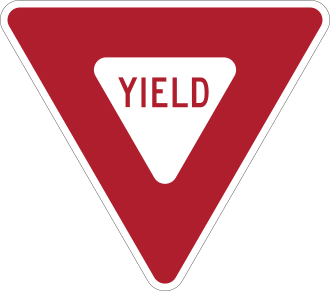
- Stop completely at all times before proceeding
- Prepare to merge into the left lane
- Slow down and be ready to stop, letting vehicles, pedestrians and bicyclists pass
- Reduce speed for a sharp curve ahead
Answer: C — Slow down and be ready to stop, letting vehicles, pedestrians and bicyclists pass
This triangular sign means slow down and give way to traffic, pedestrians and bicyclists with the right-of-way.
15. What does this sign tell you about the intersection?
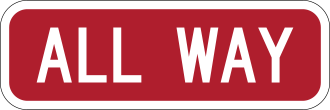
- Every approach to the intersection has a stop sign
- Only cross traffic must stop
- Right turns are prohibited at this intersection
- The intersection is a roundabout
Answer: A — Every approach to the intersection has a stop sign
This plaque indicates every road at the intersection stops, and drivers arriving together yield to the driver on the right.
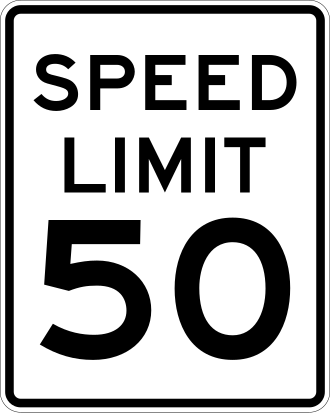
16. What does this sign indicate?
- The minimum speed required on this road
- The maximum legal speed for good conditions
- The speed limit that applies only in the adjacent work zone
- A recommended speed only, not enforceable
Answer: B — The maximum legal speed for good conditions
This sign posts the maximum legal speed in good weather; driving too fast for actual conditions can still bring a ticket.
17. What must a driver do upon seeing this sign?
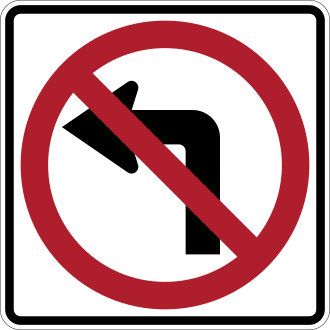
- Stop completely before proceeding through the intersection
- No right turn at this intersection
- No left turn here, though a U-turn is still permitted
- No left turn here, and no U-turn either
Answer: D — No left turn here, and no U-turn either
Left turns are illegal where this sign is posted, and U-turns are also prohibited since they count as two left turns.
18. What does this sign mean for the center lane of the road?
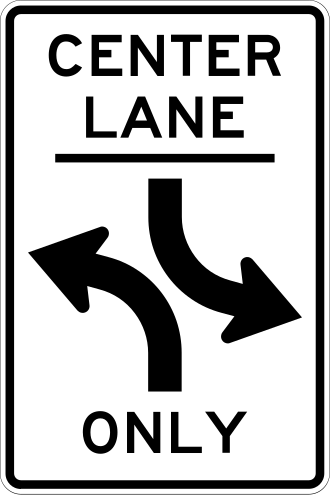
- It is for left-turning vehicles only, never through traffic or passing
- It is reserved for passing slower vehicles only
- It is a carpool lane for vehicles with two or more occupants
- It is closed ahead for construction
Answer: A — It is for left-turning vehicles only, never through traffic or passing
This sign marks a center lane reserved solely for left-turning vehicles, not for through traffic or passing.
19. What does this sign mark?
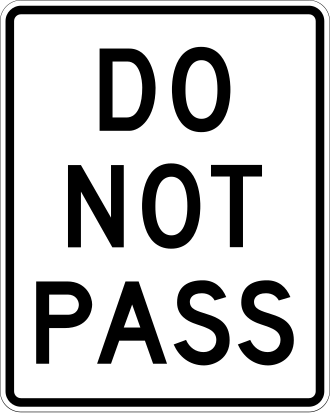
- A lane reserved for slower traffic
- The start of a no-passing zone
- The end of a no-passing zone
- A merging lane ahead
Answer: B — The start of a no-passing zone
This sign marks the start of a no-passing zone; drivers must not pass even if the road looks clear.
20. What does this sign instruct?
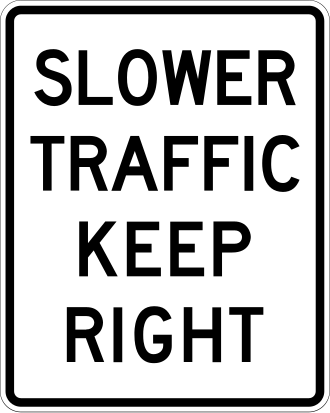
- Slower drivers should use the right lane, leaving the left lane for passing
- The right lane ends ahead and traffic must merge left
- All traffic must move right for an upcoming median
- Trucks must use the right lane only
Answer: A — Slower drivers should use the right lane, leaving the left lane for passing
This sign tells slower drivers to keep to the right lane, reserving the left lane for passing.
21. What does this sign mean?
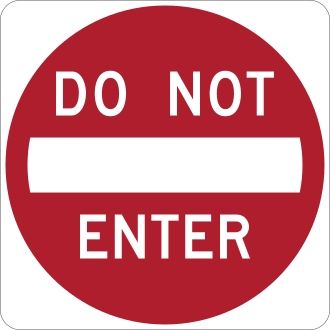
- You are already driving the wrong way; turn around
- No parking is permitted beyond this point
- You may not drive in this direction here
- Trucks are prohibited beyond this point
Answer: C — You may not drive in this direction here
This sign forbids entering or driving in that direction at all.
22. You see this sign while driving. What should you do?
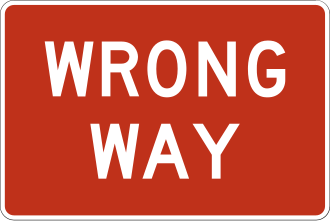
- Continue at the same speed; the sign only warns of a hazard further ahead
- Stop immediately in your lane and wait for traffic to clear
- Slow down, pull over and turn around carefully
- Speed up and take the next available exit or side street
Answer: C — Slow down, pull over and turn around carefully
This sign warns that you are traveling the wrong way and instructs you to slow, pull over and turn around carefully.
23. What does this sign indicate about the road ahead?
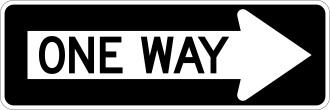
- The lane is reserved for turning traffic only
- Traffic flows only in the direction the arrow points
- The road splits into two one-way roadways separated by a median
- Two-way traffic resumes ahead
Answer: B — Traffic flows only in the direction the arrow points
This sign shows traffic moves only in the direction of the arrow.
24. What does this sign designate?
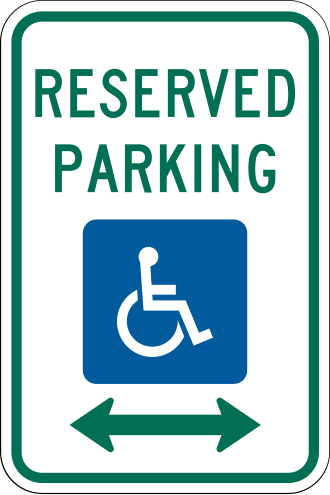
- No parking at any time
- Parking reserved for emergency vehicles only
- A loading zone for deliveries only
- Parking reserved for disabled parking permit holders
Answer: D — Parking reserved for disabled parking permit holders
This sign reserves the parking spot for holders of disabled parking permits.
25. What must a driver do at a red light when this sign is posted?
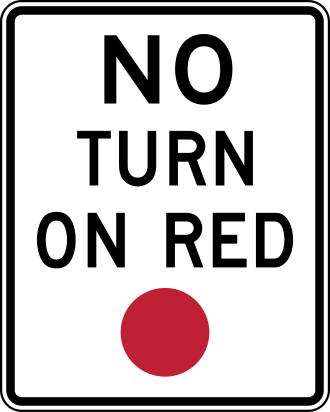
- Turn right after a complete stop, as usual
- Wait for green before turning; turning on red is not allowed
- Proceed straight through the intersection only
- Turn left only after yielding to oncoming traffic
Answer: B — Wait for green before turning; turning on red is not allowed
This sign overrides the normal right-turn-on-red rule and requires waiting for a green signal.
26. What should a driver do upon seeing this sign?
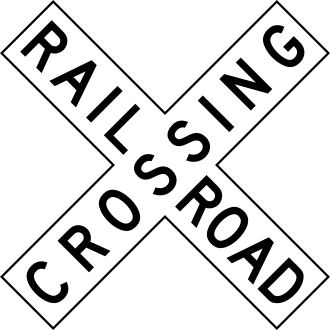
- Proceed at normal speed since gates will warn of any train
- Stop only if a plaque shows multiple tracks
- Look, listen, slow down and be ready to stop for a train from either direction
- Yield only to pedestrians, not to trains
Answer: C — Look, listen, slow down and be ready to stop for a train from either direction
This crossbuck marks the crossing itself and requires drivers to look, listen, slow down and be ready to stop for trains.
27. What does this sign warn of, and how should a driver respond?
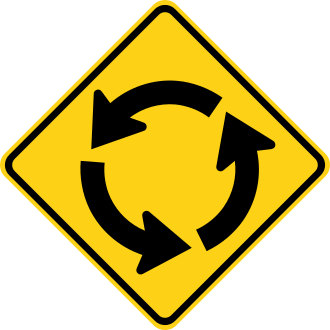
- A T-intersection ahead; prepare to turn
- A four-way stop ahead
- A divided highway beginning ahead
- A roundabout ahead; yield to traffic in the circle and go counterclockwise
Answer: D — A roundabout ahead; yield to traffic in the circle and go counterclockwise
This sign warns of a roundabout ahead, where drivers yield to circulating traffic and travel counterclockwise.
28. What does this sign indicate about the road ahead?
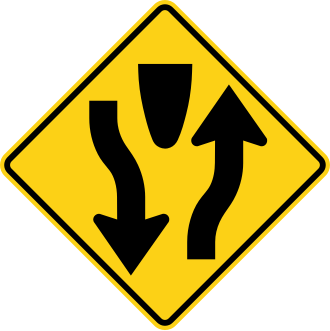
- A narrow bridge is ahead
- The highway splits into two one-way roadways separated by a median; keep right
- Two-way traffic resumes ahead
- The median ends and traffic returns to both directions
Answer: B — The highway splits into two one-way roadways separated by a median; keep right
This sign warns that the highway is about to split into divided one-way roadways, and drivers should keep right.
29. What should a driver do upon seeing this sign?
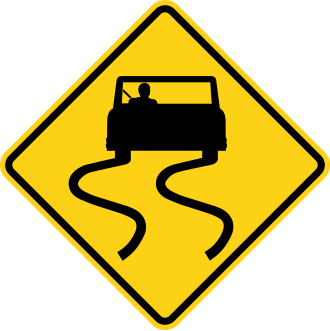
- Reduce speed and avoid hard braking or sudden turns
- Pull over until conditions improve
- Maintain speed and brake firmly if the vehicle begins to skid
- Increase following distance only if there is snow
Answer: A — Reduce speed and avoid hard braking or sudden turns
This sign warns of slippery pavement, calling for reduced speed and avoiding hard braking or sudden turns.
30. What does this sign warn a driver to do?
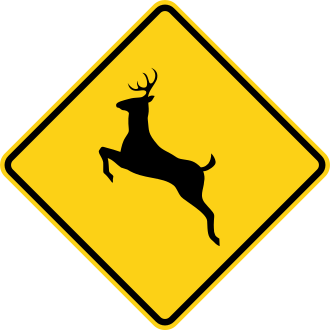
- Reduce speed for a sharp curve ahead
- Expect bicycles crossing or riding beside traffic
- Slow down, stay alert and be ready to stop for animals crossing
- Watch for pedestrians entering a crosswalk
Answer: C — Slow down, stay alert and be ready to stop for animals crossing
This sign warns that deer cross here, requiring drivers to slow down, stay alert and be ready to stop.
Take this test interactively
More Utah Driver License practice tests
- Utah Driver License: Alcohol, Drugs, Suspensions and Points — 30 questions
- Utah Driver License: Basic Driving, Parking, Passing, School Buses and Turns — 30 questions
- Utah Driver License: Distractions, Driving Challenges, Crashes and Insurance — 30 questions
- Utah Driver License: Licensing, Permits, Teen Restrictions, Documents and Renewal — 30 questions
- Utah Driver License: Sharing the Road, Trains, Equipment and Towing — 29 questions
- Utah Driver License: Vision, Health, the Tests, Belts, Car Seats and Air Bags — 30 questions