Iowa Driver License: Your License, Signs, Signals, Railroad Crossings and Markings
33 questions with the correct answer and an explanation for each.
Topic: Your License, Signs, Signals, Railroad Crossings and Markings. Free, no account needed.
Take this test interactively
1. A driver has lived in Iowa continuously for 30 days but has not registered to vote, enrolled a child in school, taken a permanent job, filed a homestead exemption, or received state assistance. Do they count as an Iowa resident for licensing purposes?
- Only after 90 days of continuous residence
- Yes, 30 days of continuous residence alone establishes residency
- No, continuous residence alone never establishes residency
- Only if they also register to vote
Answer: B — Yes, 30 days of continuous residence alone establishes residency
Living in Iowa continuously for 30 days is by itself one of the listed triggers for counting as a resident for licensing.
2. A farmer wants to drive a tractor without a license along a public road between the home farm and a field 1.5 miles away. Is this allowed?
- Yes, but only at night
- No, the exemption only applies within one mile
- No, a license is always required to drive farm equipment on public roads
- Yes, farm equipment may be driven without a license between the home farm and farmland or a farm operation within two miles
Answer: D — Yes, farm equipment may be driven without a license between the home farm and farmland or a farm operation within two miles
No license is needed to drive farm equipment between the home farm and farmland or a farm operation within two miles.
3. A driver is stopped by police and can produce their driver's license but not proof of registration or an insurance card. What is the consequence?
- They face fines and possibly impoundment of the vehicle
- Nothing, only the license is legally required
- A warning only, since registration and insurance need not be carried
- The vehicle is impounded but no fine applies
Answer: A — They face fines and possibly impoundment of the vehicle
Registration and proof of insurance must be carried along with the license; without them the driver faces fines and possible impoundment.
4. A 17-year-old has completed an Iowa-approved driver education course. Do they still need to pass a separate driving test to get a license?
- No, completing the driver education requirement means the driving test is not required
- No, but only if they are over 18
- Yes, but only the vision screening may be skipped
- Yes, a driving test is always required regardless of driver education
Answer: A — No, completing the driver education requirement means the driving test is not required
The driving test is not required when the driver education requirement is satisfied.
5. A sign is colored blue. What kind of information is it giving?
- Traveler services such as rest areas, hospitals, lodging or fuel
- A general warning of a hazard ahead
- An enforceable regulatory law
- Directions and distance to a place
Answer: A — Traveler services such as rest areas, hospitals, lodging or fuel
Blue marks traveler services such as rest areas, tourist sites, hospitals, lodging, fuel, restaurants and attractions.
6. A driver sees the blue Emergency Notification System sign posted at a railroad crossing. What is it for?
- Reporting a stalled vehicle, malfunctioning signal or hazard at that crossing to the railroad
- Marking the crossing as exempt from stopping
- Advertising the nearest hospital
- Showing the maximum safe speed through the crossing
Answer: A — Reporting a stalled vehicle, malfunctioning signal or hazard at that crossing to the railroad
The blue ENS sign carries a phone number and crossing ID used to report stalled vehicles, malfunctioning signals, or hazards at that crossing.
7. A driver on a main road passes a yellow diamond merging traffic sign. What does it tell them to do?
- Move immediately into the opposite lane
- Speed up to pass before the merge point
- Be ready for vehicles blending into your lane on the main road
- Stop and wait for all merging traffic to clear
Answer: C — Be ready for vehicles blending into your lane on the main road
A merging traffic warning tells drivers to be ready for vehicles blending into their lane on the main road.
8. A slow-moving farm vehicle displays a reflective orange triangle on its rear. What does that symbol indicate?
- The vehicle is carrying hazardous materials
- The vehicle travels 35 mph or less
- The vehicle is exempt from all traffic laws
- The vehicle must yield at every intersection
Answer: B — The vehicle travels 35 mph or less
A reflective orange triangle on the rear of a vehicle means it travels 35 mph or less.
9. A driver traveling on an interstate wants to know exactly how far they are from their exit and needs their exact location for an emergency call. What roadside feature provides this?
- Route shield signs
- Blue service signs
- Guide signs listing city names
- Mile markers counting distance from where the interstate entered the state
Answer: D — Mile markers counting distance from where the interstate entered the state
Mile markers count the miles from where the interstate entered the state, useful for computing distance to an exit and giving exact location in an emergency.
10. A traffic light shows solid yellow as a driver approaches an intersection they can still stop for safely. What must they do?
- Treat it the same as a flashing red light
- Proceed through with caution
- Speed up to clear the intersection before it turns red
- Not enter the intersection, since they can stop safely
Answer: D — Not enter the intersection, since they can stop safely
On solid yellow, a driver who can stop safely must not enter the intersection; only if they cannot stop safely should they proceed through with caution.
11. A driver waiting to turn left sees a flashing yellow arrow for their turn while oncoming traffic has a green light. What should they do?
- Turn left immediately since the arrow is yielding, not stopping, traffic
- Treat it as a steady red arrow and not turn at all
- Come to a complete stop and wait for a green arrow
- Yield to oncoming traffic and pedestrians, then turn left with caution
Answer: D — Yield to oncoming traffic and pedestrians, then turn left with caution
A flashing yellow arrow means yield to oncoming traffic, which has a green light, and to pedestrians, then turn left with caution.
12. A rideshare driver carrying a passenger for hire approaches a railroad crossing with no officer, signal, or EXEMPT marking present. What must they do before crossing?
- Proceed normally since only school buses must stop
- Slow to the posted advisory speed but need not stop
- Stop within 15 to 50 feet of the tracks before crossing
- Stop only if lights are flashing
Answer: C — Stop within 15 to 50 feet of the tracks before crossing
School buses, charter buses, drivers carrying passengers for hire, and placarded hazmat vehicles must stop within 15 to 50 feet of the tracks before crossing, unless directed otherwise or the crossing is marked EXEMPT.
13. A flagger in a fluorescent vest in a work zone holds up a stop paddle. What must a driver do?
- Follow the flagger's instructions
- Proceed if no arrow board is visible
- Ignore the flagger and follow the posted speed limit sign instead
- Stop only if a police officer is also present
Answer: A — Follow the flagger's instructions
Flagger instructions in a work zone must be followed.
14. On a two-way road, a driver sees a solid yellow line on their side paired with a dashed yellow line on the oncoming side. Can they pass?
- Yes, but only oncoming vehicles on the solid side may pass
- No, neither side may pass regardless of line type
- Yes, passing is allowed from either side
- No, passing is not allowed from the solid side, but vehicles on the dashed side may pass when safe
Answer: D — No, passing is not allowed from the solid side, but vehicles on the dashed side may pass when safe
On a two-way road with a solid line beside a dashed one, passing is not allowed from the solid side, while vehicles on the dashed side may pass when safe.
15. A driver enters a center lane marked with alternating left-turn arrows between solid and dashed yellow lines to prepare for a left turn from a busy street. Can this lane also be used to pass slower traffic?
- Yes, once stopped in the lane it may be used to pass
- Yes, but only if oncoming traffic is clear
- No, the lane may not even be entered before turning
- No, a shared left-turn lane may be entered and stopped in before a left turn but never used for passing
Answer: D — No, a shared left-turn lane may be entered and stopped in before a left turn but never used for passing
A shared left-turn lane may be entered and stopped in before a left turn but never used for passing.
16. What must a driver do on seeing this sign?
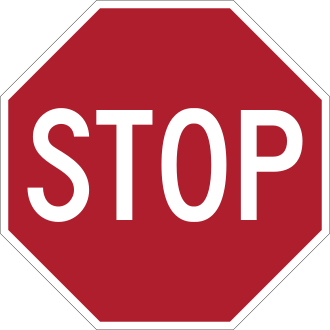
- Slow down and be ready to stop, letting vehicles, pedestrians and bicyclists pass
- Every road at this intersection stops; drivers arriving together yield to the driver on the right
- Stop completely at the sign, stop line or crosswalk and wait for vehicles and pedestrians
- The maximum legal speed in good weather
Answer: C — Stop completely at the sign, stop line or crosswalk and wait for vehicles and pedestrians
The octagon is reserved for stop signs, requiring a full stop at the intersection.
17. What must a driver do on seeing this sign?
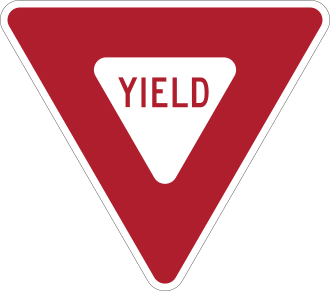
- Slow down, be ready to stop, and let vehicles, pedestrians and bicyclists pass
- Come to a complete stop regardless of other traffic
- Proceed since it only marks a school zone
- Merge left because the lane is ending
Answer: A — Slow down, be ready to stop, and let vehicles, pedestrians and bicyclists pass
The triangle yield sign means slow down, be ready to stop, and let vehicles, pedestrians and bicyclists pass.
18. What does this plaque, mounted beneath a stop sign, mean?
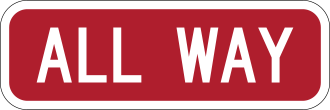
- Only cross traffic must stop
- The intersection has a traffic signal ahead
- Trucks are prohibited at this intersection
- Every road at the intersection stops; drivers arriving together yield to the driver on the right
Answer: D — Every road at the intersection stops; drivers arriving together yield to the driver on the right
The 4-Way plaque means every approach stops, and drivers arriving together yield to the driver on the right.
19. What does this sign indicate to a driver?
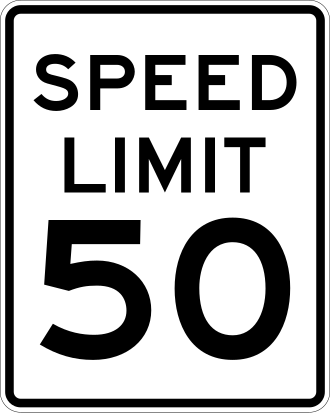
- The maximum legal speed in good weather; driving too fast for conditions can still be ticketed
- The speed limit only while lights are flashing
- The recommended speed only for exit ramps
- The minimum speed required at all times
Answer: A — The maximum legal speed in good weather; driving too fast for conditions can still be ticketed
A speed limit sign gives the maximum legal speed under good conditions, though driving too fast for actual conditions can still result in a ticket.
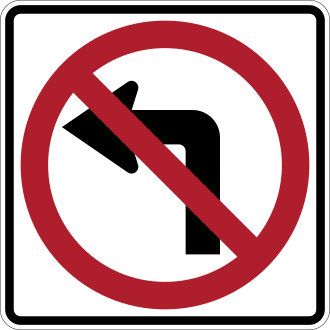
20. What is prohibited where this sign is posted?
- Right turns
- Entering the roadway in this direction
- Left turns, and also U-turns, which count as two left turns
- Passing other vehicles
Answer: C — Left turns, and also U-turns, which count as two left turns
This sign prohibits left turns, and U-turns are also illegal here since a U-turn counts as two left turns.
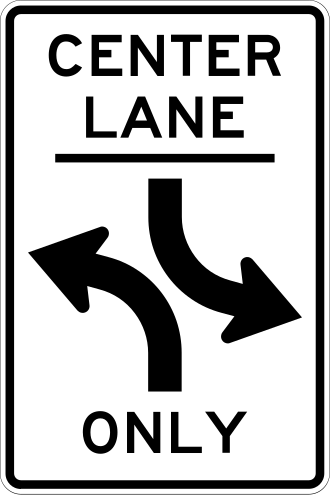
21. What is a driver allowed to do in the lane marked by this sign?
- Use it only to pass slower traffic
- Use it exclusively for right turns
- Drive in it only when carrying two or more people
- Enter and stop in it before turning left from either direction, but never pass in it
Answer: D — Enter and stop in it before turning left from either direction, but never pass in it
The center lane left-turn-only marking reserves the lane for left turns from either direction; drivers may enter and stop in it before turning but never pass there.
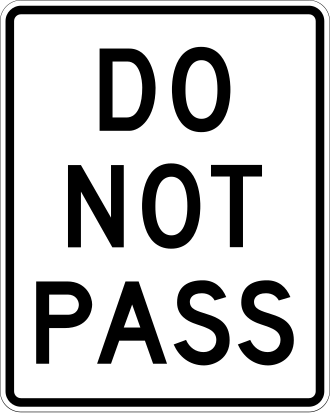
22. What must a driver do on seeing this sign, even with a clear road ahead?
- Merge into the right lane immediately
- Not pass, since this marks the start of a no-passing zone
- Pass only if no oncoming traffic is visible
- Reduce speed but passing is still permitted
Answer: B — Not pass, since this marks the start of a no-passing zone
This sign marks the start of a no-passing zone; drivers must not pass even with a clear road.
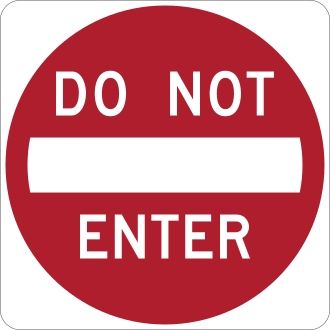
23. What does this sign mean?
- The driver has turned into oncoming traffic and must pull over and turn around
- Traffic may not drive in this direction
- A one-way street begins ahead
- An intersection with cross traffic is ahead
Answer: B — Traffic may not drive in this direction
This sign marks an opening drivers must not enter, such as an exit ramp or one-way road spot.
24. What must a driver do on seeing this sign?
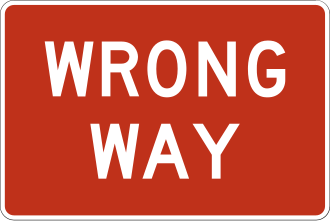
- Continue since it only marks a divided highway
- Yield to traffic entering from the right
- Recognize they have turned into oncoming traffic and pull over and turn around as quickly and safely as possible
- Slow down for a sharp curve ahead
Answer: C — Recognize they have turned into oncoming traffic and pull over and turn around as quickly and safely as possible
This sign means the driver has turned into oncoming traffic, so they must get off the traveled roadway and turn around as soon as safely possible.
25. What must a driver do on seeing this sign at a signal?
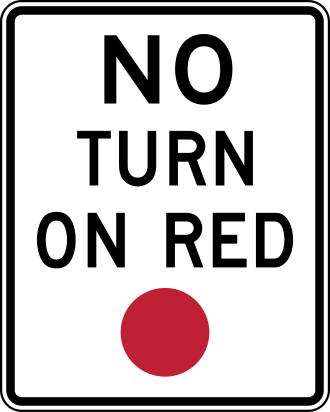
- Stop completely regardless of the signal
- Turn right if the way is clear
- Not turn on red and wait for a green light
- Yield only to pedestrians before turning
Answer: C — Not turn on red and wait for a green light
This sign forbids turning on red; the driver must wait for a green light.
26. What should a driver do on seeing this sign?
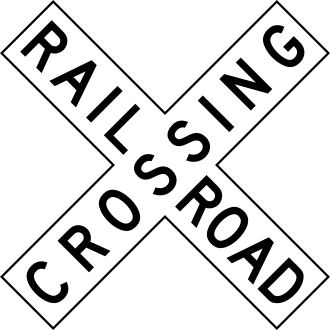
- Look, listen, slow down and be ready to stop for trains from either direction
- Only slow down if gates are visibly lowered
- Proceed normally since crossbucks mark abandoned tracks
- Speed up to clear the crossing before a train arrives
Answer: A — Look, listen, slow down and be ready to stop for trains from either direction
A railroad crossbuck warns of a railroad crossing; drivers must look, listen, slow down and be ready to stop for trains from either direction.
27. What must a driver do on approaching this intersection?
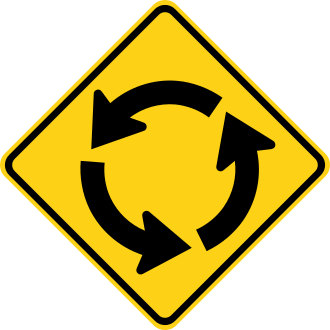
- Yield to traffic already in the circle and travel counterclockwise around it
- Turn only in the direction of an arrow board
- Proceed straight through without slowing
- Stop completely and wait for a gap in traffic
Answer: A — Yield to traffic already in the circle and travel counterclockwise around it
A circular intersection sign warns of a roundabout ahead, where drivers yield to traffic already in the circle and travel counterclockwise.
28. A driver in the right lane sees this sign ahead. What should they do?
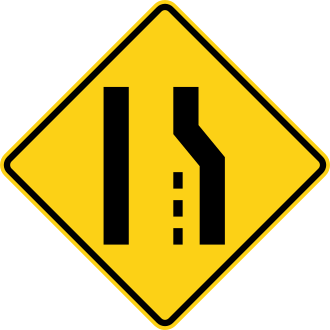
- Merge left as space opens, since the right lane is ending
- Stop and wait for oncoming traffic to clear
- Continue in the right lane since it does not affect them
- Speed up to pass vehicles in the left lane before it ends
Answer: A — Merge left as space opens, since the right lane is ending
This sign warns that the right lane ends, so right-lane drivers must merge left when space opens.
29. What should a driver expect and do on seeing this sign?
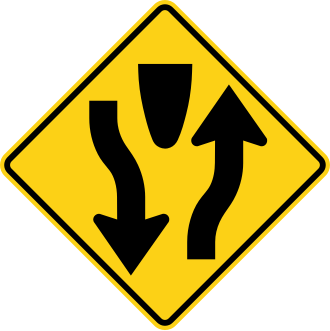
- A narrow bridge is ahead; slow down
- The median ends and two-way traffic resumes; keep right
- The highway will split into two one-way roadways; keep right
- An additional lane will join without needing to merge
Answer: C — The highway will split into two one-way roadways; keep right
This sign warns that the divided highway is beginning, splitting into two one-way roadways, so drivers should keep right.
30. What should a driver do on seeing this sign?
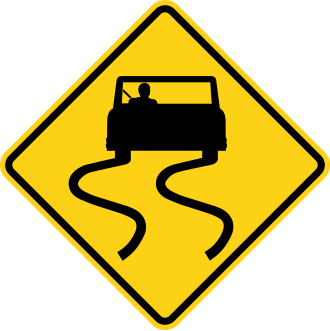
- Reduce speed and avoid hard braking or sudden turns on wet pavement
- Maintain normal speed since the warning only applies in winter
- Shift into a lower gear and accelerate through the area
- Brake hard immediately to test traction
Answer: A — Reduce speed and avoid hard braking or sudden turns on wet pavement
This sign warns of slippery pavement when wet, so drivers should reduce speed and avoid hard braking or sudden turns.
31. What should a driver do on seeing this sign?
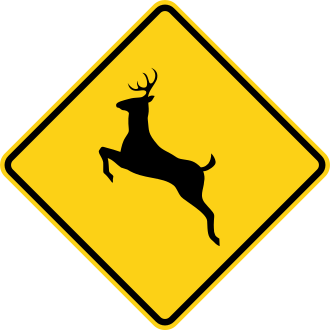
- Expect livestock being herded across the road by a farmer
- Slow down, be alert and be ready to stop for animals crossing
- Proceed at normal speed since it only applies at night
- Sound the horn continuously through the area
Answer: B — Slow down, be alert and be ready to stop for animals crossing
This sign warns of deer crossing, so drivers should slow down, stay alert, and be ready to stop.
32. What should a driver do on seeing this sign?
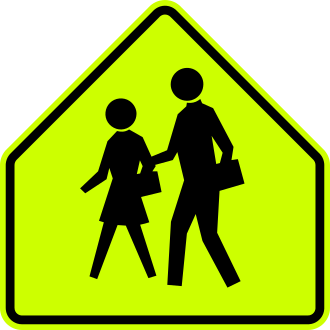
- Prepare for a roundabout ahead
- Expect a reduced speed limit only on weekends
- Watch for children and obey crossing guards in this school zone or crossing
- Expect a railroad crossing ahead
Answer: C — Watch for children and obey crossing guards in this school zone or crossing
The pentagon shape marks a school zone or crossing, requiring drivers to watch for children and obey crossing guards.
33. What does this sign indicate to a driver?
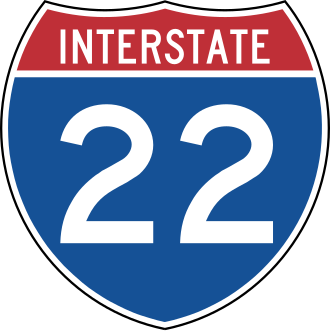
- A blue service sign for fuel
- An exit-only lane on the highway
- The shield of a U.S. highway route
- The shield of an interstate highway route
Answer: D — The shield of an interstate highway route
This marker is the shield identifying an interstate highway route.
Take this test interactively
More Iowa Driver License practice tests
- Iowa Driver License: Braking, Speed, Steering, Turning, Passing, Defensive Driving and Communicating — 30 questions
- Iowa Driver License: Intersections, Interstates, Roundabouts, Gravel Roads, Weather, Emergencies and Crashes — 30 questions
- Iowa Driver License: Maintenance, Driver Assistance, Belts, Distractions, Alcohol and Drowsiness — 29 questions
- Iowa Driver License: Right-of-Way, Emergency Vehicles, School Buses, Parking and Move Over — 30 questions