Missouri Driver License: Pavement Markings, Signs and Signals
30 questions with the correct answer and an explanation for each.
Topic: Pavement Markings, Signs and Signals. Free, no account needed.
Take this test interactively
1. You want to pass another vehicle on a two-lane road. What type of line on your side of the road tells you it's legal to cross into the opposing lane to pass?
- A broken line
- A solid white edge line
- A solid line
- Two solid yellow lines
Answer: A — A broken line
Broken lines may be crossed to pass, while solid lines should not be.
2. A traffic officer directs you to stop even though the light facing you is green. What should you do?
- Only obey if the officer is a police officer, not other highway personnel
- Proceed, since a green light overrides any officer
- Stop, obeying the officer over the signal
- Wait until the light turns red, then stop
Answer: C — Stop, obeying the officer over the signal
An officer's directions must be obeyed over any sign or signal.
3. You approach an intersection controlled by a flashing yellow light. What should you do?
- Slow down and proceed with caution
- Treat it exactly like a flashing red light
- Stop only if cross traffic is present
- Come to a complete stop and wait for green
Answer: A — Slow down and proceed with caution
A flashing yellow light means slow down and proceed with caution, unlike a flashing red which requires a stop.
4. You reach an intersection where the traffic signal is completely dark and not working. How should you treat it?
- As a flashing yellow light
- As having no special rule; proceed with normal caution
- As a yield sign in all directions
- As a four-way stop
Answer: D — As a four-way stop
A dark or non-working signal operates as a four-way stop.
5. The posted speed limit on a road is 55 mph, but heavy rain is reducing visibility and traction. What does the law require of you?
- Maintain the posted limit, since it is a legal maximum
- Slow down below the posted limit as conditions demand
- Increase your following distance but keep the posted speed
- Slow down only if a separate advisory sign is posted
Answer: B — Slow down below the posted limit as conditions demand
The speed limit is a maximum in ideal conditions, and drivers must by law slow down when conditions demand it.
6. Under normal conditions, you want to drive well under 40 mph on an interstate because you feel uncomfortable at higher speeds. What does the law say?
- It's allowed as long as you use hazard lights
- It's allowed only in the right-most lane
- It's allowed whenever traffic is light
- This isn't allowed; you should take another route instead
Answer: D — This isn't allowed; you should take another route instead
Interstates post a minimum speed of 40 mph under normal conditions, and a driver uncomfortable with that should use another route.
7. You approach a railroad crossing where the gate is lowering across your lane. What must you do?
- Proceed if you don't see a train
- Stop, and never drive around the lowered gate
- Only stop if the lights are flashing too
- Drive around it quickly before it fully closes
Answer: B — Stop, and never drive around the lowered gate
You must never drive around a lowered gate at a railroad crossing.
8. A driver is caught speeding in a work zone on a state road for the first time. What is the minimum fine?
- $250
- $500
- $100
- $300
Answer: A — $250
A first offense for speeding or passing in a work zone brings a fine of at least $250.
9. You are driving on a route marked with an odd number. What does that number indicate about the route's direction?
- It runs north-south
- It is a spur route into a city
- It loops around a city
- It runs east-west
Answer: A — It runs north-south
North-south routes carry odd numbers, while east-west routes carry even numbers.
10. Your vehicle breaks down on an interstate shoulder and you need to tell responders exactly where you are. What can nearby emergency reference markers tell you?
- The posted speed limit for that stretch of road
- Your direction and route number, since they stand every two-tenths of a mile
- The distance to the nearest hospital
- The nearest exit number only
Answer: B — Your direction and route number, since they stand every two-tenths of a mile
Emergency reference markers stand every two-tenths of a mile on interstate shoulders and give the direction and route number.
11. What must you do when you see this sign?
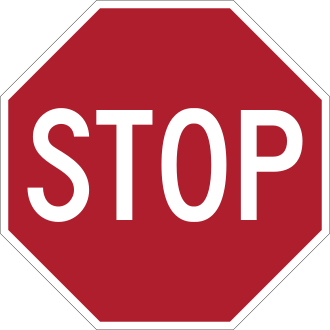
- Proceed with caution, no stop required
- Slow down and yield to crossing traffic without necessarily stopping
- Come to a full stop and wait until crossing vehicles and pedestrians have cleared
- Stop only if pedestrians are present
Answer: C — Come to a full stop and wait until crossing vehicles and pedestrians have cleared
This is the Stop sign, requiring a full stop and clearance of crossing traffic before proceeding.
12. What does this sign mean?
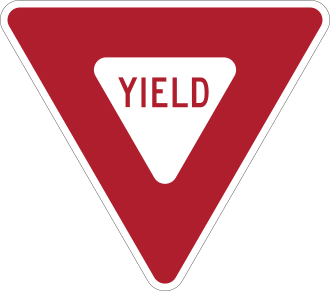
- Slow down and give the right-of-way to traffic already in the intersection or on the road you're entering
- You have the right-of-way over crossing traffic
- Come to a complete stop regardless of traffic
- A railroad crossing is ahead
Answer: A — Slow down and give the right-of-way to traffic already in the intersection or on the road you're entering
This is the Yield sign, requiring you to slow and give the right-of-way rather than come to a full stop.
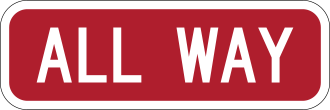
13. What does this sign mean, when posted with a stop sign?
- The intersection is a roundabout
- Traffic signals are ahead at this intersection
- Only cross traffic must stop
- All directions at the intersection have a stop sign; drivers arriving together yield to the driver on the right
Answer: D — All directions at the intersection have a stop sign; drivers arriving together yield to the driver on the right
This 4-Way plaque tells drivers every approach to the intersection stops, with arrivals at the same time yielding to the right.
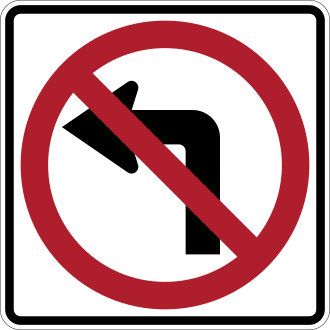
14. What must you do at this sign?
- Not enter the road at all
- Stop before proceeding in any direction
- Not turn left, including making a U-turn
- Not turn right
Answer: C — Not turn left, including making a U-turn
This is No Left Turn, which also prohibits U-turns since they count as two left turns.
15. What does this sign tell drivers about the center lane?
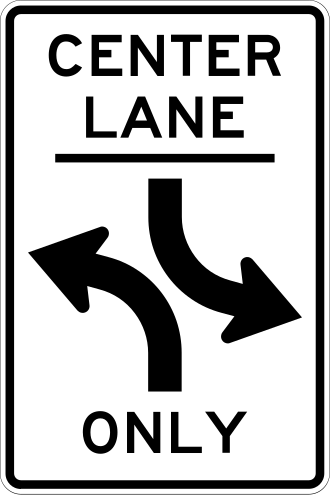
- It may be driven in as a through lane for any distance before turning left
- It may be used briefly by traffic from either direction to make a left turn
- It is for right turns only
- It is reserved exclusively for through traffic
Answer: B — It may be used briefly by traffic from either direction to make a left turn
This marks a shared center lane for left turns from both directions, not to be used for more than a short distance.
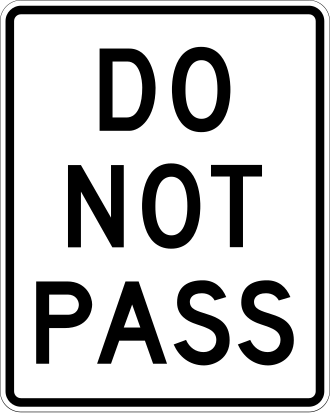
16. What must you do when you see this sign?
- Merge left because your lane ends
- Not pass other vehicles, even if the road looks clear
- Yield to oncoming traffic before turning
- Reduce speed for a curve ahead
Answer: B — Not pass other vehicles, even if the road looks clear
This marks the start of a no-passing zone; you may not pass even with a clear road.
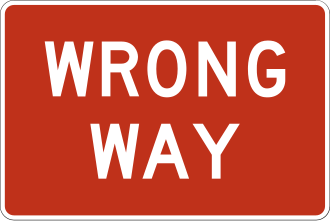
17. What does this sign mean?
- You are approaching a one-way exit safely
- A road closure is ahead
- You are driving against the flow of traffic and must pull over and turn around
- You must yield to oncoming traffic before proceeding
Answer: C — You are driving against the flow of traffic and must pull over and turn around
This Wrong Way sign means you have turned into oncoming traffic and must pull off, turn around and go back.
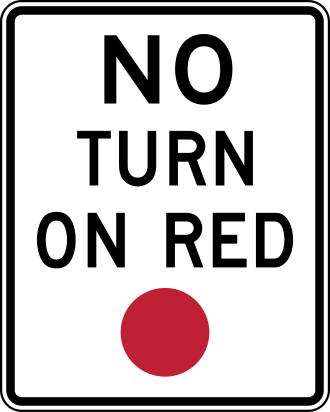
18. What must you do at this sign?
- Turn only during a flashing yellow arrow
- Wait for a green light before turning; do not turn on red
- Yield to pedestrians before turning right on red
- Stop, then turn right when the way is clear
Answer: B — Wait for a green light before turning; do not turn on red
No Turn on Red prohibits the turn-on-red that is otherwise allowed after a stop.
19. What does this sign mean?
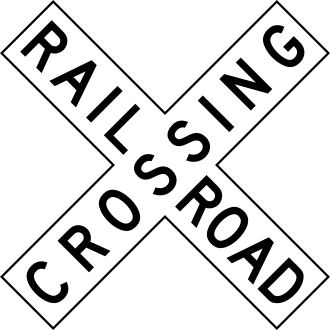
- A crossing is coming up ahead; slow down now
- A railroad crossing is here; treat it like a yield sign and watch for trains
- Multiple lanes are merging ahead
- A low bridge clearance is ahead
Answer: B — A railroad crossing is here; treat it like a yield sign and watch for trains
The crossbuck at the crossing itself means the same as a yield sign, unlike the round advance warning sign placed before the crossing.
20. What does this sign mean?
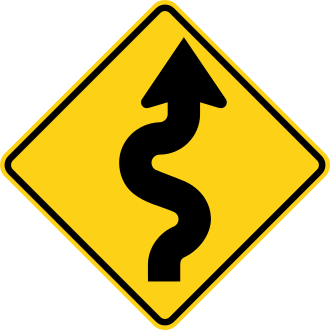
- A series of curves is ahead; slow down through all of them
- The road ends in a T intersection
- A single sharp curve is ahead
- A divided highway begins ahead
Answer: A — A series of curves is ahead; slow down through all of them
This Winding Road sign warns of multiple curves in sequence, not just one.
21. What must you do when you see this sign?
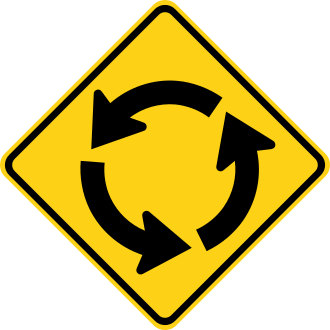
- Prepare for a side road entering from the right
- Prepare to stop at a four-way intersection
- Prepare for a divided highway to end
- Prepare for a roundabout ahead and yield to traffic already in the circle
Answer: D — Prepare for a roundabout ahead and yield to traffic already in the circle
This Circular Intersection sign warns of a roundabout, where you yield to traffic already in the circle.
22. What does this sign mean?
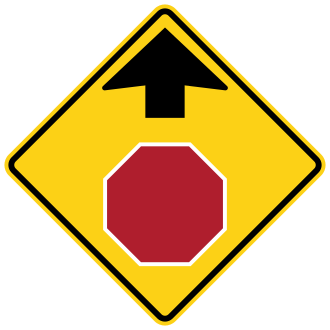
- A traffic signal is ahead
- You are approaching a school zone
- The road ends ahead
- A stop sign is coming up; slow down and be ready to stop
Answer: D — A stop sign is coming up; slow down and be ready to stop
Stop Ahead warns of a stop sign on your road ahead, distinct from Signal Ahead which warns of a traffic light.
23. You are driving in the right lane and see this sign. What must you do?
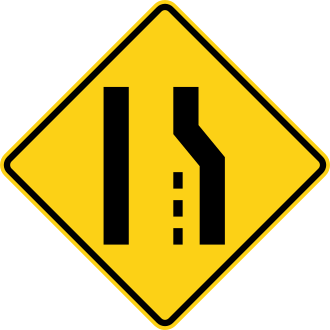
- Merge left because your lane is ending
- Stay in your lane; no action is needed
- Merge right because a new lane is starting
- Prepare to exit the highway
Answer: A — Merge left because your lane is ending
Lane Ends / Merge Left means two lanes become one and the right lane must merge left, yielding to the left lane.
24. What does this sign mean?
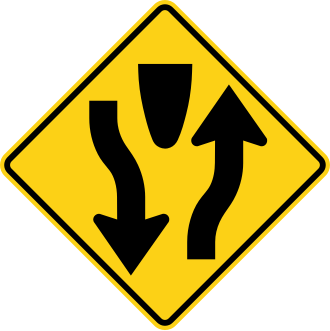
- The road ahead splits into two one-way roadways separated by a median
- A narrow bridge is ahead
- The median ahead ends and traffic will share the road again
- Two-way traffic is about to begin
Answer: A — The road ahead splits into two one-way roadways separated by a median
This marks where a median or barrier starts, dividing the roadway into separate one-way sides.
25. What does this sign warn of?
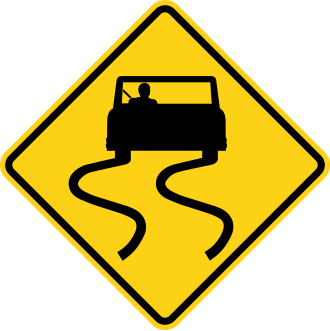
- A bridge that ices before the road does
- A steep downgrade requiring a lower gear
- The shoulder is soft and unsafe to drive on
- The pavement becomes unusually slick when wet; avoid hard braking or sudden turns
Answer: D — The pavement becomes unusually slick when wet; avoid hard braking or sudden turns
Slippery When Wet warns of a road that is unusually slick in rain, unlike Soft Shoulder which warns about the roadside.
26. What does this sign warn of?
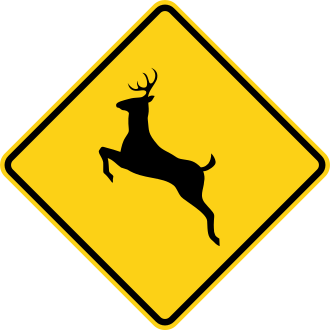
- Deer may cross the road here; slow down and watch closely
- A marked pedestrian crosswalk is ahead
- Livestock may be on the road ahead
- Bicyclists frequently cross here
Answer: A — Deer may cross the road here; slow down and watch closely
This sign specifically warns of deer crossing, distinct from bicycle or pedestrian crossing warnings.
27. What does this sign show?
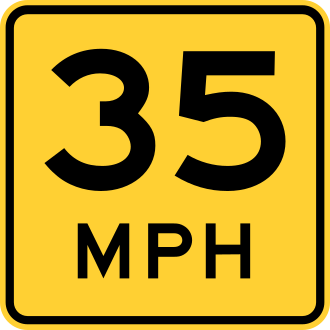
- The minimum speed allowed on that road
- The legal speed limit enforceable by law
- A speed limit that applies only to trucks
- The recommended safe speed for the curve or ramp it's paired with
Answer: D — The recommended safe speed for the curve or ramp it's paired with
The advisory plaque gives the maximum safe speed for the exit or curve, and that advised speed is for fair weather only.
28. What does this sign mean?
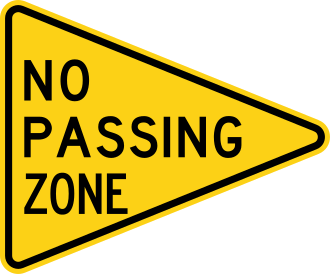
- A passing lane is available ahead
- You are entering a zone where passing is not allowed
- Trucks may not use this lane ahead
- The road is about to become one-way
Answer: B — You are entering a zone where passing is not allowed
The pennant-shaped No Passing Zone sign marks the start of a no-passing zone.
29. What must you do when you see this sign?
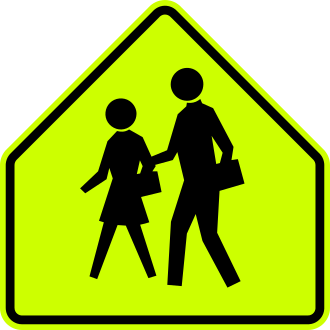
- Come to a complete stop at the sign before continuing
- Reduce speed only if flashing lights are active
- Prepare to stop at a railroad crossing
- Watch for children and be ready to obey crossing guards near a school
Answer: D — Watch for children and be ready to obey crossing guards near a school
The School sign marks a school zone or crossing, where drivers must watch for children and obey crossing guards.
30. What does this sign identify?
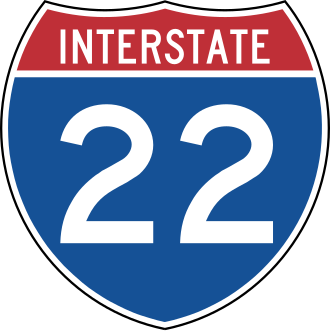
- A county road route
- A U.S. numbered route
- An interstate highway route
- A state highway route
Answer: C — An interstate highway route
This is the shield marking an interstate route, distinct from the U.S. Route shield.
Take this test interactively
More Missouri Driver License practice tests
- Missouri Driver License: Alcohol, Points, Insurance, Registration and Inspections — 30 questions
- Missouri Driver License: Belts, Child Seats, Defensive Driving, Distraction and Traffic Stops — 30 questions
- Missouri Driver License: Night, Weather, Skids, Emergencies and Crashes — 28 questions
- Missouri Driver License: Right-of-Way, Passing, Turns, Roundabouts and Parking — 30 questions
- Missouri Driver License: Sharing the Road and Highway Driving — 30 questions
- Missouri Driver License: Your License, the GDL and the Driver Examination — 38 questions