Wisconsin Driver License: Highway Signs
30 questions with the correct answer and an explanation for each.
Topic: Highway Signs. Free, no account needed.
Take this test interactively
1. A police officer at an intersection signals you to proceed even though the traffic light is red. What should you do?
- Stop and wait for the light to turn green
- Follow the officer's direction and proceed
- Wait for a crossing guard to confirm
- Sound your horn to alert the officer
Answer: B — Follow the officer's direction and proceed
Officers directing traffic must be obeyed even when their directions conflict with a signal or sign.
2. What must you do when you see this sign?
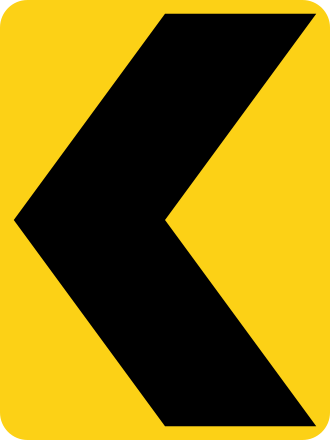
- Slow down for a series of curves ahead
- Slow down; the road bends sharply in the direction shown
- Watch for a side road entering from the right
- Prepare to merge because a lane is ending
Answer: B — Slow down; the road bends sharply in the direction shown
The chevron marks a sharp bend in the direction the arrow points.
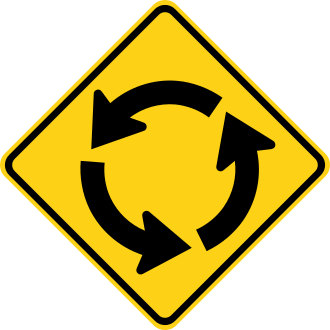
3. What does this sign warn you to do?
- Stop completely before entering the intersection
- Yield to traffic already in the circle and travel counterclockwise
- Bear right or left to stay on the road
- Watch for a side road entering ahead
Answer: B — Yield to traffic already in the circle and travel counterclockwise
This warns of a roundabout ahead where you must yield to circulating traffic and go counterclockwise.
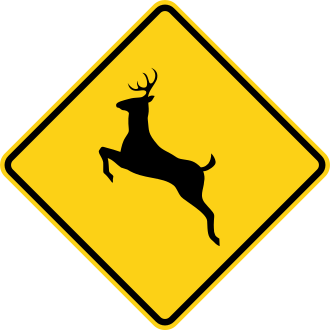
4. What does this sign mean?
- Livestock may be crossing the road ahead
- A wildlife refuge boundary is ahead
- Deer often cross here, so slow down and be ready to stop
- Bicycles cross or ride beside traffic here
Answer: C — Deer often cross here, so slow down and be ready to stop
This sign marks an area where deer often cross the road.
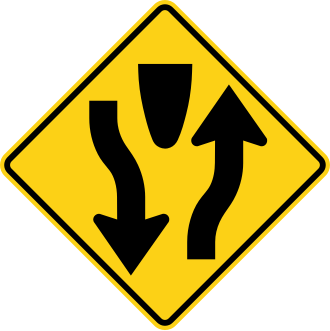
5. What does this sign tell you?
- A narrow bridge is ahead
- Two-way traffic is beginning; keep right
- The highway is about to split into two one-way roadways, so keep right
- The median is ending and traffic will move both ways
Answer: C — The highway is about to split into two one-way roadways, so keep right
This marks where a highway divides into separate one-way roadways.
6. A tractor displays an orange reflective triangle on its rear. What does this indicate about the vehicle?
- It travels at 25 mph or less
- It may only travel on the shoulder
- It is exempt from stopping at railroad crossings
- It has the right-of-way over all traffic
Answer: A — It travels at 25 mph or less
The orange reflective triangle marks a slow-moving vehicle, one that may travel 25 mph or less.
7. What must you do when you see this sign?
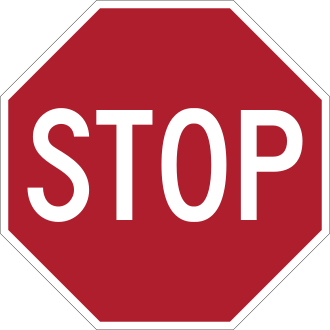
- Merge left before proceeding
- Slow down and yield if the way is clear
- Reduce speed for the curve ahead
- Stop completely and wait until your path is clear
Answer: D — Stop completely and wait until your path is clear
The octagonal stop sign requires a complete stop and waiting until the path is clear.
8. What must you do when you see this sign?
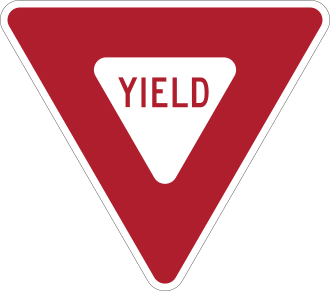
- Proceed at normal speed since you have priority
- Come to a complete stop regardless of traffic
- Merge into the lane on your left
- Slow down, be ready to stop, and let others pass first
Answer: D — Slow down, be ready to stop, and let others pass first
The yield triangle means give the right-of-way to other traffic, not necessarily a full stop.
9. This plaque appears below a stop sign at an intersection. What does it mean?
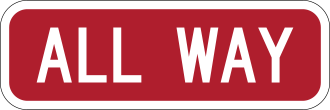
- Traffic on the road ahead does not stop
- Every approach to the intersection has a stop sign; drivers arriving together yield to the one on the right
- The intersection is controlled by a traffic signal
- Only cross traffic must stop
Answer: B — Every approach to the intersection has a stop sign; drivers arriving together yield to the one on the right
A 4-way plaque means every approach stops, and simultaneous arrivals yield to the driver on the right.
10. What does this sign prohibit?
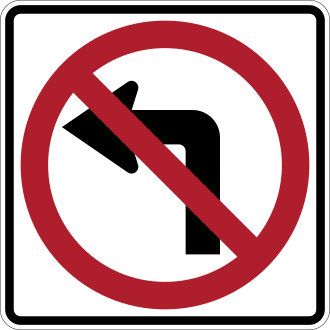
- Right turns only
- Parking along the curb
- Passing other vehicles
- Left turns and U-turns
Answer: D — Left turns and U-turns
This sign bans left turns, and U-turns are also prohibited since they count as two left turns.
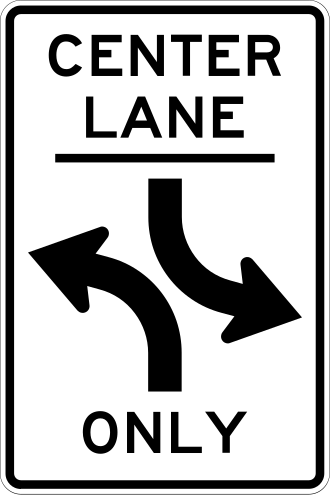
11. You are driving on a road with a center lane marked by this sign. When may you use that lane?
- To pass slower traffic
- As a through lane when traffic is heavy
- To merge onto the highway
- Only to turn left or make a U-turn from either direction, crossing the solid line just for that maneuver
Answer: D — Only to turn left or make a U-turn from either direction, crossing the solid line just for that maneuver
The center lane is reserved for left turns or U-turns from either direction, entered only for that maneuver.
12. What does this sign mean?
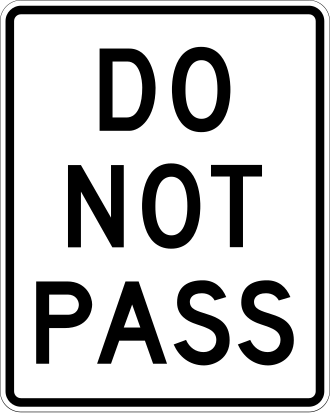
- A no-passing zone is beginning; do not pass even if the road looks clear
- Slower traffic must move to the right lane
- The right lane is ending ahead
- Passing is allowed only for the next mile
Answer: A — A no-passing zone is beginning; do not pass even if the road looks clear
This marks the start of a no-passing zone, where passing is prohibited regardless of visibility.
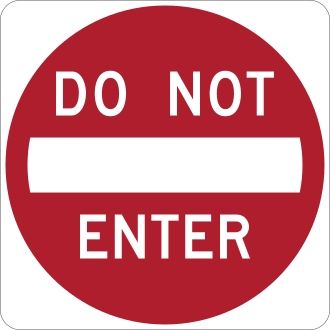
13. What does this sign tell you?
- The road ahead is closed for construction
- Trucks are not permitted beyond this point
- You are traveling the wrong way; find a safe place to turn around
- You cannot drive in this direction; find another route
Answer: D — You cannot drive in this direction; find another route
This sign is posted at wrong-way exit ramps and one-way streets to bar entry in that direction.
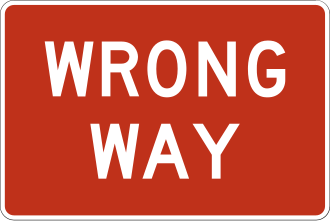
14. What should you do when you see this sign?
- Continue since it only applies to the opposite lane
- You are going the wrong way; slow down, pull over and turn around carefully
- Stop and wait for other traffic to pass
- Speed up to merge with oncoming traffic
Answer: B — You are going the wrong way; slow down, pull over and turn around carefully
This sign warns that you are driving against the correct flow and must safely turn around.
15. What does this sign indicate about the road ahead?
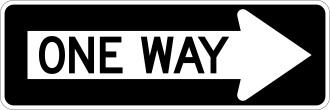
- You must turn in the direction shown at the next intersection
- Traffic flows only in the direction the arrow points
- Two-way traffic is permitted
- The road is closed to all vehicles
Answer: B — Traffic flows only in the direction the arrow points
This sign marks a one-way street, with traffic moving only in the arrow's direction.
16. You are stopped at a red light beneath this sign. What must you do?
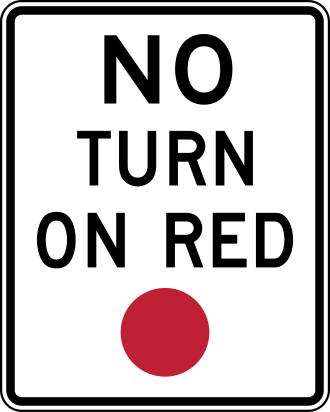
- Turn left after yielding to oncoming traffic
- Proceed straight through if no cross traffic is present
- Wait for the green light; you may not turn on red
- Turn right after stopping if the way is clear
Answer: C — Wait for the green light; you may not turn on red
This sign specifically bans turning on red, so you must wait for a green signal.
17. You are in the middle lane of a three-lane road where the left lane may go left or straight, the middle lane goes straight, and the right lane turns right. What movement is permitted from your lane?
- Turn right only
- Turn left or right
- Turn left
- Go straight only
Answer: D — Go straight only
In this lane-use example, the middle lane is marked for going straight only.
18. You are driving past a school posted “School Speed Limit 15 When Children Are Present” and children are visible on the sidewalk. What speed limit applies?
- 15 mph, because children are present
- There is no special limit unless a crossing guard is present
- The construction-zone speed limit
- The regular posted speed limit, since the children are not in the crosswalk
Answer: A — 15 mph, because children are present
This sign caps your speed at 15 mph whenever children are visible.
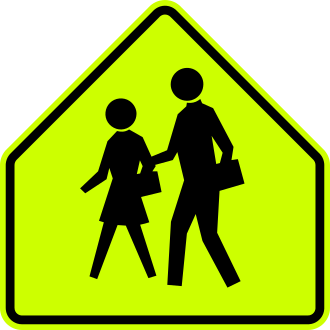
19. What does this sign mean?
- A hospital zone is ahead
- A playground is ahead with no crossing
- A school zone or crossing is ahead; watch for children and obey crossing guards
- A pedestrian crosswalk with no children present
Answer: C — A school zone or crossing is ahead; watch for children and obey crossing guards
The pentagon shape marks a school zone or crossing where children may be present.
20. While driving through a construction zone, you want to use your cell phone. When is this allowed?
- Cell phone use is never allowed in construction zones
- Only if traffic is stopped
- Only to report an emergency
- Anytime, as long as you use hands-free mode
Answer: C — Only to report an emergency
Cell phone use in a construction zone is limited to reporting an emergency.
21. What is described as a leading cause of crashes in work zones?
- Excessive speed on entry ramps
- Failure to use turn signals
- Driving with low tire pressure
- Tailgating
Answer: D — Tailgating
Following too closely is identified as a leading cause of work-zone crashes.
22. You see a sign giving directions and distance to a city, reached by taking an interstate route. What colors would this destination sign have?
- Green or brown with white lettering
- Blue with white symbols
- White with black numbers
- Orange with black lettering
Answer: A — Green or brown with white lettering
Destination signs giving directions to cities are green or brown with white lettering.
23. You need to find the next hospital or campground along the highway. What colors should you look for on the sign?
- Blue with white symbols
- Orange with black lettering
- Yellow with black symbols
- Green or brown with white lettering
Answer: A — Blue with white symbols
Service signs for things like camping or hospitals are blue with white symbols.
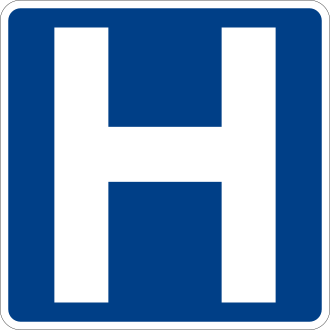
24. What does this sign indicate?
- A gas station is nearby
- A hospital is nearby
- A campground is ahead
- A rest area is ahead
Answer: B — A hospital is nearby
This blue service sign indicates a nearby hospital.
25. Your vehicle breaks down on the highway and you need to tell emergency responders your exact location. What would a nearby mile marker tell you?
- The distance to the next town only
- The direction of travel, route number and mile
- The speed limit for that stretch of road
- The name of the county you are in
Answer: B — The direction of travel, route number and mile
Mile markers show the direction of travel, route number, and mile to help emergency response find you.
26. You see a road sign shaped like a milk jug with a spout at the bottom, white with black numbers. What kind of route is this?
- A Wisconsin state road
- A county road
- A U.S. route
- An Interstate highway
Answer: A — A Wisconsin state road
The milk-jug shape with a spout identifies a Wisconsin state road marker.
27. What does this shield indicate?
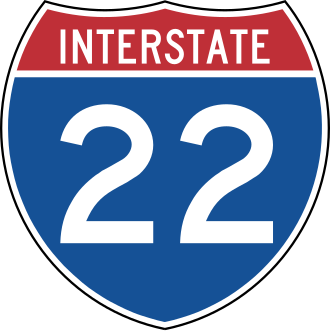
- A U.S. route
- An interstate highway
- A state road
- A county road
Answer: B — An interstate highway
The red-on-top, blue-below shield with white numbers marks an interstate highway.
28. You are crossing railroad tracks and traffic ahead is backed up with no room for your vehicle on the other side. What should you do?
- Cross quickly since no train is visible
- Shift into a lower gear while crossing to speed up
- Cross anyway and wait on the tracks if needed
- Do not cross until there is room on the other side
Answer: D — Do not cross until there is room on the other side
You should never cross unless there is room to fully clear the tracks on the other side.
29. What must you do when you see this sign?
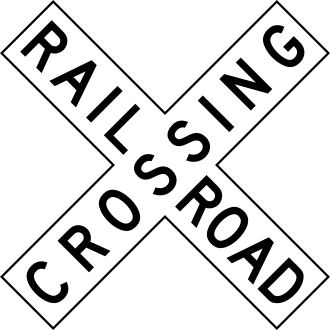
- Stop only if the crossing has flashing lights
- Yield only if a train is visible
- Proceed if no gate is present
- Look, listen, slow down and be ready to stop for trains from either direction
Answer: D — Look, listen, slow down and be ready to stop for trains from either direction
The crossbuck marks the crossing itself and requires looking, listening, and being ready to stop for trains from either direction.
30. Your vehicle stalls on the tracks at a railroad crossing. What at the crossing tells you how to report it?
- A blue sign with a phone number for reporting the problem
- An orange sign giving the distance to the next work zone
- A green sign naming the crossing road
- A brown sign with mileage to the nearest town
Answer: A — A blue sign with a phone number for reporting the problem
Every crossing has a blue sign with a phone number for reporting a stuck vehicle or malfunctioning warning device.
Take this test interactively
More Wisconsin Driver License practice tests
- Wisconsin Driver License: Alcohol, Distraction, Drowsiness and Sharing the Road — 26 questions
- Wisconsin Driver License: Right-of-Way, Speed, Turning, Passing, Parking and Signaling — 30 questions
- Wisconsin Driver License: Signals, Markings, Special Lanes, Roundabouts and Ramps — 28 questions
- Wisconsin Driver License: Tests, Permits, the Probationary License, Points and Insurance — 30 questions
- Wisconsin Driver License: Weather, Rural Roads, Avoiding Crashes and Emergencies — 26 questions