Colorado Driver License: Traffic Signs
30 questions with the correct answer and an explanation for each.
Topic: Traffic Signs. Free, no account needed.
Take this test interactively
1. A driver is on a highway posted at 55 mph, but heavy rain and poor visibility make that speed unsafe. What should the driver do?
- Speed up to leave the area of poor visibility quickly
- Maintain the posted speed since it is the maximum legal limit
- Slow to a speed appropriate for the conditions
- Drive at 55 mph only while in the right lane
Answer: C — Slow to a speed appropriate for the conditions
Posted maximum speeds assume ideal conditions, so a driver must reduce speed when weather or visibility make the posted limit unsafe.
2. A driver approaches a stop sign, but there is no stop line and no crosswalk. Where must they stop?
- At least one full car length before the sign itself
- Anywhere before entering the intersection
- Only after their front bumper enters the intersection
- At the point nearest the cross street where they can see approaching traffic
Answer: D — At the point nearest the cross street where they can see approaching traffic
Without a marked stop line or crosswalk, the driver must stop at the point nearest the cross street that allows a clear view of approaching traffic.
3. Traffic ahead means a driver stopped at a railroad crossing would not have room to fully clear the tracks if they proceeded. What should they do?
- Cross quickly since a stopped train cannot reach the crossing in time
- Cross partway and wait for room to open on the far side
- Shift into a lower gear while crossing for extra control
- Not start across until there is room for the whole vehicle beyond the tracks
Answer: D — Not start across until there is room for the whole vehicle beyond the tracks
A driver must never start across railroad tracks without enough room on the far side for the entire vehicle.
4. Which of these is an example of something a sign might legally prohibit a driver from doing at an intersection?
- Merging into the right-hand lane
- Making a U-turn
- Slowing down when conditions make the posted speed unsafe
- Reducing speed in a school zone
Answer: B — Making a U-turn
Signs prohibiting specific maneuvers, such as U-turns or left turns, tell drivers what they may not do at that location.
5. A yellow plaque mounted below a curve warning sign shows a number such as 35 mph. What does that number represent?
- The speed enforced by radar at that exact spot
- The safe speed for that curve under ideal conditions
- The legal minimum speed allowed on that road
- The maximum speed allowed for trucks only
Answer: B — The safe speed for that curve under ideal conditions
Advisory speed signs and plaques state the safe speed for a curve, corner, or off-ramp under ideal conditions, not a legal minimum or enforced limit.
6. What color are the signs marking a shared-use path crossing where both bicyclists and pedestrians may be in the road?
- Blue with white symbols
- Yellow with black symbols
- Brown with white symbols
- Orange with black symbols
Answer: B — Yellow with black symbols
Bicycle and pedestrian crossing signs are yellow with black symbols, distinct from orange work-zone signs or blue service signs.
7. A driver wants to report a problem using the phone number posted on a sign at a highway-rail crossing. What does the number printed directly below that phone number provide?
- Directions to the nearest hospital
- The maximum speed trains may travel through that crossing
- A Department of Transportation number that identifies that exact crossing
- The distance to the next railroad crossing
Answer: C — A Department of Transportation number that identifies that exact crossing
The blue emergency notification sign gives a phone number plus, directly below it, a Department of Transportation number that pinpoints that specific crossing.
8. A driver approaches an area marked by orange signs, cones, and a flagger directing traffic around road construction. What should the driver do?
- Treat the orange signs as optional suggestions and keep normal speed
- Follow the flagger and posted signs to move safely through the area
- Obey the posted signs but pass the flagger without slowing when no workers are visible
- Ignore the flagger since only traffic signals are legally binding
Answer: B — Follow the flagger and posted signs to move safely through the area
Work zone signs work together with other devices and flaggers to guide traffic safely and protect workers, so drivers must follow their direction.
9. What does the shape of a route marker tell a driver?
- Whether the route is currently under construction
- The speed limit for that route
- The distance remaining to the next town
- The type of road, such as Interstate, US, state, or county highway
Answer: D — The type of road, such as Interstate, US, state, or county highway
Route markers use distinct shapes to identify the type of highway, such as Interstate, US, state, or county roads.
10. A driver wants to pass a bicyclist on a rural road with no posted signage about bicycle passing distance. How much clearance must the driver leave?
- At least six feet, but only on roads posted above 45 mph
- At least three feet, whether or not a sign is posted
- Enough space to avoid contact, with no specific legal minimum
- At least one foot, since no sign is posted
Answer: B — At least three feet, whether or not a sign is posted
Drivers must leave three feet of clearance when passing a bicyclist on every road, regardless of whether a sign is posted.
11. A bicyclist rides in the center of a narrow travel lane instead of staying close to the right edge. Under what condition is this allowed?
- Never; bicyclists must always ride as far right as possible
- Only on roads that already have a marked bike lane
- Only during daylight hours
- When hazards or poor visibility make the right side of the lane unsafe
Answer: D — When hazards or poor visibility make the right side of the lane unsafe
A bicyclist may use the full lane when hazards or poor visibility make riding on the right side of the lane unsafe.
12. A driver without a disabled parking placard or plate parks in a space reserved for disabled parking. What penalty applies?
- Automatic one-year license suspension with no fine
- A warning only, with no penalty for a first offense
- A misdemeanor with a fine between $350 and $5,000, possible jail, loss of driving privileges, and impoundment
- A flat $100 fine with no other consequences
Answer: C — A misdemeanor with a fine between $350 and $5,000, possible jail, loss of driving privileges, and impoundment
Parking in a disabled space without a placard or plate is a misdemeanor carrying a $350 to $5,000 fine plus possible jail, loss of driving privileges, and impoundment.
13. What must a driver do on seeing this sign?
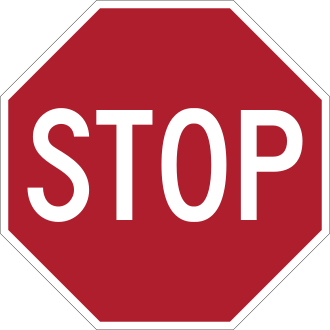
- Come to a complete stop and check for vehicles and pedestrians before proceeding
- Slow down and yield to crossing traffic without necessarily stopping
- Slow to the posted advisory speed and proceed
- Stop only if another vehicle is already at the intersection
Answer: A — Come to a complete stop and check for vehicles and pedestrians before proceeding
This sign requires a complete stop, at the marked line, before the crosswalk, or where the driver can see approaching traffic.
14. What does this sign mean?
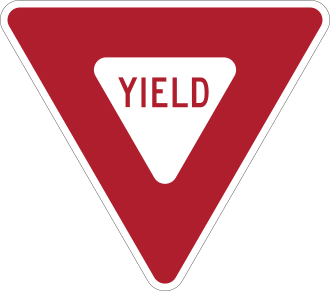
- Come to a complete stop regardless of traffic
- Merge into the lane to the right
- Slow down or stop to let crossing vehicles, pedestrians, and bicyclists go first
- Watch for a railroad crossing ahead
Answer: C — Slow down or stop to let crossing vehicles, pedestrians, and bicyclists go first
This sign means to slow down or stop and give the right-of-way to vehicles, pedestrians, and bicyclists that have it.
15. What must a driver do when they see this sign?
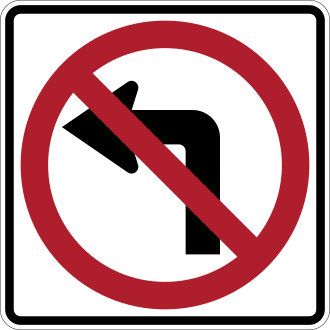
- Stop completely before proceeding straight
- Not turn left or make a U-turn here
- Merge left into the next lane
- Avoid turning right at this intersection
Answer: B — Not turn left or make a U-turn here
This sign prohibits left turns, and a U-turn counts as two left turns, so it is also prohibited.
16. What is the lane marked with this sign used for?
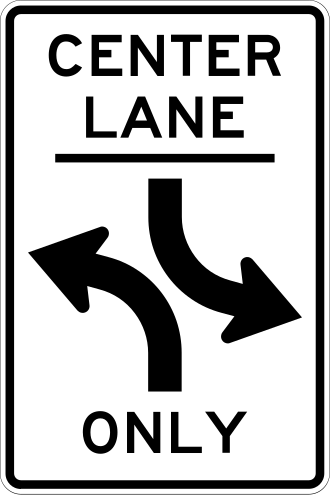
- Right turns only
- Through travel in either direction
- Left turns from traffic moving in either direction, never for through travel or passing
- Passing slower vehicles
Answer: C — Left turns from traffic moving in either direction, never for through travel or passing
The center lane marked this way is only for left turns from either direction and should never be used to pass or travel through.
17. What does this sign mean?
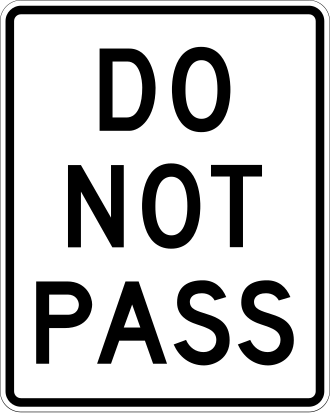
- A no-passing zone begins, so passing is not allowed even if the road looks clear
- A passing lane is ending ahead
- The road narrows ahead, making passing risky but not illegal
- Slower traffic must move to the right lane
Answer: A — A no-passing zone begins, so passing is not allowed even if the road looks clear
This sign marks the start of a no-passing zone, where passing is prohibited even with a clear road ahead.
18. What does this sign mean?
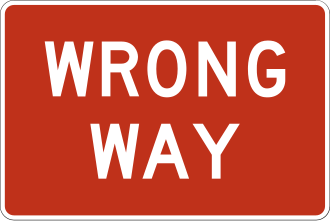
- The driver is going the wrong way and should slow, pull over, and turn around carefully
- A one-way street begins just ahead
- The driver may not enter this road under any circumstance
- Trucks are prohibited from using this road
Answer: A — The driver is going the wrong way and should slow, pull over, and turn around carefully
This sign warns a driver they are traveling against the flow of traffic and should slow down, pull over, and turn around carefully.
19. What does this sign mean?
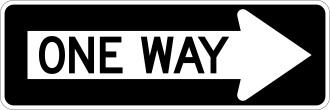
- Traffic flows only in the direction the arrow points
- All traffic must exit at the next ramp
- The road becomes two-way just ahead
- Two directions of traffic merge into a single lane
Answer: A — Traffic flows only in the direction the arrow points
This sign permits travel only in the direction the arrow shows.
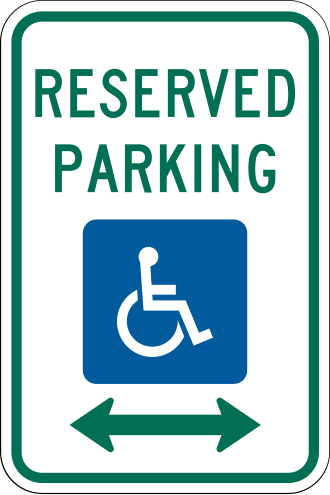
20. What does this sign indicate?
- Parking here is prohibited entirely
- Parking is reserved for drivers displaying a disabled parking permit
- Only emergency vehicles may park in this space
- Parking is limited to loading and unloading
Answer: B — Parking is reserved for drivers displaying a disabled parking permit
This sign reserves the parking space for vehicles displaying a disabled parking permit.
21. What must a driver do when they see this sign?
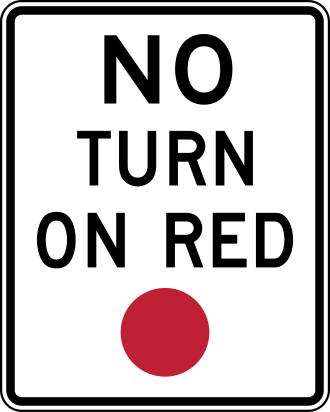
- Treat it as prohibiting left turns only
- Wait for a green light before turning
- Stop, then proceed with any turn once clear
- Turn right on red after coming to a complete stop
Answer: B — Wait for a green light before turning
This sign forbids turning on a red light, so the driver must wait for green.
22. What must a driver do when they see this sign?
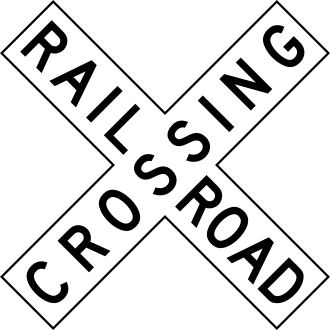
- Look for an emergency notification phone at this exact spot
- Note that the crossing is a mile ahead and no action is needed yet
- Expect a flagger directing traffic through a work zone
- Look, listen, slow down, and be ready to stop for a train from either direction
Answer: D — Look, listen, slow down, and be ready to stop for a train from either direction
This sign marks a railroad crossing itself, requiring the driver to look, listen, slow down, and be ready to stop for a train from either direction.
23. What does this sign mean?
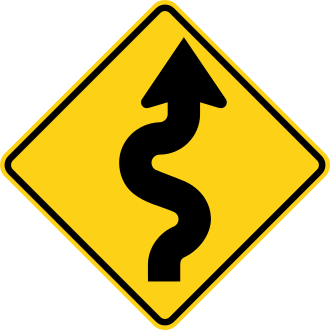
- A single sharp curve lies just ahead
- The road ends and the driver must turn
- A series of curves is ahead, and the driver should slow down through all of them
- A divided highway begins ahead
Answer: C — A series of curves is ahead, and the driver should slow down through all of them
This sign warns of a series of curves ahead, and the driver should slow down for all of them, not just the first.
24. What must a driver do when they see this sign?
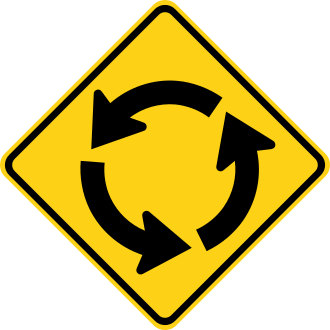
- Choose a direction at an upcoming Y intersection
- Yield to traffic already in the circle ahead and travel counterclockwise
- Prepare to merge as two lanes become one
- Prepare for a four-way stop ahead
Answer: B — Yield to traffic already in the circle ahead and travel counterclockwise
This sign warns of a roundabout ahead, where the driver must yield to traffic already circulating and travel counterclockwise.
25. What must a driver do when they see this sign?
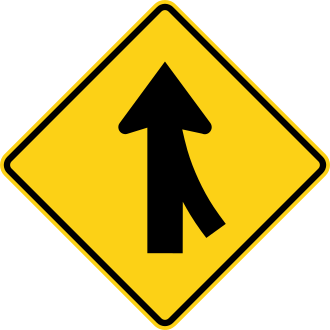
- Continue normally, since an added lane is joining and no merge is needed
- Recognize a lane is ending and only right-lane drivers must merge
- Keep right because a divided highway begins ahead
- Merge safely as two lanes become one, since drivers in both lanes are responsible for merging
Answer: D — Merge safely as two lanes become one, since drivers in both lanes are responsible for merging
This sign warns that two lanes are merging into one, and drivers in both lanes are responsible for merging safely.
26. What must a driver do when they see this sign?
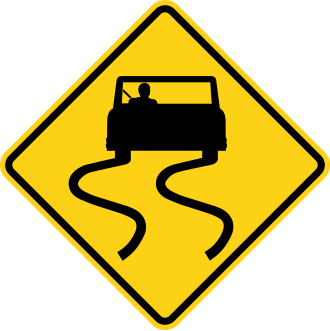
- Check the brakes before a steep downgrade
- Reduce speed on wet pavement and avoid hard braking or sudden turns
- Watch for a drop-off between the pavement and the shoulder
- Stay on the pavement because the shoulder is soft
Answer: B — Reduce speed on wet pavement and avoid hard braking or sudden turns
This sign warns that the road can be slippery when wet, so the driver should reduce speed and avoid hard braking or sudden turns.
27. What must a driver do when they see this sign?
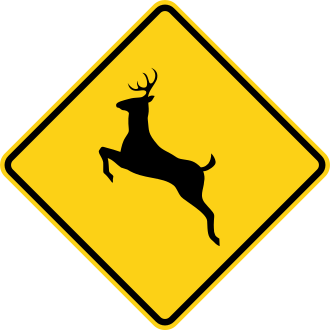
- Expect the entrance to a wildlife refuge ahead
- Slow down, stay alert, and be ready to stop for deer crossing the road
- Watch for bicycles crossing or riding beside traffic
- Watch for livestock that may be crossing the road
Answer: B — Slow down, stay alert, and be ready to stop for deer crossing the road
This sign warns that deer cross in the area, so the driver should slow down, stay alert, and be ready to stop.
28. What must a driver do when they see this sign?
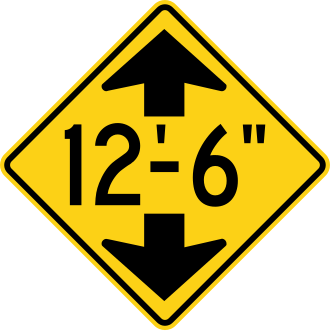
- Check for a posted weight limit ahead
- Slow down because a narrow bridge is ahead
- Turn on headlights because a tunnel is ahead
- Not proceed if the vehicle is taller than the height shown
Answer: D — Not proceed if the vehicle is taller than the height shown
This sign warns of limited overhead clearance, and a vehicle taller than the posted height must not proceed.
29. What must a driver do when they see this sign?
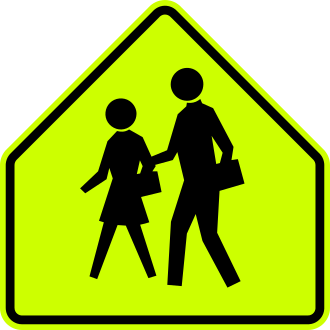
- Treat it as an ordinary pedestrian crossing unrelated to a school
- Expect a hospital facility nearby
- Assume the school-zone speed limit is always in effect
- Watch for children and obey crossing guards near a school zone or crossing
Answer: D — Watch for children and obey crossing guards near a school zone or crossing
This sign marks a school zone or crossing, where drivers should watch for children and obey any crossing guards.
30. What does this sign identify?
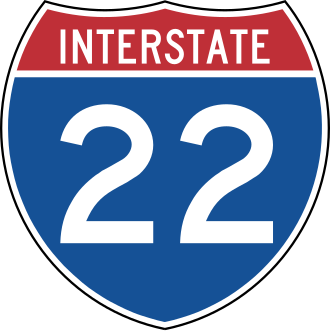
- A state highway
- A U.S. route
- A route restricted to trucks
- An Interstate highway
Answer: D — An Interstate highway
This shield identifies an Interstate highway, distinct from the shields used for U.S. or state routes.
Take this test interactively
More Colorado Driver License practice tests
- Colorado Driver License: Aggressive Driving, Emergencies, Crashes and the Move Over Law — 28 questions
- Colorado Driver License: Before You Drive, Signals, Markings and Lane Controls — 30 questions
- Colorado Driver License: Licenses, Minor Drivers, Seat Belts and Impaired Driving — 30 questions
- Colorado Driver License: Night, Weather, Mountains, Work Zones and Safe Driving — 30 questions
- Colorado Driver License: Right-of-Way, Speed, Turning, Parking, Freeways and Passing — 30 questions
- Colorado Driver License: Sharing the Road, Railroads, Bicyclists and Pedestrians — 30 questions