South Carolina Driver License: Right-of-Way, Signals, Signs and Markings
30 questions with the correct answer and an explanation for each.
Topic: Right-of-Way, Signals, Signs and Markings. Free, no account needed.
Take this test interactively
1. Two drivers reach an intersection without stop signs at different moments, one just ahead of the other. Who has the right-of-way?
- The driver who arrives at or reaches the intersection first
- Neither driver; both must stop and wave the other through
- The driver on the wider or busier road
- The driver on the right
Answer: A — The driver who arrives at or reaches the intersection first
The first-car rule gives right-of-way to whoever is at or reaches the intersection before the other driver.
2. You and another driver reach a four-way stop at the same instant, and the other car is to your right. What should you do?
- Yield only if you are turning left
- Proceed since you arrived at the same time
- Yield to the driver on your left
- Yield to the driver on your right
Answer: D — Yield to the driver on your right
The same-time rule requires yielding to the driver on your right when both vehicles reach a four-way stop together.
3. A driver pulls out of a private driveway onto a public road that has no stop sign at that point. Who has the right-of-way?
- Whichever driver reaches the edge of the road first
- The driver leaving the driveway, since driveways take priority
- Traffic already on the public road
- Neither; whoever signals first may go
Answer: C — Traffic already on the public road
Drivers entering a public highway from a driveway or private road must yield to traffic already on that highway.
4. A driver merges onto an interstate from an acceleration ramp. Who must yield?
- Interstate traffic must slow for the merging driver
- Whoever is in the left lane has priority
- The merging driver has the right-of-way once signaling
- The merging driver yields to traffic already on the interstate
Answer: D — The merging driver yields to traffic already on the interstate
Drivers entering from an entrance or acceleration ramp must yield to traffic already on the limited-access or interstate highway.
5. A traffic light turns yellow just as a driver is already inside the intersection. What should the driver do?
- Reverse back out of the intersection
- Stop immediately, even in the middle of the intersection
- Speed up to beat the red light
- Clear the intersection quickly since already in it
Answer: D — Clear the intersection quickly since already in it
A driver already in the intersection when the light turns yellow should clear it quickly rather than stopping in place.
6. A traffic signal is flashing red at an intersection. How should a driver treat it?
- Like a yield sign, slowing without stopping
- Stop only if cross traffic is visible
- Proceed with caution if the way looks clear
- Exactly like a stop sign, stopping and yielding before proceeding
Answer: D — Exactly like a stop sign, stopping and yielding before proceeding
A flashing red signal must be treated exactly as a stop sign, requiring a stop and yield before proceeding.
7. Before turning right at a red light where it is permitted, what must a driver do?
- Come to a full stop before the crosswalk and yield to pedestrians and traffic
- Slow down but not stop if the road looks clear
- Sound the horn to alert pedestrians, then turn
- Wait for a green arrow before turning
Answer: A — Come to a full stop before the crosswalk and yield to pedestrians and traffic
A right turn on red requires stopping before the crosswalk on the near side and yielding to pedestrians and other traffic.
8. A plaque below a railroad crossing sign shows there is more than one track. What should a driver do after the first train passes?
- Check for a second train on another track before crossing
- Proceed immediately since the crossing is now clear
- Wait only if the plaque shows three or more tracks
- Follow the vehicle ahead across the tracks
Answer: A — Check for a second train on another track before crossing
Multi-track crossings require checking for a second train, since one train passing does not mean the crossing is clear.
9. A driver's vehicle stalls on railroad tracks. What should the driver do?
- Try alone to push the vehicle off the tracks before calling anyone
- Call the emergency number posted on the blue sign and report the location
- Call the county's non-emergency police line
- Call 911 and describe the nearest cross street instead
Answer: B — Call the emergency number posted on the blue sign and report the location
A vehicle stuck on the tracks should be reported using the emergency number on the blue sign, giving the crossing information.
10. A person is holding a sign or flag and directing traffic through a work zone. What must a driver do?
- Follow their directions, since they must be obeyed
- Follow posted signs instead if they conflict with the flagger
- Proceed at normal speed since flaggers are advisory only
- Only follow the flagger if a police officer is also present
Answer: A — Follow their directions, since they must be obeyed
A flagger's directions to slow, stop or change direction must be obeyed.
11. A two-way road has a double solid yellow center line. What does it mean for passing?
- Passing is allowed only from the right lane
- Passing is allowed only when there is no oncoming traffic
- Passing is allowed only for the direction with a broken line
- Passing is prohibited in both directions
Answer: D — Passing is prohibited in both directions
A double solid yellow line prohibits passing for traffic moving in either direction.
12. A road marker begins with the letter S, followed by a county number and a road number. What does this indicate?
- A local road in that county's own set of secondary roads
- A state-numbered scenic route
- A shortcut route meant for through-traffic bypassing towns
- An emergency evacuation route
Answer: A — A local road in that county's own set of secondary roads
A secondary system road marker starting with S, then a county number, then a road number identifies a county's own local secondary road.
13. What must a driver do at this sign?
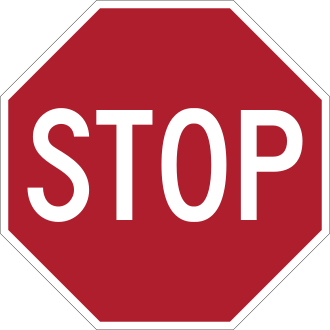
- Slow down and yield only if traffic is present
- Stop only if other vehicles are approaching
- Merge carefully without stopping
- Stop completely and wait for a safe gap in traffic and pedestrians before proceeding
Answer: D — Stop completely and wait for a safe gap in traffic and pedestrians before proceeding
The octagonal sign requires a complete stop and waiting for vehicles and pedestrians to clear before going.
14. What does this sign require of a driver?
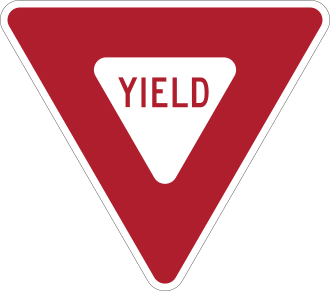
- Merge left immediately
- Slow down, be ready to stop, and let other traffic pass before entering
- Proceed only if turning right
- Come to a complete stop every time
Answer: B — Slow down, be ready to stop, and let other traffic pass before entering
The downward triangle requires slowing and yielding to vehicles, pedestrians and bicyclists before entering.
15. What does this plaque tell drivers?
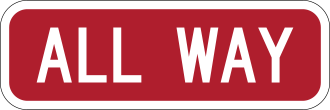
- Only vehicles on the main road must stop
- All approaches to the intersection have stop signs
- The intersection has a signal instead of stop signs
- Four lanes merge ahead
Answer: B — All approaches to the intersection have stop signs
The plaque marks a four-way stop, where every approach stops and drivers arriving together yield to the right.
16. What does this sign indicate?
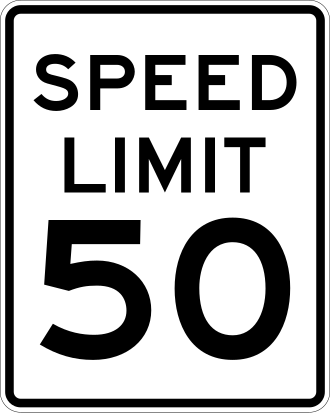
- The minimum speed required on this road
- The maximum legal speed under ideal conditions
- The speed limit for trucks only
- A recommended speed only, not enforceable
Answer: B — The maximum legal speed under ideal conditions
The sign gives the maximum legal speed in good conditions, though driving too fast for actual conditions can still be ticketed.
17. What is prohibited at this sign?
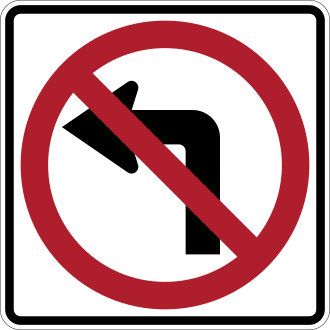
- Left turns and U-turns
- Right turns only
- Passing other vehicles
- Left turns only, since U-turns remain legal
Answer: A — Left turns and U-turns
This sign prohibits left turns, and U-turns are also illegal since they count as two left turns.
18. What is the lane marked by this sign used for?
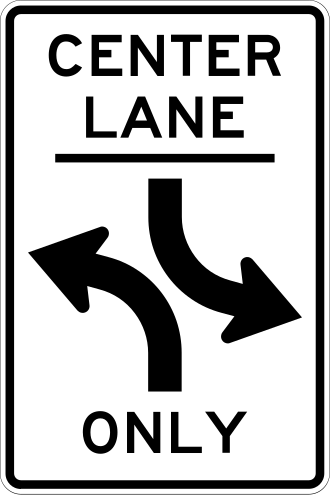
- A dedicated bus and bicycle lane
- Left turns from either direction of travel
- Passing slower vehicles
- Through traffic in both directions
Answer: B — Left turns from either direction of travel
The center lane marked this way is reserved for left turns from either direction, never through traffic or passing.
19. What does this sign mean?
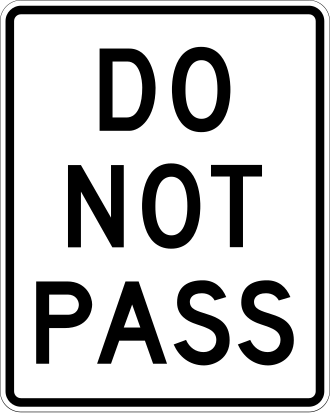
- A no-passing zone begins here, even if the road looks clear
- A merge is ahead, no lane change needed
- Passing is allowed only on the left
- The speed limit drops for the next mile
Answer: A — A no-passing zone begins here, even if the road looks clear
The sign marks the start of a no-passing zone, so passing is not allowed even with a clear road ahead.
20. What does this sign mean for a driver approaching it?
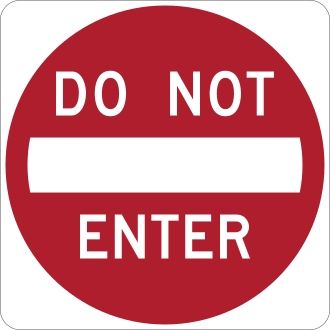
- Traffic in this direction must yield to a highway ahead
- Trucks are prohibited beyond this point
- Parking is not permitted here
- Driving into that roadway from this direction is not permitted
Answer: D — Driving into that roadway from this direction is not permitted
The sign means a driver cannot drive into that roadway in that direction.
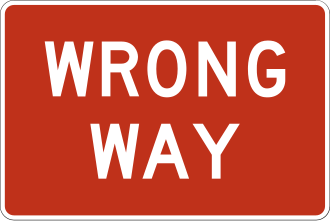
21. A driver sees this sign while driving. What should the driver do?
- Speed up to reach the next exit quickly
- Continue, since it applies only to oncoming traffic
- Stop immediately in the travel lane
- Slow down, pull over safely and turn around
Answer: D — Slow down, pull over safely and turn around
Seeing this sign means the driver is going the wrong way and should slow down, pull over and turn around carefully.
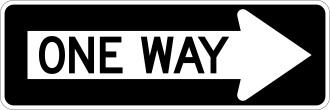
22. What does this sign indicate about the road ahead?
- U-turns are permitted at the next intersection
- Traffic flows only in the direction the arrow points
- Two-way traffic resumes ahead
- The road narrows to one lane
Answer: B — Traffic flows only in the direction the arrow points
The sign shows the only direction of travel permitted on that road.
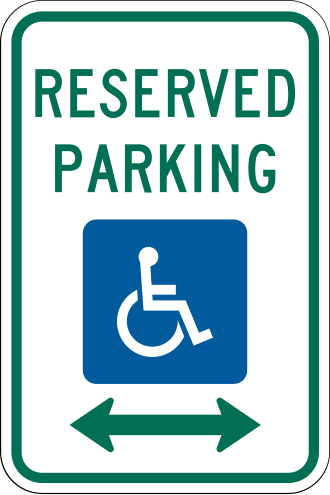
23. What does this sign mean?
- Parking is limited to a short time
- Parking is free for the public
- Parking is reserved for holders of a disabled parking permit
- Parking is reserved for deliveries only
Answer: C — Parking is reserved for holders of a disabled parking permit
The sign reserves the parking space for disabled parking permit holders.
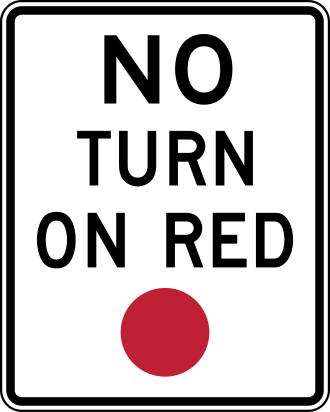
24. What must a driver do at a red light displaying this sign?
- Proceed straight through without stopping
- Turn right cautiously after stopping and checking traffic
- Wait for a green light before turning
- Turn left only, since right turns are blocked
Answer: C — Wait for a green light before turning
This sign prohibits turning on red, so the driver must wait for green before turning.
25. What does this sign at a railroad crossing require of a driver?
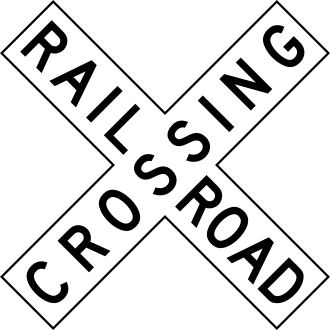
- Yield only if the gates are down
- Sound the horn before crossing
- Stop at the crossing every time, even with no train in sight
- Look, listen, slow down and be ready to stop for trains from either direction
Answer: D — Look, listen, slow down and be ready to stop for trains from either direction
The crossbuck at the crossing requires looking, listening, and being ready to stop for trains from either direction.
26. What must a driver do when approaching this sign?
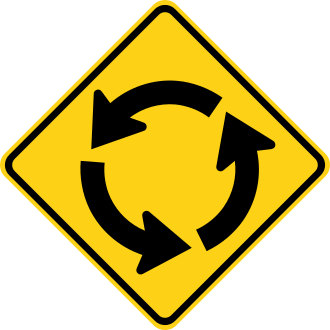
- Prepare for a sharp right turn only
- Stop completely before entering
- Yield to traffic already in the circle and travel counterclockwise
- Merge onto a one-way divided highway
Answer: C — Yield to traffic already in the circle and travel counterclockwise
This sign warns of a roundabout, requiring yielding to traffic in the circle and travel counterclockwise.
27. What does this sign warn a driver about?
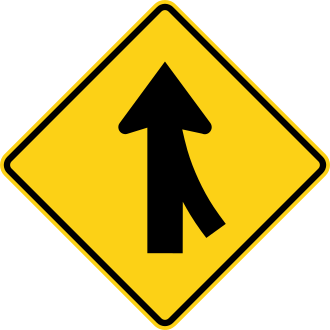
- Two lanes ahead will become one, and drivers in both must merge
- A lane closure due to construction
- An added lane joining with no need to merge
- A narrow bridge ahead
Answer: A — Two lanes ahead will become one, and drivers in both must merge
This sign warns that two lanes are merging into one, requiring drivers in both lanes to merge safely.
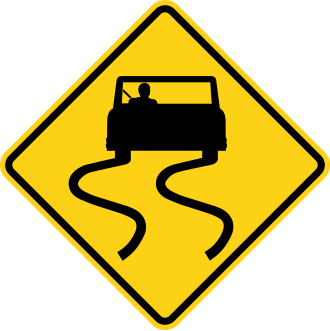
28. What should a driver do when seeing this sign in wet weather?
- Maintain normal speed since it only applies to ice
- Turn on hazard lights and stop
- Reduce speed and avoid hard braking or sudden turns
- Increase following distance only if it is raining heavily
Answer: C — Reduce speed and avoid hard braking or sudden turns
This sign warns of slippery pavement when wet, calling for reduced speed and no hard braking or sudden turns.
29. What does this sign warn a driver to do?
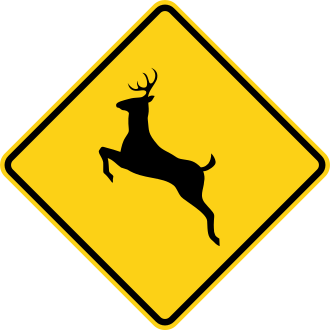
- Prepare for a low overpass
- Expect a school zone ahead
- Watch for bicycles entering the road
- Slow down, stay alert and be ready to stop for animals crossing
Answer: D — Slow down, stay alert and be ready to stop for animals crossing
This sign warns of deer crossing, requiring the driver to slow down, stay alert and be ready to stop.
30. What does this sign indicate?
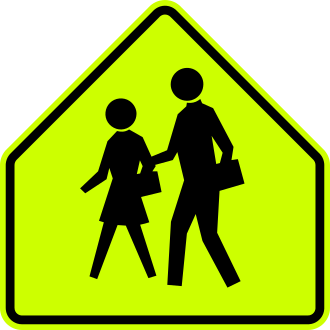
- A hospital zone with reduced speed
- A school zone or crossing; watch for children and obey crossing guards
- A pedestrian crosswalk unrelated to schools
- A speed limit that applies only when lights flash
Answer: B — A school zone or crossing; watch for children and obey crossing guards
The pentagon-shaped sign marks a school zone or crossing, requiring watching for children and obeying crossing guards.
Take this test interactively
More South Carolina Driver License practice tests
- South Carolina Driver License: Night, Work Zones, Rural Roads, Winter and Trailering — 25 questions
- South Carolina Driver License: Sharing the Road, Trucks, Traffic Stops and the Move-Over Law — 30 questions
- South Carolina Driver License: Speed, Space, Communicating, Avoiding Collisions and Malfunctions — 30 questions
- South Carolina Driver License: The License, Permits, the GDL, Tests, Points and Suspensions — 30 questions
- South Carolina Driver License: Tires, Belts, Child Seats, Loads, Steering and Backing — 28 questions
- South Carolina Driver License: Turns, Intersections, Roundabouts, School Buses, Parking and Passing — 30 questions
- South Carolina Driver License: Vision, Fatigue, Distraction, Alcohol and Drugs — 29 questions