California Driver License: Signs, Signals and Right-of-Way
30 questions with the correct answer and an explanation for each.
Topic: Signs, Signals and Right-of-Way. Free, no account needed.
Take this test interactively
1. What must a driver do when reaching this sign?
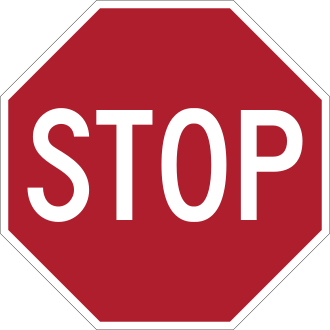
- Proceed with caution without stopping if the way looks clear
- Slow down and be ready to yield to crossing traffic
- Come to a full stop before the crosswalk or limit line, or before the intersection, and check traffic in every direction
- Stop only if another vehicle or pedestrian is present
Answer: C — Come to a full stop before the crosswalk or limit line, or before the intersection, and check traffic in every direction
The sign requires a complete stop and a check of traffic in every direction, not just caution or a conditional stop.
2. This plaque appears beneath a stop sign at an intersection. What does it tell drivers?
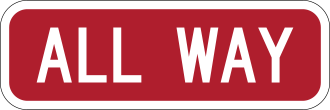
- Every approach must stop, and if two vehicles arrive together, the one on the right goes first
- Stopping is required only during posted hours
- Every approach must yield but need not come to a complete stop
- Only cross traffic must stop; the road you're on has the right-of-way
Answer: A — Every approach must stop, and if two vehicles arrive together, the one on the right goes first
It marks an all-way stop: every approach stops, and a tie among vehicles arriving together goes to the one on the right.
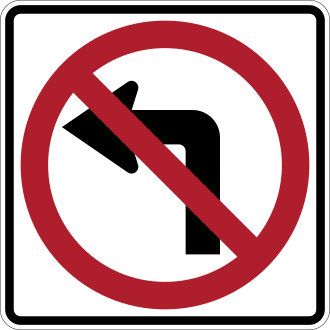
3. What does this sign prohibit?
- Turning right at this location
- Entering this road at all
- Turning left at this location
- Making a U-turn at this location
Answer: C — Turning left at this location
The sign specifically bars a left turn, not a right turn, U-turn, or entry.
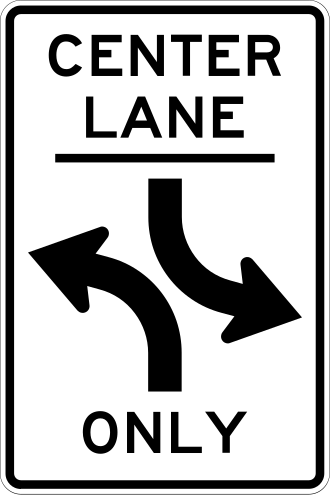
4. A driver is in the center lane marked with this sign. What may they use it for?
- Traveling straight through when other lanes are congested
- Turning right only
- Passing slower traffic in either direction
- Turning left or making a U-turn only
Answer: D — Turning left or making a U-turn only
This center lane is reserved for left turns and U-turns, never for through travel or passing.
5. What does this sign tell a driver?
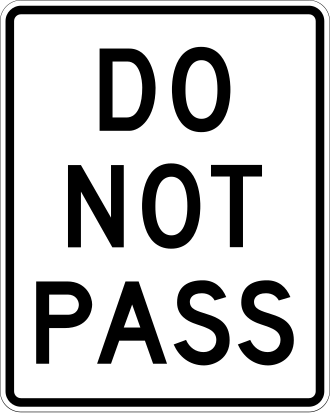
- Passing another vehicle is not allowed here
- Parking along this stretch is not allowed
- Merging into this lane is not allowed
- Stopping on the roadway is not allowed here
Answer: A — Passing another vehicle is not allowed here
The sign bars passing, not stopping, parking, or merging.
6. A driver sees this sign facing them. What does it mean?
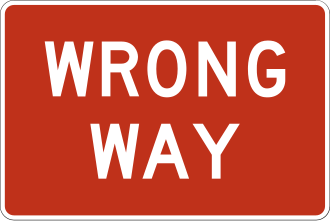
- They must not enter the upcoming ramp under any circumstance
- The road ahead is closed to all traffic
- A one-way street begins just ahead
- They are driving against the flow of traffic and must back out or turn around when safe
Answer: D — They are driving against the flow of traffic and must back out or turn around when safe
Facing this sign means the driver is going the wrong way and must correct course when it is safe to do so.
7. What does this sign indicate about the street ahead?
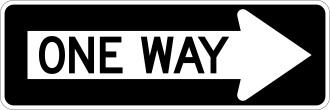
- Two-way traffic resumes ahead
- U-turns are prohibited on this street
- Traffic moves only in the direction the arrow points
- The street ends ahead with no outlet
Answer: C — Traffic moves only in the direction the arrow points
The sign marks a one-way street, where all traffic moves only in the direction shown.
8. What does this sign mean for a parking space?
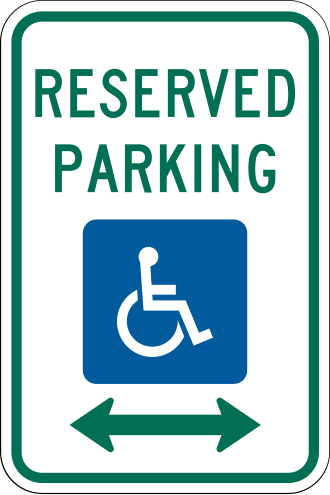
- Only buses may park here
- Only a vehicle displaying a disabled placard or plate may park here
- Parking is prohibited here at all times
- Parking is limited to a short time only
Answer: B — Only a vehicle displaying a disabled placard or plate may park here
The space is reserved for vehicles with a disabled placard or plate, not closed to all parking or limited by time.
9. A driver stopped at a red light sees this sign. What must they do?
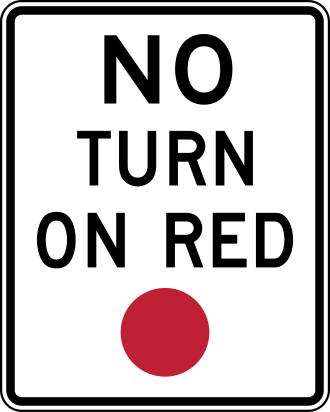
- Turn left only, never right, on the red
- Treat the red light as a stop sign and proceed when clear
- Turn right after stopping and checking traffic
- Wait for a green signal before turning
Answer: D — Wait for a green signal before turning
The sign removes the usual right-turn-on-red option, so the driver must wait for green.
10. What does this sign tell a driver?
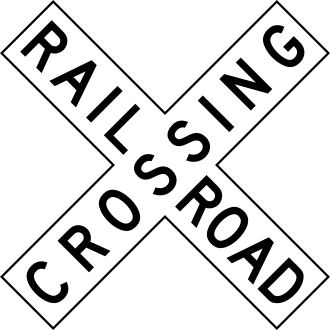
- A highway interchange
- A school zone
- A steep downgrade
- A railroad crossing; look, listen, slow down and be ready to stop for trains
Answer: D — A railroad crossing; look, listen, slow down and be ready to stop for trains
This crossbuck marks the railroad crossing itself, requiring the driver to look, listen, slow down and be ready to stop and let trains pass.
11. What should a driver expect after seeing this sign?
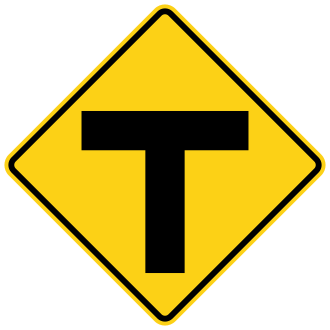
- The road curves sharply ahead
- A side road joins from the right
- The road ends ahead, and they must turn left or right
- A road crosses straight through ahead; watch for cross traffic
Answer: C — The road ends ahead, and they must turn left or right
This marks a T intersection, where the road the driver is on ends and forces a turn.
12. What should a driver do after seeing this sign?
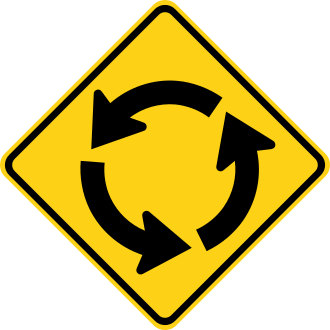
- Slow down and be ready to yield to traffic already circulating ahead
- Come to a complete stop before proceeding into the intersection ahead
- Prepare for a traffic signal ahead
- Prepare for a divided highway to begin
Answer: A — Slow down and be ready to yield to traffic already circulating ahead
The sign warns of a roundabout ahead, where the driver must slow and yield to traffic already in it.
13. What does this sign tell a driver in the right lane?
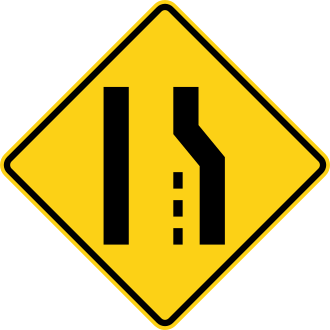
- Traffic from the right is about to join the lane
- The right lane is ending ahead; merge left
- The road narrows to a single lane in both directions
- A new lane is beginning; no need to merge
Answer: B — The right lane is ending ahead; merge left
The sign warns that the right lane ends, so the driver must merge left.
14. What does this sign warn a driver to expect?
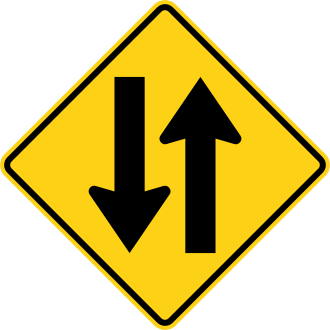
- A divided highway is ending and two-way traffic resumes ahead
- One-way traffic only ahead
- A divided highway is about to begin
- Oncoming traffic should be expected in the lane to their left
Answer: D — Oncoming traffic should be expected in the lane to their left
The sign alerts drivers to oncoming traffic sharing the road, distinct from a divided highway ending or beginning.
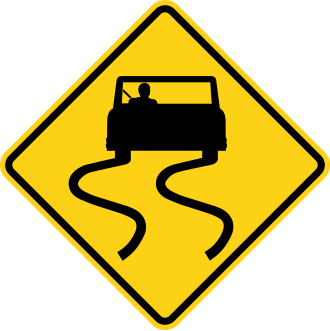
15. What does this sign warn a driver about?
- The shoulder ahead is soft
- The road surface may be slippery when wet
- The pavement ends ahead
- A bump is ahead in the roadway
Answer: B — The road surface may be slippery when wet
The sign warns of reduced traction on a wet road surface.
16. What does this sign warn a driver to watch for?
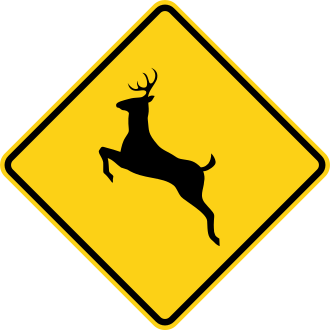
- Animals that may cross the road ahead
- Bicyclists crossing the road ahead
- Pedestrians crossing the road ahead
- Trucks entering or crossing the road ahead
Answer: A — Animals that may cross the road ahead
The sign warns specifically of animals that may cross the roadway.
17. What must a driver check before proceeding past this sign?
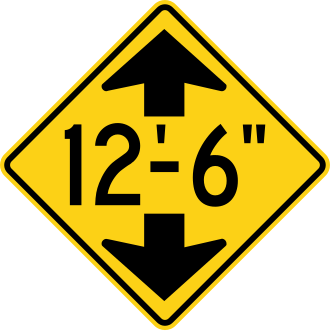
- Whether their vehicle is taller than the height shown
- Whether their vehicle is wider than the lane
- Whether their vehicle's weight exceeds the posted limit
- Whether the bridge ahead is narrower than the road
Answer: A — Whether their vehicle is taller than the height shown
The sign warns of a height restriction, not weight, width, or bridge narrowness.
18. What should a driver do after seeing this sign?
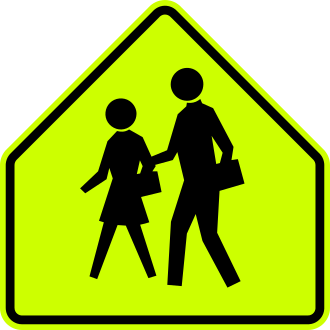
- Expect a playground with no pedestrian crossing
- Obey the posted speed limit only when its light is flashing
- Drive slowly and stop for children in the crosswalk
- Expect a hospital zone ahead
Answer: C — Drive slowly and stop for children in the crosswalk
The sign marks a school zone, requiring slower driving and stopping for children in the crosswalk.
19. A driver wants to turn left at an intersection where the signal shows a red arrow. What must they do?
- Slow down and turn cautiously, watching for a signal change
- Treat the red arrow as a yield sign and turn if the way is clear
- Stop completely and wait for a green light or green arrow before turning
- Stop, then turn left after checking that no traffic is approaching
Answer: C — Stop completely and wait for a green light or green arrow before turning
A red arrow forbids any turn, unlike a solid red light, which sometimes allows a turn after stopping.
20. A left-turn signal shows a flashing yellow arrow. What does this allow a driver to do?
- Not turn left at all until the arrow turns solid green
- Turn left only after yielding to oncoming traffic, since the turn is not protected
- Turn left with a fully protected turn, since oncoming traffic has a red light
- Turn left only after coming to a complete stop first
Answer: B — Turn left only after yielding to oncoming traffic, since the turn is not protected
A flashing yellow arrow permits a left turn, but oncoming traffic may still have the right-of-way, so the driver must yield.
21. A driver approaches an intersection where the traffic signal is completely dark, with no lights lit. What should they do?
- Proceed with caution, since a dark signal requires no stop
- Treat the intersection as an all-way stop, then proceed cautiously when safe
- Only vehicles on the busier road need to stop
- Wait until the signal comes back on before proceeding
Answer: B — Treat the intersection as an all-way stop, then proceed cautiously when safe
A dead signal is handled like a four-way stop rather than being ignored or waited out.
22. A pedestrian signal shows a flashing DON'T WALK or raised hand. What does this mean for someone who has not yet stepped into the crosswalk?
- They must wait for a sound signal before crossing
- They may cross only if a vehicle waves them through
- They should not start crossing, since the signal is about to change
- They should cross quickly before the signal finishes changing
Answer: C — They should not start crossing, since the signal is about to change
The flashing signal warns that time is running out, so a pedestrian not already crossing should not begin.
23. What does the push button at a pedestrian crossing do?
- It requests the WALK signal
- It activates flashing lights for drivers only
- It is only usable by pedestrians with disabilities
- It starts a countdown for vehicles at the signal
Answer: A — It requests the WALK signal
Pressing the button requests that the WALK signal be given.
24. Two vehicles reach an intersection with no stop or yield signs at the same moment. Which one has the right-of-way?
- The vehicle on the right
- Whichever vehicle is larger
- The vehicle on the left
- Whichever vehicle is going straight
Answer: A — The vehicle on the right
When vehicles arrive together at an uncontrolled intersection, the one on the right is yielded to.
25. At an unsigned T intersection, which traffic has the right-of-way?
- Traffic on the through road
- Traffic on the road that ends at the intersection
- Whichever vehicle signals first
- Traffic turning left, over traffic going straight
Answer: A — Traffic on the through road
At an unsigned T intersection, the continuing through road has priority over the road that terminates there.
26. Two vehicles meet on a steep, narrow mountain road where neither can pass. Which one must back up?
- Whichever vehicle is smaller
- The vehicle facing downhill, since it has more control in reverse
- The vehicle facing uphill, since it can see further back
- Whichever vehicle arrived at the spot first
Answer: B — The vehicle facing downhill, since it has more control in reverse
The uphill vehicle has the right-of-way, so the downhill vehicle backs up because it has better control in reverse.
27. A driver in a multi-lane roundabout wants to make a right turn. Which lane should they use to enter and exit?
- Enter from either lane and exit from the center
- Enter from the center lane only
- Enter and exit from the right lane
- Enter from the left lane and cross over before exiting
Answer: C — Enter and exit from the right lane
A right turn in a multi-lane roundabout is made from the right lane, exiting in that same right lane.
28. A driver misses their intended exit while going around a roundabout. What should they do?
- Cross the central island to reach the exit
- Stop and carefully reverse to the exit
- Continue around again until reaching the exit
- Exit at the nearest point even if unmarked
Answer: C — Continue around again until reaching the exit
Missing the exit means simply continuing around the roundabout rather than reversing or exiting somewhere unmarked.
29. A driver sees another vehicle stopped at a crosswalk ahead. What should they do?
- Pass on the left if there is enough room
- Not pass the stopped vehicle, since it may be hiding a pedestrian
- Honk to prompt the stopped driver to move
- Pass only if no pedestrians are visible
Answer: B — Not pass the stopped vehicle, since it may be hiding a pedestrian
A stopped vehicle at a crosswalk may be concealing a crossing pedestrian, so passing it is unsafe regardless of visibility.
30. A blind pedestrian at a corner pulls in their white cane and steps back from the intersection. What does this usually mean?
- The pedestrian needs more time before crossing
- The pedestrian is waiting for a sound signal
- The pedestrian is asking the driver to stop
- The driver may now go
Answer: D — The driver may now go
Pulling in the cane and stepping back is the usual cue that the pedestrian is not crossing, so the driver may proceed.
Take this test interactively
More California Driver License practice tests