New York Driver License: Signs, Signals and Markings
30 questions with the correct answer and an explanation for each.
Topic: Signs, Signals and Markings. Free, no account needed.
Take this test interactively
1. A driver spots a blue sign with white lettering along the highway. What is it telling them?
- A traffic rule is in effect at this location
- A service such as a rest area, gas, camping or medical facility is nearby
- A hazardous location is ahead
- The distance and direction to a destination
Answer: B — A service such as a rest area, gas, camping or medical facility is nearby
Blue with white lettering marks service signs, which point out rest areas, gas, camping and medical facilities.
2. A driver sees a yellow diamond-shaped sign with black symbols ahead. What is it telling them?
- Workers are present on or near the road
- Fuel, food or lodging services are nearby
- A hazardous location or special rule is ahead
- A traffic regulation must be obeyed here
Answer: C — A hazardous location or special rule is ahead
Yellow diamonds with black symbols are warning signs, which flag a hazardous location or special rule ahead.
3. A driver approaches an intersection controlled by a STOP sign. There is no stop line and no crosswalk. Where must the driver stop?
- Anywhere before entering the intersection, since no line is marked
- At the edge of the pavement, regardless of visibility
- Before the intersection, at the nearest point that gives a view of cross traffic
- Only if another vehicle is already stopped there
Answer: C — Before the intersection, at the nearest point that gives a view of cross traffic
Without a stop line or crosswalk, the driver must stop before the intersection at the nearest point that gives a view of cross traffic.
4. A sign shows a red circle with a diagonal slash drawn over a symbol. What does it mean?
- A hazard matching the symbol is ahead
- The action shown is recommended but optional
- The action shown, or that type of vehicle, is not allowed
- The restriction applies only during posted work hours
Answer: C — The action shown, or that type of vehicle, is not allowed
A red circle with a slash over a symbol means that action is prohibited or that vehicle type is restricted.
5. A driver enters a work area where no work-zone speed limit is posted, and a flag person signals for traffic to stop. What must the driver do?
- Obey the flag person and stop, since a flag person's signals must always be followed
- Proceed at the normal posted speed limit, since no reduced limit was posted
- Follow the flag person's signals only if a work area sign is also visible
- Stop only if a police officer is also present
Answer: A — Obey the flag person and stop, since a flag person's signals must always be followed
Even without a posted work-zone limit, drivers must slow down and always obey the flag person's signals.
6. A driver approaches an intersection where the traffic light is dark and not working. What must they do?
- Treat it like a flashing yellow light and proceed with caution
- Proceed through at normal speed since no signal is displayed
- Stop and wait there until a traffic officer arrives to direct you through
- Treat it like a STOP sign, then proceed by right-of-way rules
Answer: D — Treat it like a STOP sign, then proceed by right-of-way rules
An out-of-service or malfunctioning light is treated like a STOP sign, and the driver proceeds by right-of-way rules.
7. A driver is stopped at a steady red light in New York City. No sign is posted permitting a turn. May the driver turn right on red?
- No, but a left turn on red from a one-way road onto another one-way road is allowed
- No, right turns on red are prohibited everywhere in the state
- No; in New York City a turn on red requires a sign permitting it
- Yes, after a full stop and yielding, as anywhere else in the state
Answer: C — No; in New York City a turn on red requires a sign permitting it
New York City is an exception to the general right-on-red rule: turning on red there requires a sign that permits it.
8. Overhead lane-use lights show a flashing yellow X above a driver's lane. What does it mean?
- The lane may be used only to make a left turn
- The lane is open for through travel
- The lane is reserved for buses and carpools
- The lane is closed; move out of it
Answer: A — The lane may be used only to make a left turn
A flashing yellow X over a lane restricts that lane to left turns only.
9. A driver on a two-lane road wants to pass a slow-moving vehicle. The lane markings are double solid lines. May the driver pass?
- Yes, but only on the right side of the lines
- Yes, if no oncoming traffic is visible
- No; double solid lines prohibit passing or lane changes except to turn left
- No, unless obstructions make passing necessary
Answer: C — No; double solid lines prohibit passing or lane changes except to turn left
Double solid lines forbid passing or lane changes; the only crossing allowed is to turn left into or out of the highway.
10. A traffic officer signals a driver to stop at an intersection where the light is green. What must the driver do?
- Stop, since the officer's directions override the signal
- Continue through the intersection and stop after clearing it
- Proceed, since a green light has the right-of-way over an officer
- Stop only if the officer is a police officer, not a flag person
Answer: A — Stop, since the officer's directions override the signal
A traffic officer's directions override signs, signals and pavement markings, so the driver must stop.
11. What must you do when you see this sign?
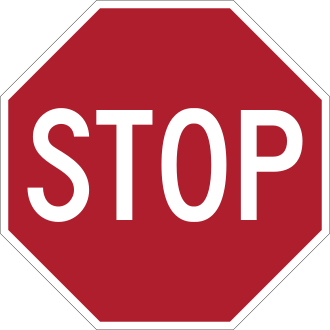
- Reduce speed and prepare to stop at a signal ahead
- Slow down and yield the right-of-way, stopping only if necessary
- Merge with traffic already on the road
- Come to a full stop, yield to traffic and pedestrians, then go when safe
Answer: D — Come to a full stop, yield to traffic and pedestrians, then go when safe
A STOP sign requires coming to a full stop, yielding to vehicles and pedestrians, then proceeding when it is safe.
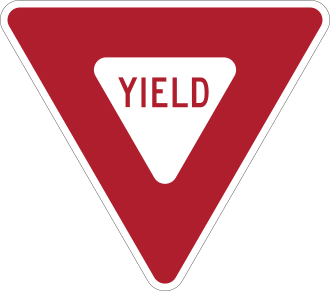
12. What must you do when you see this sign?
- Stop only if a flag person is present
- Come to a full stop before proceeding
- Prepare to stop at a stop sign ahead
- Slow down, be ready to stop, and give the right-of-way to traffic and pedestrians
Answer: D — Slow down, be ready to stop, and give the right-of-way to traffic and pedestrians
A YIELD sign requires slowing down, being ready to stop, and giving the right-of-way to traffic and pedestrians.
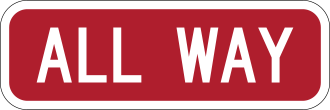
13. What does this sign mean?
- Only cross traffic must stop
- Traffic on the main road has the right-of-way
- Every approach to the intersection must stop; the first vehicle to arrive goes first
- The stop applies only during school hours
Answer: C — Every approach to the intersection must stop; the first vehicle to arrive goes first
An All Way plaque means every approach to the intersection stops, and the first vehicle to arrive proceeds first.
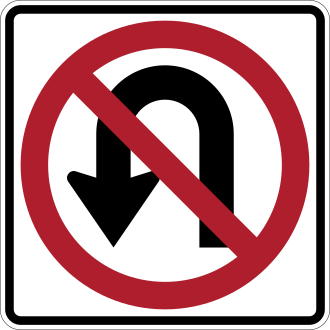
14. What does this sign mean?
- A left turn is prohibited here
- Passing is prohibited
- Turning around (a U-turn) is prohibited here
- A right turn is prohibited here
Answer: C — Turning around (a U-turn) is prohibited here
This sign prohibits making a U-turn at this location.
15. What does this sign mean?
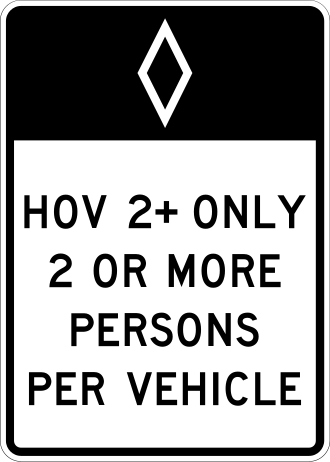
- The lane is reserved for buses only, at all times
- The lane is closed to all traffic
- The lane is reserved for carpools, vanpools and buses during the posted hours
- The lane is for vehicles exiting the highway
Answer: C — The lane is reserved for carpools, vanpools and buses during the posted hours
An HOV lane sign reserves the lane for carpools, vanpools and buses during the posted hours, not at all times.
16. What does this sign mean?
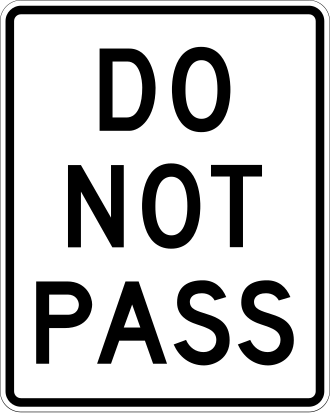
- Passing is prohibited
- Slower traffic must use the right lane
- No U-turn is allowed
- Do not enter this road
Answer: A — Passing is prohibited
This sign prohibits passing.
17. What must you do when you see this sign?
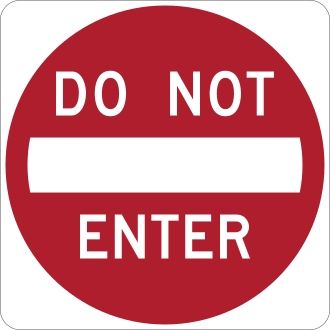
- Turn around; you are going against traffic
- Merge left because the lane ahead ends
- Stop and wait for a green signal
- Not enter this road or ramp
Answer: D — Not enter this road or ramp
A Do Not Enter sign means the driver may not enter that road or ramp.
18. What does this sign mean?
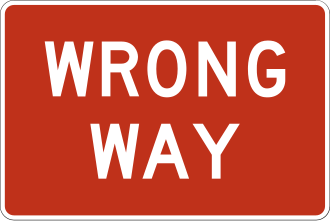
- You are driving against the flow of traffic
- You may not enter this road or ramp
- The road ahead is closed
- A one-way road is ahead
Answer: A — You are driving against the flow of traffic
A Wrong Way sign warns that the driver is traveling against traffic and must correct course immediately.
19. What does this sign mean?
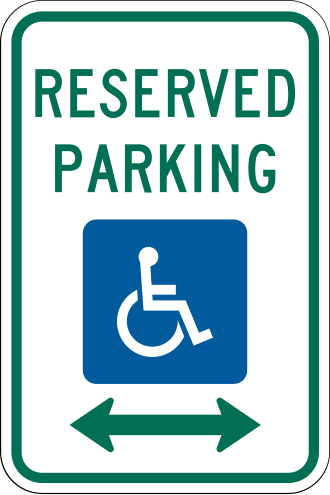
- Parking is prohibited entirely
- Parking is limited to a posted time
- Only a vehicle displaying a disabled permit may park here
- This space is reserved for buses only
Answer: C — Only a vehicle displaying a disabled permit may park here
This sign reserves the parking space for a vehicle with a disabled permit.
20. What must you do when you see this sign?
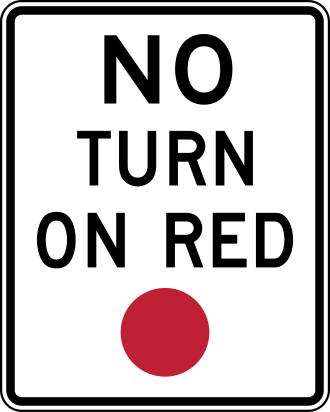
- Turn only if no pedestrians are crossing
- Wait for a green signal before turning
- Proceed as usual; the sign applies only to trucks
- Turn only after coming to a full stop
Answer: B — Wait for a green signal before turning
A No Turn on Red sign requires waiting for a green signal before making the turn.
21. What does this sign mean?
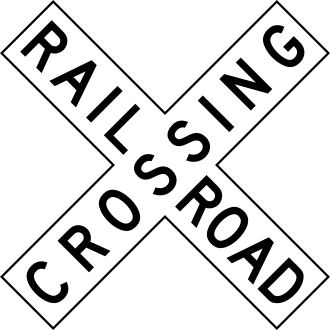
- A hospital is nearby
- A truck route crosses ahead
- A railroad crossing is ahead; slow down, look, listen, and be ready to stop
- A divided highway begins here
Answer: C — A railroad crossing is ahead; slow down, look, listen, and be ready to stop
A crossbuck marks a railroad crossing, requiring the driver to slow down, look, listen and be ready to stop.
22. What does this sign mean?
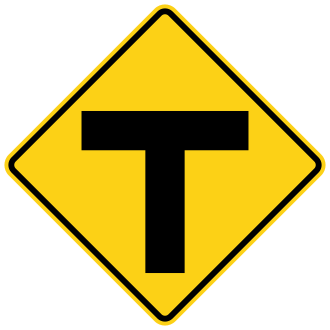
- The road ends ahead; you must turn left or right
- The road curves sharply right
- A road enters from the right
- A roundabout is ahead
Answer: A — The road ends ahead; you must turn left or right
A T-Intersection sign warns that the road ends ahead and the driver must turn left or right.
23. What must you do when you see this sign?
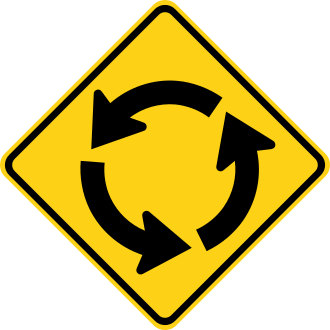
- Come to a full stop before proceeding
- Merge left because the lane ends
- Prepare to stop at a signal ahead
- Slow down and yield to traffic already in the roundabout ahead
Answer: D — Slow down and yield to traffic already in the roundabout ahead
A roundabout warning sign calls for slowing down and yielding to traffic already circulating in the roundabout.
24. What must you do when you see this sign?
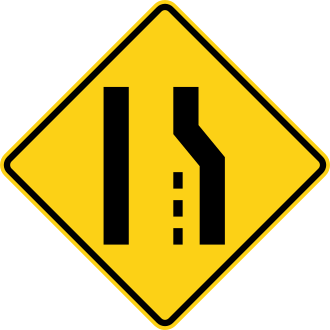
- The bridge ahead is narrower than the road
- Prepare to merge left because the right lane ends ahead
- Slow down for a bump in the road
- A new lane is beginning; no need to merge
Answer: B — Prepare to merge left because the right lane ends ahead
A Lane Ends sign warns that the right lane ends ahead and the driver should merge left.
25. What does this sign mean?
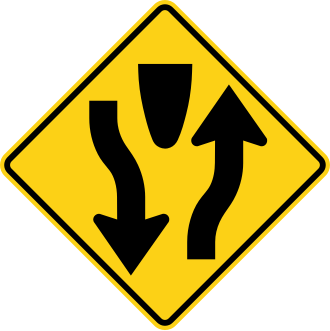
- Two-way traffic resumes ahead
- Expect oncoming traffic in the left lane
- Opposing traffic will be separated by a median ahead
- The road narrows ahead
Answer: C — Opposing traffic will be separated by a median ahead
This sign warns that a divided highway begins ahead, with opposing traffic separated by a median.
26. What must you do when you see this sign?
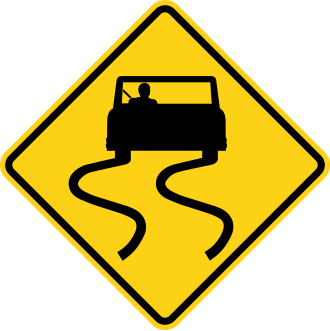
- Slow down; a bridge ahead may ice before the road
- Slow down; the road may be slippery in wet conditions
- Slow down; the pavement ends ahead
- Slow down; the shoulder is soft
Answer: B — Slow down; the road may be slippery in wet conditions
This sign warns that the road may be slippery when wet, so the driver should slow down.
27. What must you do when you see this sign?
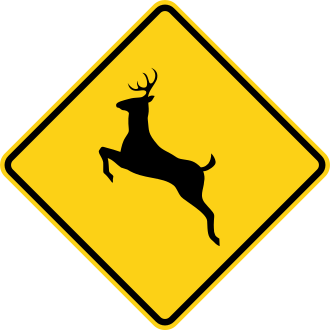
- Slow down; pedestrians cross here
- Slow down and be alert; animals may cross the road
- Slow down; trucks may enter or cross the road
- Slow down; bicyclists cross here
Answer: B — Slow down and be alert; animals may cross the road
A Deer Crossing sign warns that animals may cross the road, so the driver should slow down and stay alert.
28. What must you do when you see this sign?
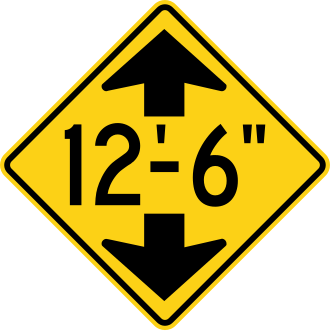
- Not enter if your vehicle is wider than the lane shown
- Reduce speed for a dip in the road ahead
- Slow down for a narrow bridge ahead
- Not enter if your vehicle is taller than the height shown
Answer: D — Not enter if your vehicle is taller than the height shown
A Low Clearance sign means a vehicle taller than the posted height must not enter.
29. What must you do when you see this sign?
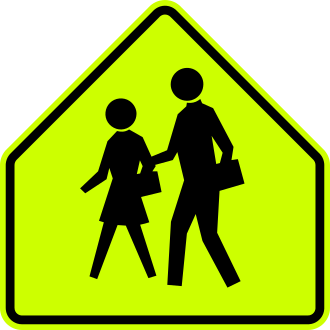
- Stop; a school bus is loading ahead
- Slow down and watch for children; you are near a school zone or crossing
- Yield to pedestrians only at marked crosswalks
- Obey the posted speed only when its light is flashing
Answer: B — Slow down and watch for children; you are near a school zone or crossing
A School sign marks a school zone or crossing, requiring the driver to slow down and watch for children.
30. What does this sign mean?
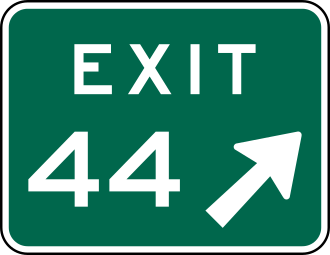
- This lane leaves the highway ahead
- The right lane ends ahead; merge left
- A new lane is beginning; no need to merge
- An interstate route begins here
Answer: A — This lane leaves the highway ahead
An Exit Only sign indicates the lane beneath it leaves the highway ahead.
Take this test interactively
More New York Driver License practice tests