Illinois Driver License: Signs, Signals and Markings
30 questions with the correct answer and an explanation for each.
Topic: Signs, Signals and Markings. Free, no account needed.
Take this test interactively
1. What must a driver do upon seeing this sign?
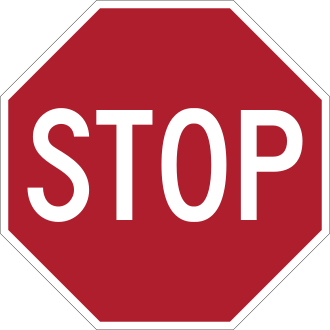
- Stop only if cross traffic is approaching, otherwise proceed
- Slow down because a stop sign is coming up ahead
- Come to a complete stop at the stop line, crosswalk, or intersection, then yield before proceeding
- Slow down and yield to traffic already in the intersection, stopping only if necessary
Answer: C — Come to a complete stop at the stop line, crosswalk, or intersection, then yield before proceeding
This sign requires a full stop at the stop line, or before the crosswalk or intersection if there is no line, before yielding and proceeding.
2. What does this sign require a driver to do?
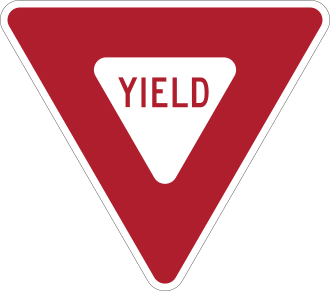
- Slow down and let all traffic and pedestrians go first, stopping if necessary
- Come to a complete stop regardless of traffic conditions
- Merge into traffic without slowing down
- Slow down because a traffic signal is ahead
Answer: A — Slow down and let all traffic and pedestrians go first, stopping if necessary
This sign means give the right-of-way to other traffic and pedestrians, stopping if that is needed to do so safely.
3. This plaque appears beneath a stop sign at an intersection. What does it mean?
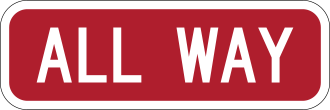
- Stop signs are posted at every approach; the first vehicle to stop goes first
- Only one direction of traffic is required to stop
- Only cross traffic must stop; the driver has the right-of-way
- The intersection has a signal light, not stop signs
Answer: A — Stop signs are posted at every approach; the first vehicle to stop goes first
The plaque tells drivers that every approach has its own stop sign, so right-of-way goes to whoever stopped first.
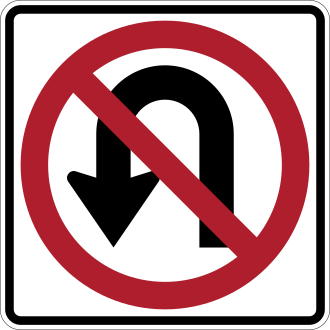
4. What does this sign prohibit, and who may still use the opening it marks?
- Passing another vehicle is prohibited; only emergency vehicles may pass here
- Turning around is prohibited; the opening is reserved for police, ambulances, snow plows and maintenance vehicles
- Entering the roadway is prohibited to all but local residents
- Turning left is prohibited; only bicycles may use the opening
Answer: B — Turning around is prohibited; the opening is reserved for police, ambulances, snow plows and maintenance vehicles
This sign bans U-turns at a divided-highway median opening that is reserved for authorized vehicles like police, ambulances, snow plows and maintenance crews.
5. What does this sign tell a driver about the lane it marks?
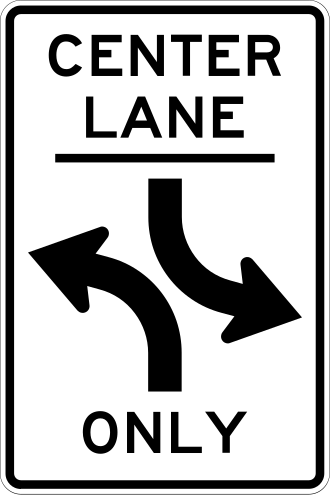
- As a dedicated lane for right turns from either direction
- Only to prepare for or complete a left turn or a legal U-turn
- As an extra through lane during rush hour
- As a passing lane for faster traffic in either direction
Answer: B — Only to prepare for or complete a left turn or a legal U-turn
A two-way left turn lane is reserved solely for vehicles preparing to turn left or make a legal U-turn, not for through travel or passing.
6. What does this sign tell a driver?
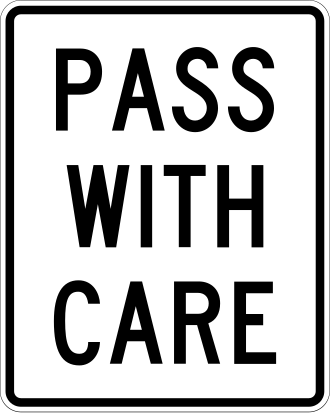
- The no-passing zone has ended; pass only when it is safe
- A no-passing zone begins here
- Slower traffic must move into the right lane
- Passing is prohibited beyond this point
Answer: A — The no-passing zone has ended; pass only when it is safe
This sign marks the end of a no-passing zone, meaning passing is now legal if it can be done safely.
7. On a multilane highway, what does this sign instruct?
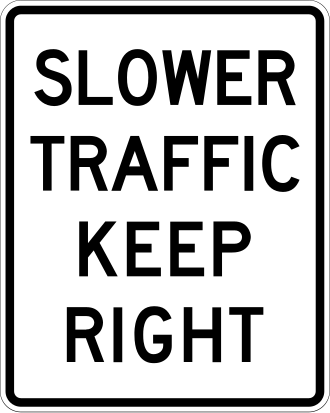
- Drivers going slower than the flow of traffic should stay in the right lane
- The right lane is closed ahead
- Only trucks may use the right lane
- All traffic must stay right of a median or island
Answer: A — Drivers going slower than the flow of traffic should stay in the right lane
This sign directs slower-moving vehicles to keep to the right so faster traffic can pass on the left.
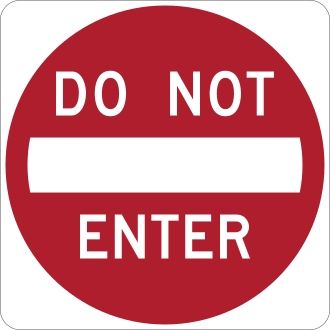
8. What does this sign indicate?
- The driver is already traveling the wrong way on a one-way street
- The roadway ahead, such as a one-way street or ramp, is closed to traffic entering from this direction
- Parking is prohibited on this street
- A U-turn is not permitted at this opening
Answer: B — The roadway ahead, such as a one-way street or ramp, is closed to traffic entering from this direction
This sign blocks entry into a one-way street or ramp from this direction, before a driver would be going the wrong way.
9. A driver sees this sign a short distance past a Do Not Enter sign on a ramp. What does it mean?
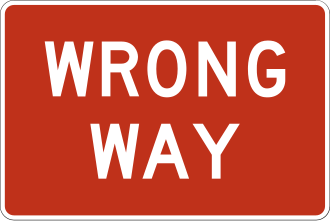
- The driver must not enter the ramp under any circumstances
- The driver is going the wrong direction, having passed a Do Not Enter sign
- The ramp ahead is closed for construction
- A divided highway is about to end
Answer: B — The driver is going the wrong direction, having passed a Do Not Enter sign
This sign appears a short way past a Do Not Enter sign and tells the driver they are travelling against traffic.
10. Who may legally park in a space marked with this sign?
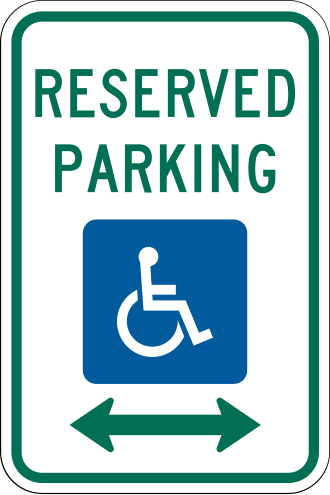
- Any vehicle for up to 15 minutes
- Any vehicle once the lot is full
- Only vehicles displaying disability plates, placards, or Disabled Veteran plates
- Only delivery vehicles
Answer: C — Only vehicles displaying disability plates, placards, or Disabled Veteran plates
These spaces are reserved specifically for vehicles with disability plates, disability placards, or Disabled Veteran plates.
11. Where is this sign typically posted, and what does it require?
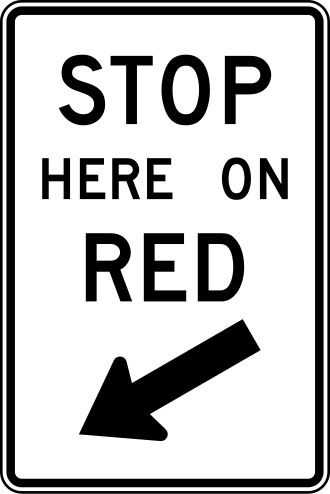
- Come to a complete stop at this line at all times, whatever the signal shows
- Stop at the marked line for a red light, where the stopping point is otherwise unclear
- Stop only when children are present in a school zone
- Stop only when a train is present
Answer: B — Stop at the marked line for a red light, where the stopping point is otherwise unclear
This sign is used where drivers might otherwise be unsure exactly where to stop for a red signal.
12. What does this sign prohibit?
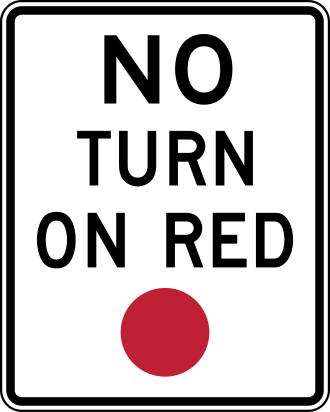
- Turning right on red, and turning left on red between one-way streets, are both prohibited
- Only U-turns are prohibited; other turns on red remain legal
- Any turn is prohibited, even after the light turns green
- Only turning right on red is prohibited; left on red is always allowed
Answer: A — Turning right on red, and turning left on red between one-way streets, are both prohibited
This sign bans both a right turn on red and a left turn on red from a one-way street onto another one-way street.
13. What does this sign function as for approaching vehicles?
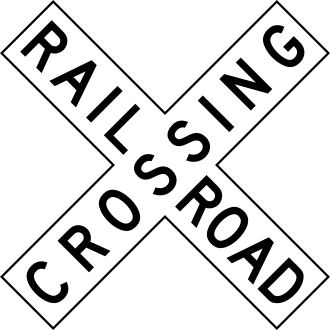
- A warning that a crossing is up to 750 feet ahead
- A guide sign showing the distance to the next town
- A stop sign, requiring a complete stop even with no train present
- A yield sign, requiring the driver to yield to any oncoming train or railroad equipment
Answer: D — A yield sign, requiring the driver to yield to any oncoming train or railroad equipment
The crossbuck acts as a yield sign, meaning a driver must give way to any approaching train or railroad equipment.
14. What does this sign warn a driver about?
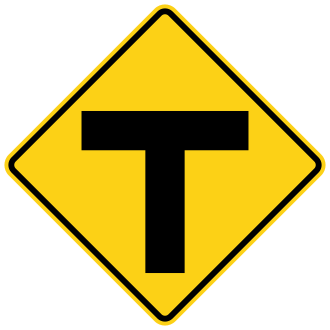
- A side road joins from the right ahead
- The road ahead ends; the driver must turn left or right
- The road ahead splits into two separate roads
- A crossroad lies ahead with traffic from both sides
Answer: B — The road ahead ends; the driver must turn left or right
This sign marks a T intersection, where the road a driver is on ends and they must turn one way or the other.
15. What should a driver do upon seeing this sign?
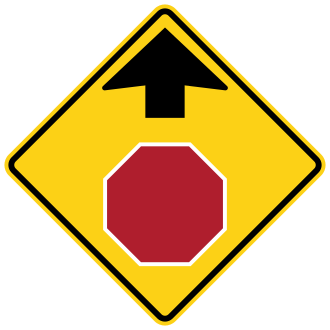
- Come to a complete stop immediately at the sign itself
- Yield to cross traffic because the intersection has no controls
- Begin slowing down because a stop sign is ahead but not yet visible
- Prepare to merge because a lane is ending
Answer: C — Begin slowing down because a stop sign is ahead but not yet visible
This sign warns that a stop sign lies ahead, not yet visible, so the driver should start slowing now.
16. What does this sign call for?
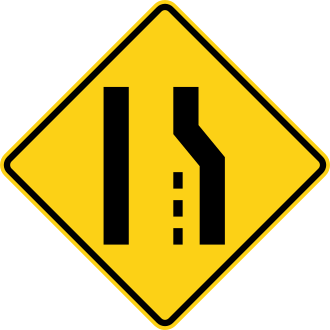
- Change lanes or let others merge because a lane ahead is ending
- Slow down because the road narrows on both sides
- Prepare for a divided highway to begin
- Yield because two ramps are merging into an expressway
Answer: A — Change lanes or let others merge because a lane ahead is ending
This sign warns that a lane is ending ahead, so drivers should change lanes or allow merging traffic in.
17. What does this sign indicate about the bridge ahead?
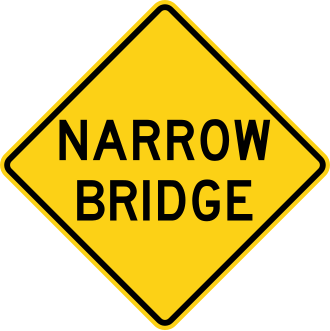
- The bridge ahead is closed to all traffic
- The road narrows permanently beyond the bridge
- The bridge ahead is generally about 2 feet narrower than the approach road
- The bridge ahead has a low clearance for tall vehicles
Answer: C — The bridge ahead is generally about 2 feet narrower than the approach road
This sign warns that the bridge surface is narrower than the road leading up to it, typically by about 2 feet.
18. What should a driver do on seeing this sign?
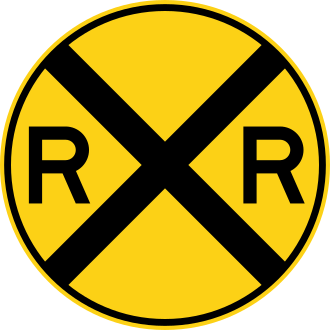
- Come to a complete stop regardless of whether a train is present
- Yield only if gates or flashing lights are active
- Maintain speed since the crossing is still far ahead
- Slow down, look and listen, and stop if needed, since a crossing is up to 750 feet ahead
Answer: D — Slow down, look and listen, and stop if needed, since a crossing is up to 750 feet ahead
This advance warning sign is posted up to 750 feet before a crossing, so the driver should slow, look, listen, and stop if a train is coming.
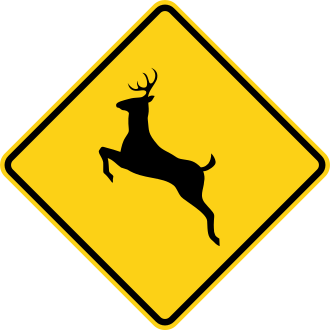
19. What does this sign warn a driver of?
- Bicyclists may cross the road ahead
- Deer may cross the road ahead
- Livestock may be on the roadway ahead
- A wildlife refuge with a reduced speed limit lies ahead
Answer: B — Deer may cross the road ahead
This sign specifically warns that deer may cross the roadway ahead.
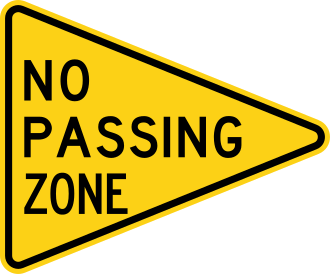
20. What does this sign mark?
- A construction zone with a reduced speed limit
- The start of a no-passing zone, posted on the left side of the road
- The end of a no-passing zone, where passing becomes legal again
- A school zone where passing a stopped bus is prohibited
Answer: B — The start of a no-passing zone, posted on the left side of the road
This pennant-shaped sign is posted on the left side of the road at the point where a no-passing zone begins.
21. What do brown road signs typically mark?
- Gas, food and lodging services
- Traffic incidents such as crashes and natural disasters
- Parks and recreation areas
- Construction and maintenance zones
Answer: C — Parks and recreation areas
Brown is used on guide signs to mark parks and recreation areas.
22. A driver on a freeway travels well below the posted minimum speed even though conditions are safe. Is this legal?
- Yes, minimum speed limits are only advisory
- No, driving below the minimum is illegal unless safety requires it
- Yes, as long as hazard lights are used
- No, minimum speeds apply only inside construction zones
Answer: B — No, driving below the minimum is illegal unless safety requires it
Freeway minimum speed limits are enforceable, and driving below them without a safety reason is illegal.
23. A lane near an intersection is marked with a solid white line that changes to a dotted line as it nears the corner. What does this indicate?
- The lane is a reversible lane used only during rush hour
- The lane is a no-parking zone
- The lane is a merge lane for highway traffic
- It is a bike lane, which is sometimes painted green
Answer: D — It is a bike lane, which is sometimes painted green
Bike lanes are marked by a solid white line that turns dotted before the corner, and are sometimes painted green.
24. What is prohibited while driving through a posted school speed zone?
- Passing another vehicle in a marked passing zone
- Turning right on red
- Parking curbside
- Using a phone
Answer: D — Using a phone
Phone use is specifically banned while driving through a posted school speed zone.
25. Traffic is heavily congested where two lanes merge into one ahead. What is the recommended technique?
- Use both lanes to the merge point and alternate, one vehicle from each lane
- Merge into the continuing lane as early as possible
- Use the shoulder to bypass the congestion
- Stop and wait for a large gap before merging
Answer: A — Use both lanes to the merge point and alternate, one vehicle from each lane
In heavy congestion, the zipper merge calls for using both lanes fully and alternating at the merge point rather than merging early.
26. A driver approaches a crash involving a truck carrying a hazardous materials placard and begins to feel ill from fumes. What should the driver do?
- Avoid the area, report it, and seek medical help, since exposure symptoms can be delayed
- Wait at the scene until a tow truck arrives
- Turn off the vehicle's ventilation and continue driving through
- Drive closer to identify the placard's symbols
Answer: A — Avoid the area, report it, and seek medical help, since exposure symptoms can be delayed
At a placarded crash a driver should avoid the area, report it, and get medical attention if feeling ill, because exposure symptoms may not appear right away.
27. A signal shows a red arrow for left turns. A driver wants to turn left from a one-way street onto another one-way street moving left. What must the driver do?
- Turning left here is never allowed, regardless of street direction
- Come to a complete stop, yield, then turn
- Wait for a green arrow; no left turn is ever allowed on a red arrow
- Proceed without stopping if no traffic is approaching
Answer: B — Come to a complete stop, yield, then turn
A left turn from a one-way onto a one-way street moving left is an exception to the red arrow, but only after a full stop and yielding.
28. A traffic signal at an intersection is flashing red. What must a driver do?
- Stop, yield to traffic in the intersection, then go when safe
- Slow down but continue through without stopping
- Wait for the light to turn solid red before stopping
- Treat it the same as a flashing yellow arrow and proceed with caution
Answer: A — Stop, yield to traffic in the intersection, then go when safe
A flashing red signal is treated like a stop sign: stop, yield to traffic and pedestrians, then proceed when it is safe.
29. A driver wants to turn left into a private driveway across a double solid yellow center line. Is this allowed?
- Only if a broken white line is also present
- Only at intersections controlled by a traffic signal
- No, a double solid yellow line may never be crossed
- Yes, crossing it to turn left into or out of an alley, private road, driveway or street is allowed
Answer: D — Yes, crossing it to turn left into or out of an alley, private road, driveway or street is allowed
Double solid yellow lines may be crossed for the specific purpose of turning left into or out of a driveway, alley, private road or street.
30. At a railroad crossing, the gates begin to lower as a driver approaches. What must the driver do?
- Honk and wait for a flagger to wave them through
- Drive around the gate if no train is visible
- Proceed quickly before the gate fully closes
- Stop and remain stopped until the gates rise and the lights stop
Answer: D — Stop and remain stopped until the gates rise and the lights stop
A driver must stop and stay stopped until the gates rise and the lights stop, never trying to beat or go around a lowering or lowered gate.
Take this test interactively
More Illinois Driver License practice tests