Ohio Driver License: Signs, Signals and Markings
30 questions with the correct answer and an explanation for each.
Topic: Signs, Signals and Markings. Free, no account needed.
Take this test interactively
1. A driver approaches an intersection just as the signal turns red. What must they do?
- Come to a complete stop, then go once nothing is crossing their path
- Slow down and proceed through with caution if the way is clear
- Treat the signal as a yield sign and proceed if no cross traffic is approaching
- Stop before the intersection and wait behind the stop line or crosswalk until it turns green
Answer: D — Stop before the intersection and wait behind the stop line or crosswalk until it turns green
A red light requires stopping before the intersection and waiting behind the line until it turns green, unlike a flashing red which allows going once the path is clear.
2. A signal at an intersection is flashing red in every direction. What must a driver do?
- Come to a complete stop behind the line or crosswalk, then go only when nothing is crossing your path
- Treat the signal as inoperable and proceed without stopping
- Stop and wait until the light turns green before proceeding
- Slow down and proceed with caution, ready to stop for traffic entering the intersection
Answer: A — Come to a complete stop behind the line or crosswalk, then go only when nothing is crossing your path
A flashing red requires a full stop, after which the driver may go once the intersection is clear of crossing traffic.
3. The traffic signal at an intersection is completely dark because of a power outage. How should a driver treat the intersection?
- As a stop sign, yielding and entering with caution
- As a flashing yellow signal, proceeding with caution at speed
- As a yield sign, slowing only if other traffic is affected
- As an uncontrolled intersection, proceeding without stopping if no other vehicle is near
Answer: A — As a stop sign, yielding and entering with caution
A dark or inoperable signal is treated as a stop sign, requiring the driver to yield and enter with caution.
4. A driver approaches an intersection controlled by this sign. What must they do?
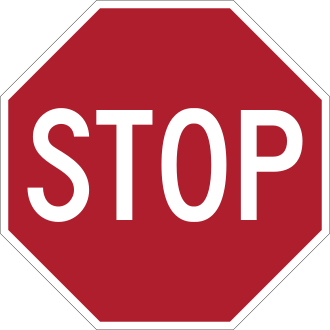
- Come to a complete stop behind the stop line or crosswalk, check for pedestrians and cross traffic, then go when clear
- Stop only if a train appears to be approaching
- Proceed carefully without stopping if the intersection looks clear
- Slow down and yield only if other traffic is affected
Answer: A — Come to a complete stop behind the stop line or crosswalk, check for pedestrians and cross traffic, then go when clear
This is the octagonal Stop sign, requiring a complete stop and a check for pedestrians and cross traffic before proceeding.
5. What must a driver do at this sign?
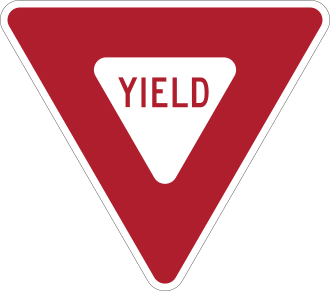
- Slow down and give the right-of-way to pedestrians and oncoming traffic, stopping only if other traffic is affected
- Maintain speed, since oncoming traffic must give way instead
- Stop and wait for a green light before proceeding
- Come to a complete stop regardless of surrounding traffic
Answer: A — Slow down and give the right-of-way to pedestrians and oncoming traffic, stopping only if other traffic is affected
A Yield sign only requires stopping if other traffic is actually affected; otherwise the driver slows and gives the right-of-way.
6. This plaque is posted beneath a stop sign at an intersection. What does it mean?
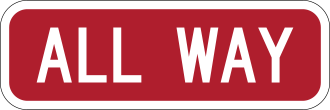
- Only cross traffic must stop, while the driver's direction has the right-of-way
- Traffic in all four directions must stop, with the first vehicle to arrive going first and the driver on the left yielding to the right
- Only left-turning vehicles must stop before proceeding
- A traffic signal at this intersection is about to activate
Answer: B — Traffic in all four directions must stop, with the first vehicle to arrive going first and the driver on the left yielding to the right
The 4-Way plaque means every approach must stop, the first vehicle to arrive goes first, and the driver on the left yields to the right.
7. What does this sign indicate?
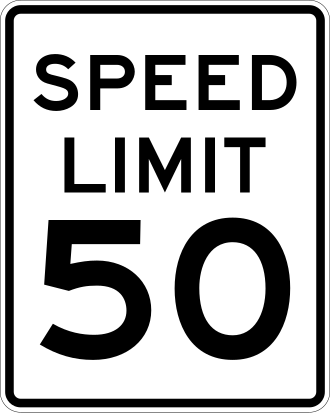
- The minimum speed a driver must maintain to keep up with traffic
- The maximum legal speed under ideal conditions, though slower speeds may be required in poor conditions
- A speed limit that only applies while school zone lights are flashing
- The recommended speed for safely navigating an upcoming curve
Answer: B — The maximum legal speed under ideal conditions, though slower speeds may be required in poor conditions
A speed limit sign posts the maximum legal speed for ideal conditions; drivers must slow further when conditions require it.
8. A sign displays a red circle with a diagonal slash drawn over a symbol. What does this design mean?
- The sign marks a hazard that might or might not be present ahead
- The action shown inside the circle is required of all drivers
- The action or item shown inside the circle is forbidden
- The sign gives directions toward a nearby service
Answer: C — The action or item shown inside the circle is forbidden
A red circle with a slash is the standard prohibitory symbol meaning "no" — whatever appears inside it is forbidden.
9. What is prohibited by this sign?
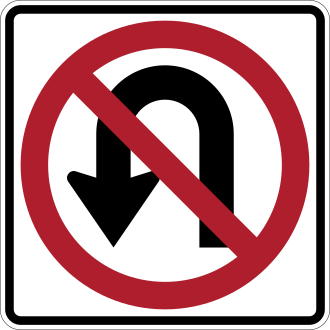
- Turning around to travel in the opposite direction
- Turning left at this intersection
- Passing another vehicle on this stretch of road
- Turning right at this intersection
Answer: A — Turning around to travel in the opposite direction
This sign forbids turning around to head back the opposite way.
10. What does this sign tell a driver about the lane it marks?
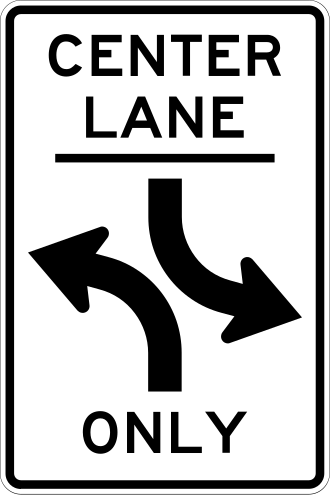
- The lane is only for left turns from either direction, never for travel or passing
- The lane may be used to pass slower vehicles
- The lane converts into a right-turn lane near intersections
- The lane is reserved for through travel during off-peak hours
Answer: A — The lane is only for left turns from either direction, never for travel or passing
This sign marks the center lane as usable only for left turns from either direction, never for through travel or passing.
11. What does this sign require of a driver?
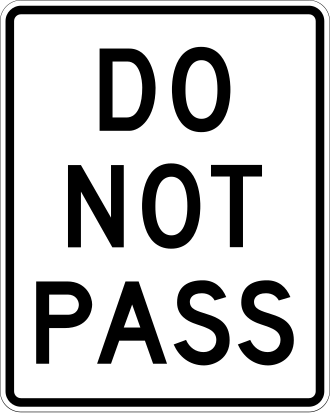
- Merge left because the right lane is ending ahead
- Do not pass other vehicles traveling in the same direction
- Yield to oncoming traffic before proceeding
- Reduce speed because a bridge ahead is narrow
Answer: B — Do not pass other vehicles traveling in the same direction
This sign prohibits passing other vehicles traveling the same direction.
12. A driver sees this sign facing them at the entrance to a road. What does it mean?
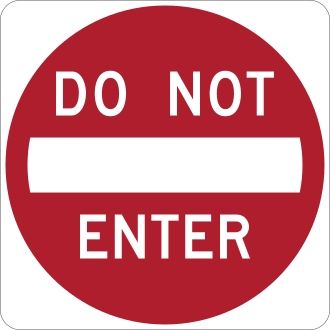
- Parking is prohibited beyond this point
- The driver has already entered a one-way road against traffic
- Entry onto this street or ramp, such as a one-way road, is prohibited
- Trucks are prohibited from using this road
Answer: C — Entry onto this street or ramp, such as a one-way road, is prohibited
This sign faces drivers who should not enter, marking a one-way street or ramp entrance as off-limits.
13. A driver already on a roadway sees this sign facing them. What does it mean?
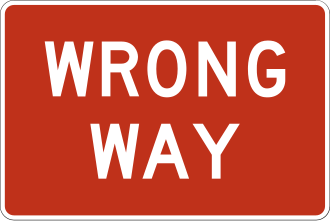
- The driver must not enter the road ahead
- The road narrows and traffic must merge
- The driver has entered a one-way road against the flow of traffic and should pull over and turn around safely
- The road ahead is closed to all traffic
Answer: C — The driver has entered a one-way road against the flow of traffic and should pull over and turn around safely
This sign warns a driver already on the road that they are heading the wrong way against one-way traffic and should safely turn around.
14. What does this sign tell a driver about the road ahead?
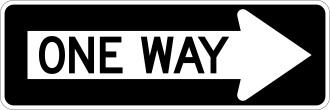
- Traffic may travel in either direction but must keep right
- The road is closed to entering traffic
- Traffic moves only in the direction shown by the arrow
- Two-way traffic is about to begin ahead
Answer: C — Traffic moves only in the direction shown by the arrow
This sign shows the single direction that traffic on the road is permitted to travel.
15. Who may legally park in a space marked with this sign?
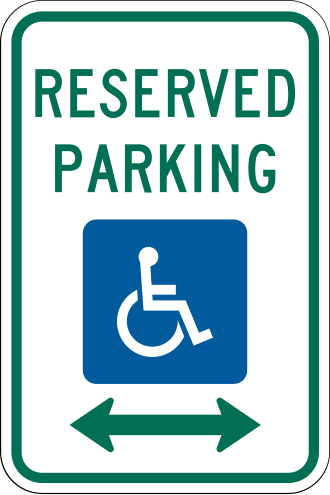
- Only vehicles displaying a disability placard or plate
- Any vehicle after normal business hours
- Any vehicle, for a short period, while the driver stays inside
- Delivery vehicles making brief stops
Answer: A — Only vehicles displaying a disability placard or plate
This sign reserves the parking space for vehicles displaying a disability placard or plate.
16. A driver faces a red light at an intersection posted with this sign. What must they do?
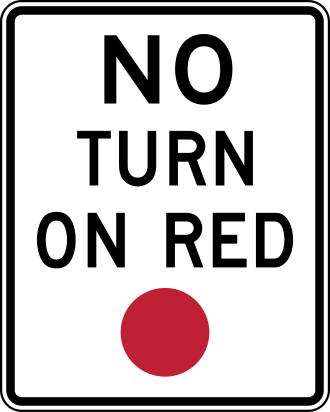
- Turn only if no pedestrians are present in the crosswalk
- Wait for the green signal before turning
- Treat the intersection as an all-way stop
- Turn after stopping and confirming cross traffic is clear
Answer: B — Wait for the green signal before turning
This sign removes the usual option to turn on red, so the driver must wait for a green signal.
17. What should a driver do when approaching this sign?
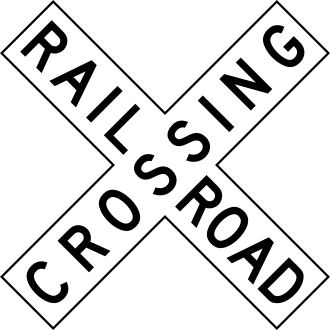
- Continue at normal speed, since crossings always have working signals
- Yield only if a train is visibly approaching from the left
- Stop completely every time, regardless of whether a train is present
- Slow down, look and listen, and stop 15 to 50 feet back if a train is coming
Answer: D — Slow down, look and listen, and stop 15 to 50 feet back if a train is coming
This sign marks a rail crossing where a driver should slow down, look and listen, and stop well back if a train is approaching.
18. What does this sign warn a driver about?
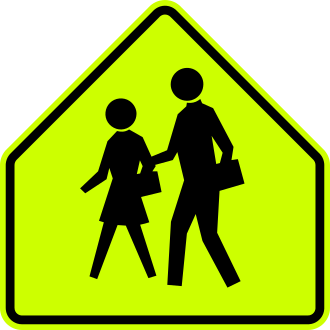
- A reduced speed limit that applies only while lights are flashing
- A pedestrian crossing unrelated to any school
- A school zone ahead, calling for slower speed and watchfulness for children
- A permanent speed limit reduction for the entire road
Answer: C — A school zone ahead, calling for slower speed and watchfulness for children
This sign marks a school zone, where a driver should slow down and watch for children.
19. What does this sign warn about, and what should a driver do?
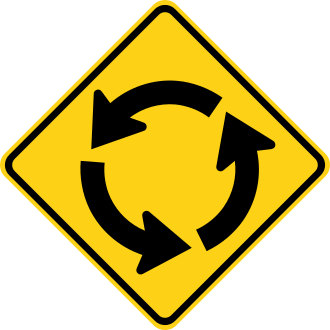
- A traffic signal ahead that may be hard to see
- An intersection ahead where the road ends, requiring a turn
- The road splitting into two directions ahead
- A roundabout ahead; slow down and yield to circulating traffic
Answer: D — A roundabout ahead; slow down and yield to circulating traffic
This sign warns of a roundabout ahead, where a driver should slow down and yield to traffic already circulating.
20. What does this sign warn a driver about?
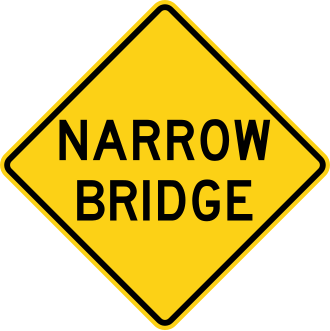
- The bridge is narrow, and the vehicle nearest it has the right-of-way
- The road ahead ends at a T intersection
- The bridge is closed to vehicles above a certain height
- A divided highway begins at the bridge
Answer: A — The bridge is narrow, and the vehicle nearest it has the right-of-way
This sign warns that the bridge ahead is narrow and gives right-of-way to whichever vehicle is nearest to it.
21. What should a driver do upon seeing this sign?
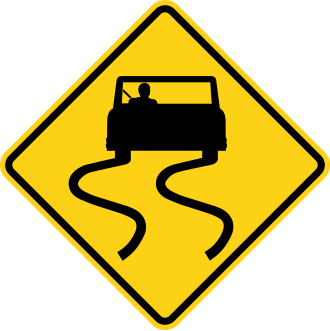
- Shift to a lower gear ahead of a steep downhill grade
- Expect the shoulder to be unpaved and avoid hard braking
- Reduce speed and following distance, and avoid sudden moves
- Prepare to stop for a hidden traffic signal ahead
Answer: C — Reduce speed and following distance, and avoid sudden moves
This sign warns that the pavement becomes slippery when wet, calling for reduced speed, more following distance, and no sudden moves.
22. What does this sign indicate?
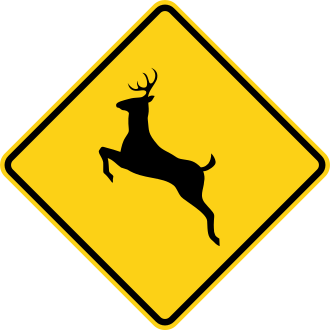
- Bicyclists frequently cross the road at this location
- Deer frequently cross the road at this location
- Livestock may be present on the roadway ahead
- Pedestrians frequently cross the road at this location
Answer: B — Deer frequently cross the road at this location
This sign marks a location where deer frequently cross the road.
23. A worker in a highway construction zone holds up a sign directing traffic to stop. What must a driver do?
- Follow the posted speed limit and disregard hand signals from workers
- Proceed with caution, since a flagger's signals are only advisory
- Obey the worker's direction
- Stop only if a police officer is also present at the scene
Answer: C — Obey the worker's direction
A worker directing traffic with a sign or flag in a work zone must be obeyed.
24. What can result from speeding through a highway work zone?
- Doubled fines and possible jail time
- Mandatory community service, with no fine or jail time
- A verbal warning only, since fines are waived in work zones
- Points on the license but no monetary fine
Answer: A — Doubled fines and possible jail time
Work zone speeding penalties can include doubled fines and jail.
25. What should a driver do upon seeing this sign?
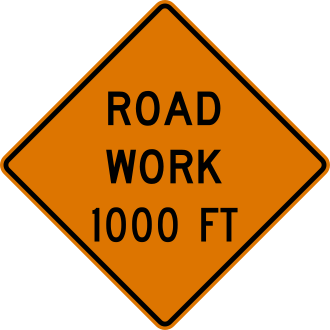
- Maintain normal speed, since the work zone is probably inactive
- Come to a complete stop before proceeding past the sign
- Slow down and watch for workers, even if none are currently visible
- Merge left immediately because the right lane is permanently closed
Answer: C — Slow down and watch for workers, even if none are currently visible
This orange work zone sign calls for slowing down and watching for workers even before any are seen.
26. What does this route marker identify?
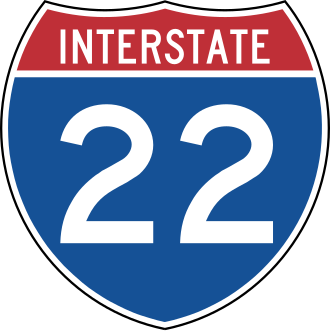
- An interstate route
- A county or local road route
- A U.S. route
- A state highway route
Answer: A — An interstate route
The red, white and blue shield is the marker used to identify an interstate route.
27. A driver wants to pass a bicyclist moving slowly ahead on a road with a double solid yellow center line. Is passing allowed?
- Yes, but only if the bicyclist waves the driver past
- No, unless the double yellow line is on the driver's left side only
- Yes, a driver may cross a double solid yellow line to pass a slow-moving vehicle such as a bicycle
- No, crossing a double solid yellow line is never permitted
Answer: C — Yes, a driver may cross a double solid yellow line to pass a slow-moving vehicle such as a bicycle
A double solid yellow line normally keeps traffic right of it, but allows crossing to pass a slow-moving vehicle such as a bicycle.
28. A center line has a solid yellow line on one side and a broken yellow line on the other. A driver is traveling in the lane next to the solid line. May they pass?
- Yes, because a solid line always permits passing from that side
- No, passing is prohibited in both lanes in this configuration
- No, only the lane next to the broken line may pass
- Yes, but only when meeting oncoming traffic
Answer: C — No, only the lane next to the broken line may pass
Only the lane next to the broken yellow line may pass; the lane next to the solid yellow line may not.
29. A driver wants to travel a long distance using the center lane bordered by broken and solid yellow lines with left-turn arrows. Is this allowed?
- No, this lane is for left turns only, entered just before turning, and not for through travel or passing
- Yes, as long as no oncoming traffic is present
- No, the lane is reserved exclusively for buses and emergency vehicles
- Yes, if the driver keeps a turn signal on the whole time
Answer: A — No, this lane is for left turns only, entered just before turning, and not for through travel or passing
The two-way left turn lane is only for left turns from either direction, entered just before the turn, and may not be used for through travel or passing.
30. A pedestrian is crossing the road within a marked crosswalk. What must a driver do?
- Yield to the pedestrian, stopping at the stop line if one is painted before the crosswalk
- Sound the horn to encourage the pedestrian to hurry
- Yield only if a traffic signal is also present at that crosswalk
- Proceed if the pedestrian is already more than halfway across
Answer: A — Yield to the pedestrian, stopping at the stop line if one is painted before the crosswalk
Drivers must yield to pedestrians in a crosswalk, stopping at the stop line where one is painted before the crosswalk.
Take this test interactively
More Ohio Driver License practice tests