Georgia Driver License: Signs, Signals and Markings
30 questions with the correct answer and an explanation for each.
Topic: Signs, Signals and Markings. Free, no account needed.
Take this test interactively
1. An officer standing in an intersection signals you to stop even though the traffic light is green. What should you do?
- Stop and follow the officer's directions
- Proceed since the green light has priority
- Sound your horn and proceed with caution
- Wait for the light to turn red before stopping
Answer: A — Stop and follow the officer's directions
Drivers must obey official signs and signals unless a police officer or emergency worker directs otherwise, and that direction overrides the signal.
2. You approach a stop sign at an intersection with no stop line painted and no crosswalk. Where should you stop?
- Where you can best see approaching traffic
- About four feet back from where the crosswalk would be, the usual urban stop-line distance
- At the sign itself, since the sign marks the legal stopping point
- Anywhere within 50 feet of the intersection
Answer: A — Where you can best see approaching traffic
Without a stop line or crosswalk, you stop where you have the best view of cross traffic.
3. What must you do when you see this sign?
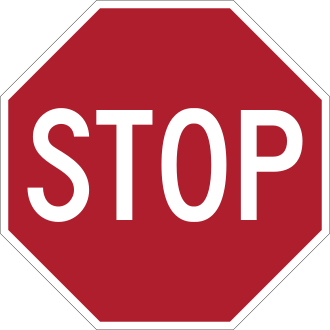
- Yield to traffic already in the intersection, but you need not stop
- Slow down and proceed if the way is clear
- Stop completely, then yield to pedestrians and cross traffic before proceeding
- Come to a rolling stop if no other traffic is present
Answer: C — Stop completely, then yield to pedestrians and cross traffic before proceeding
An octagon always means a complete stop, followed by yielding to pedestrians and close traffic before going.
4. What does this sign require you to do?
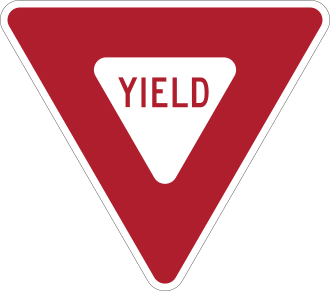
- Come to a complete stop every time, regardless of traffic
- Proceed at normal speed since you have the right-of-way
- Merge immediately without slowing
- Slow down and give way to traffic in or approaching the intersection, stopping if necessary
Answer: D — Slow down and give way to traffic in or approaching the intersection, stopping if necessary
A yield sign means slow down and give way to traffic in or near the intersection, stopping only if necessary.
5. You are driving toward a railroad crossing and a slower vehicle ahead is about to cross the tracks. Can you pass it at the crossing?
- No, passing is prohibited at all railroad crossings
- Yes, if you signal your intention clearly
- Yes, if no train is visible or audible
- Yes, if you can see at least a quarter mile down the tracks
Answer: A — No, passing is prohibited at all railroad crossings
Passing is never allowed at a railroad crossing, regardless of visibility or signaling.
6. About how far before school grounds or a school crossing is the school sign posted?
- 50 to 100 feet
- Immediately at the edge of the school property
- 150 to 700 feet
- 1,000 to 1,500 feet
Answer: C — 150 to 700 feet
The school sign is placed 150 to 700 feet before the school grounds or crossing to give drivers advance warning.
7. What does this sign warn you is ahead?
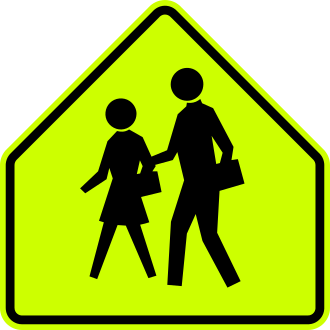
- A playground with no through traffic
- A pedestrian crosswalk unrelated to a school
- A school zone or school crossing
- A hospital zone with reduced speed
Answer: C — A school zone or school crossing
The pentagon shape is used only for school zone or school crossing warnings.
8. A regulatory sign shows a red circle with a diagonal slash over a picture of a bicycle. What does this mean?
- Bicycle crossing ahead
- Bicycles are prohibited here
- A bicycle lane begins here
- Yield to bicycles here
Answer: B — Bicycles are prohibited here
A red circle with a slash means "no," with the picture inside showing exactly what is prohibited, in this case bicycles.
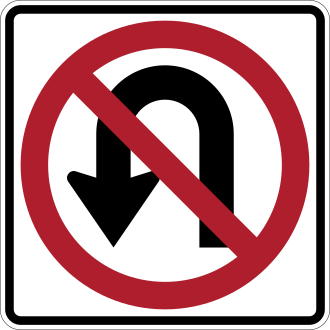
9. What does this sign tell you?
- You may not turn left at this intersection
- You must turn around ahead due to a road closure
- You may not turn around to travel the opposite direction at this intersection
- You may not turn right at this intersection
Answer: C — You may not turn around to travel the opposite direction at this intersection
This sign forbids turning around to go back the way you came at this intersection.
10. What does this sign mean?
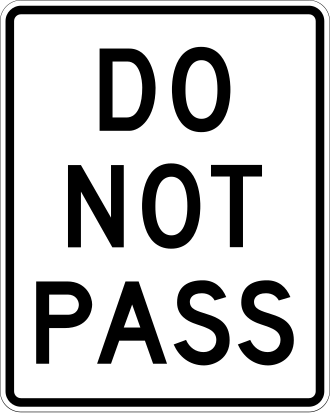
- A reduced speed limit is in effect here
- Passing other vehicles is prohibited here
- No parking is allowed along this stretch of road
- Entering this road is prohibited
Answer: B — Passing other vehicles is prohibited here
This sign simply prohibits passing other vehicles.
11. What does this sign mean for a driver facing it?
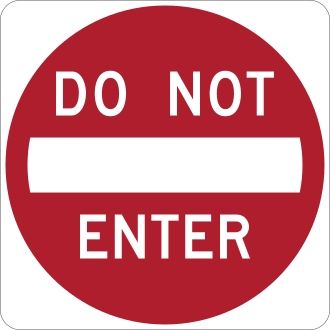
- The road ahead is closed for construction
- Parking is prohibited at this location
- Oncoming traffic is headed toward you on this road
- Driving onto this road or ramp in this direction is not allowed
Answer: D — Driving onto this road or ramp in this direction is not allowed
This sign marks a one-way road or ramp that may not be entered from this direction.
12. What does this sign mean and what should you do?
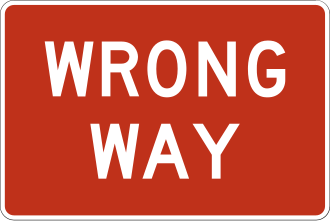
- You have entered a one-way road going the correct direction
- A detour is ahead; follow the marked route
- Traffic is coming toward you; you must not continue in this direction
- You are approaching a dead end and must turn around
Answer: C — Traffic is coming toward you; you must not continue in this direction
This sign warns that you are facing oncoming traffic and must not keep going that way.
13. What does this sign indicate about a parking space?
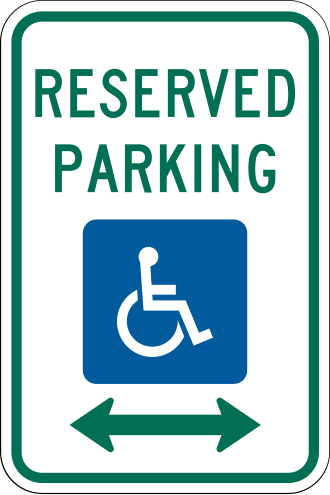
- Only vehicles with a disability placard or plate may park there
- Parking is prohibited in that space at all times
- The space is reserved for loading and unloading only
- Parking is free for a limited time only
Answer: A — Only vehicles with a disability placard or plate may park there
This sign reserves the space for vehicles displaying a disability placard or plate.
14. You stop at a red light where this sign is posted. May you turn after coming to a complete stop?
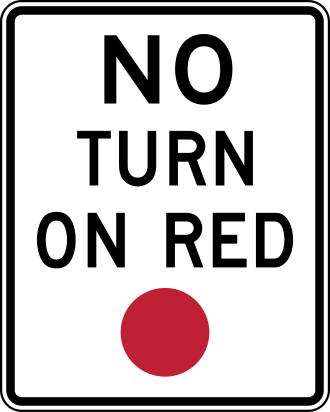
- Yes, but only if turning right
- No, the turn is forbidden even after a complete stop
- Yes, after a complete stop and checking for cross traffic
- Yes, if no pedestrians are present
Answer: B — No, the turn is forbidden even after a complete stop
This sign forbids the turn on red entirely, even if you come to a full stop first.
15. A driver sees a warning sign for a narrow bridge ahead. What does this indicate about the bridge?
- It requires a toll payment to cross
- It is closed to all vehicle traffic
- It has a low weight limit for trucks
- It has room for only two lanes of traffic
Answer: D — It has room for only two lanes of traffic
The narrow bridge sign warns that the bridge ahead has room for only two lanes.
16. What does this sign warn you about?
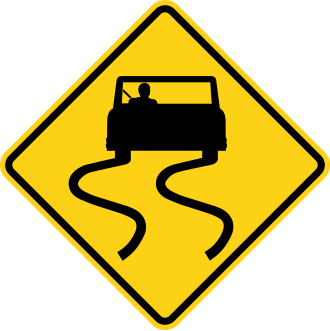
- The road narrows ahead to a single lane
- The pavement can be slippery when wet, so slow down
- A steep downgrade is ahead; shift to a lower gear
- The road has a soft shoulder; avoid driving on it
Answer: B — The pavement can be slippery when wet, so slow down
This sign warns that the pavement is slippery when wet; the first half-hour of rain is the most hazardous.
17. What does this sign tell you to do?
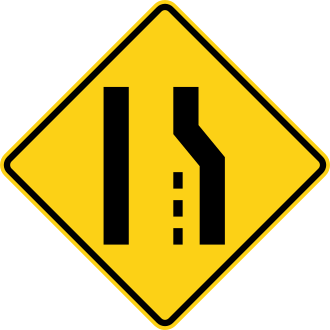
- Merge left because the right lane ends ahead
- Merge right because the left lane ends ahead
- Prepare for an added lane on the right
- Slow down for a narrow bridge ahead
Answer: A — Merge left because the right lane ends ahead
This sign warns that the right lane is ending, so traffic in it must merge left.
18. You are approaching this sign. What should you expect and do?
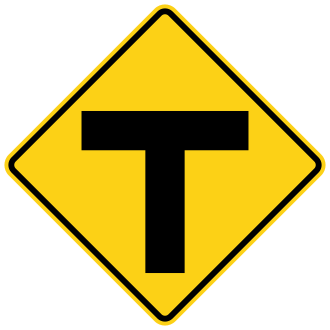
- The road ends ahead; slow down and prepare to yield or stop before turning
- The road curves sharply; reduce speed before the bend
- The road splits into two directions; choose a lane early
- A side road joins from the right; watch for merging traffic
Answer: A — The road ends ahead; slow down and prepare to yield or stop before turning
This sign marks a T intersection where the road ends and you must slow to yield or stop before turning.
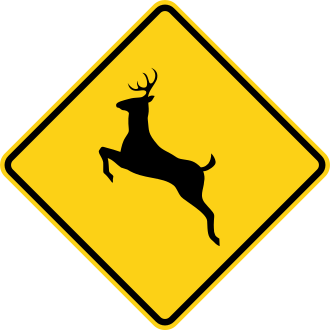
19. What does this sign warn you about?
- Farm equipment may enter the road ahead
- Pedestrians may cross the road ahead
- Deer may cross the road here; slow down
- Bicycles may cross the road ahead
Answer: C — Deer may cross the road here; slow down
This sign warns that deer cross here and drivers should slow down, especially at dawn and dusk.
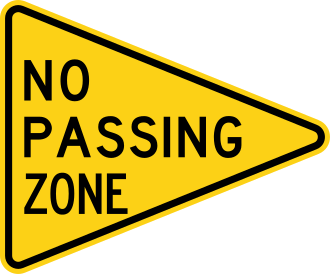
20. You see this sign on the left side of the road. What does it tell you about passing?
- Passing is allowed for the next mile
- Any pass must already be finished before reaching this point
- Passing is allowed only for trucks
- A passing lane begins here
Answer: B — Any pass must already be finished before reaching this point
The no-passing pennant marks the point by which any pass must already be completed.
21. A tractor displaying an orange triangular emblem on the back is traveling on a rural highway. What does the emblem tell other drivers?
- The vehicle is carrying hazardous materials
- The vehicle is oversized and needs a wide berth
- The vehicle is traveling under 25 mph
- The vehicle is stopped and disabled
Answer: C — The vehicle is traveling under 25 mph
The orange triangular emblem marks a vehicle traveling under 25 mph.
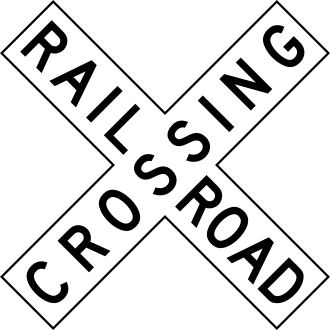
22. What must you do when you see this sign at a railroad crossing?
- Come to a complete stop only when you hear a train horn
- Yield to trains, slowing, looking and listening before crossing
- Stop only if a gate is visibly lowered
- Stop completely at the crossbuck every time before crossing
Answer: B — Yield to trains, slowing, looking and listening before crossing
The crossbuck stands at every crossing and requires drivers to yield to trains, slowing, looking and listening.
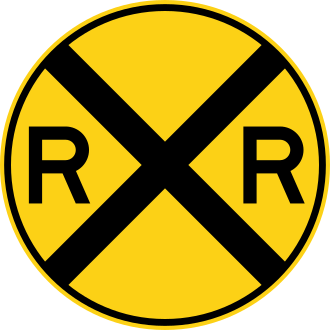
23. What should you do when you see this sign?
- Stop only if you hear a train whistle
- Slow down, look and listen, and prepare to stop for a train
- Speed up to clear the tracks before a train arrives
- Nothing special; the crossbuck at the tracks will tell you when to stop
Answer: B — Slow down, look and listen, and prepare to stop for a train
This sign warns of a railroad crossing ahead, requiring drivers to slow, look, listen and be ready to stop.
24. A motorcyclist wants to use the I-85 Express Lanes in Gwinnett County without paying a toll. Is this possible?
- Yes, motorcycles ride free on those lanes
- No, tolls apply to all vehicles at all times
- Yes, but only during rush hour
- No, only transit buses ride free
Answer: A — Yes, motorcycles ride free on those lanes
Motorcycles are among the vehicle types that ride free on the I-85 Express Lanes.
25. You are in a lane marked with this sign on the highway. What does it mean for your lane?
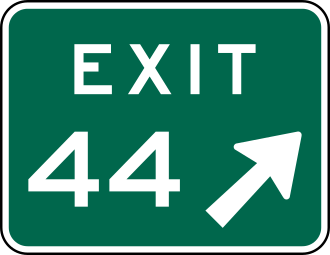
- This lane leaves the highway at the upcoming exit
- This lane is reserved for carpools only
- This lane continues straight past the exit
- This lane merges with incoming traffic
Answer: A — This lane leaves the highway at the upcoming exit
This sign marks a lane that exits the highway rather than continuing on it.
26. You approach an intersection and notice the traffic signal is completely dark, with no lights lit in any direction. How should you treat this intersection?
- As having the right-of-way since no signal is displayed
- Yield to cross traffic, but continue without stopping if the intersection is clear
- Wait until the signal comes back on before moving
- As a four-way stop, treating the signal as a stop sign for all directions
Answer: D — As a four-way stop, treating the signal as a stop sign for all directions
A completely dark signal is treated as a stop sign for all directions.
27. You want to turn left and the signal shows a flashing yellow arrow. What does this allow you to do?
- Turn left only after the arrow turns solid green
- Wait, because a flashing yellow arrow means turns are prohibited
- Turn left after yielding to oncoming traffic and pedestrians, since oncoming traffic has a green light
- Turn left immediately with no need to yield
Answer: C — Turn left after yielding to oncoming traffic and pedestrians, since oncoming traffic has a green light
A flashing yellow arrow permits a left turn only after yielding to oncoming traffic and pedestrians, since oncoming traffic still has a green light.
28. What does this sign warn you to prepare for?
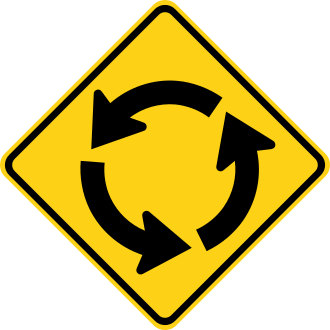
- A roundabout ahead, where circulating traffic must yield to you as you enter
- A roundabout ahead, where you must yield to circulating traffic
- A four-way stop ahead, where the first vehicle to arrive goes first
- A sharp bend ahead where the road changes direction
Answer: B — A roundabout ahead, where you must yield to circulating traffic
This sign warns of a roundabout ahead, where entering traffic must yield to vehicles already circulating.
29. A driver plans to turn left into a driveway using a center two-way left turn lane. How far before the turn may the driver enter that lane?
- There is no distance limit as long as no oncoming traffic is present
- No more than 50 feet before the turn
- At least a half mile before the turn
- No more than 300 feet before the turn
Answer: D — No more than 300 feet before the turn
A two-way left turn lane may be entered no more than 300 feet before the turn, since opposing drivers use the same lane.
30. You are entering a roundabout. Which direction does traffic circulate, and who must you yield to before entering?
- Clockwise, yielding to vehicles already circulating
- Counterclockwise, with no yielding required since entering traffic has the right-of-way
- Counterclockwise, yielding to vehicles already circulating
- Clockwise, yielding only to pedestrians
Answer: C — Counterclockwise, yielding to vehicles already circulating
Traffic in a roundabout circulates counterclockwise, and entering drivers must yield to all vehicles already circulating.
Take this test interactively
More Georgia Driver License practice tests