New Jersey Driver License: Signals, Signs and Road Markings
30 questions with the correct answer and an explanation for each.
Topic: Signals, Signs and Road Markings. Free, no account needed.
Take this test interactively
1. A traffic light is green, but a police officer at the intersection signals for cross traffic to proceed instead. What should a driver facing the green light do?
- Proceed on the green light, since traffic signals take precedence over hand signals
- Follow the officer's directions, since an officer's orders override the signal
- Stop and wait until the officer leaves the intersection
- Proceed only if no cross traffic is visible
Answer: B — Follow the officer's directions, since an officer's orders override the signal
A police officer can overrule signals, and officers' orders must always be obeyed, even when they conflict with the light.
2. In a standard vertical traffic signal, which light is positioned at the top?
- Red
- The green arrow
- Green
- Yellow
Answer: A — Red
In a vertical signal the lights run red, then yellow, then green from top to bottom, with any green arrow at the very bottom.
3. The signal light turns yellow just as a driver reaches a point too close to the intersection to stop safely. What should the driver do?
- Brake hard and stop immediately
- Continue through the intersection
- Slow down and proceed with care, as at a flashing yellow signal
- Stop only if pedestrians are present
Answer: B — Continue through the intersection
A yellow light means stop before entering unless the driver is too close to stop safely, in which case they should proceed through.
4. At a railroad crossing, the signal begins flashing red. When is it safe for a driver to proceed?
- After stopping and waiting five seconds
- As soon as the driver can see a clear track in both directions
- Only once the lights stop flashing and all warning devices have deactivated
- Once the gates begin to rise, even if the lights are still flashing
Answer: C — Only once the lights stop flashing and all warning devices have deactivated
A flashing red at a railroad crossing means a train is coming; a driver goes only when the lights stop and all warning devices deactivate.
5. A pedestrian is midway across an intersection when the signal changes to a steady raised palm. What should the pedestrian do?
- Immediately turn back to the curb they left
- Wait where they are for the walking figure to reappear
- Continue crossing to reach the other side
- Stop and remain in the middle of the crosswalk
Answer: C — Continue crossing to reach the other side
The steady raised palm means not to start crossing, but anyone already in the crosswalk finishes crossing.
6. A driver notices an orange, diamond-shaped sign ahead. What kind of information does it warn about?
- An upcoming no-passing zone
- Construction or road-maintenance activity ahead
- A posted speed regulation
- A roadway hazard such as an animal crossing or curve
Answer: B — Construction or road-maintenance activity ahead
Orange diamonds are road work signs warning of construction and maintenance activity such as lane closings and flaggers.
7. A yellow, diamond-shaped sign with a black symbol appears along a road. What is it warning about?
- An upcoming no-passing area
- An active construction or maintenance zone
- A posted maximum speed
- A general roadway hazard, such as a curve, deer crossing, or railroad crossing
Answer: D — A general roadway hazard, such as a curve, deer crossing, or railroad crossing
Yellow diamonds are warning signs with black symbols covering road conditions, deer, railroad and school crossings, and curves.
8. A flagger in a highway work zone signals a driver to stop, though no stop sign is posted there. Must the driver obey, and what happens to fines for violations in that zone?
- No, flaggers apply only after dark, and fines are doubled only at night
- Yes, the flagger has the authority of a regulatory sign, and fines are doubled in work zones
- No, flaggers only advise; the driver may proceed with caution, and fines are unchanged
- Yes, but only construction vehicles must obey the flagger, and fines are unchanged
Answer: B — Yes, the flagger has the authority of a regulatory sign, and fines are doubled in work zones
A flagger has the authority of a regulatory sign, and all fines are doubled in work zones.
9. A curve ahead is sharper than most, and the posted speed limit is not safe for that particular curve. What does the additional plaque mounted below the curve warning sign show?
- A lower, advisory speed safe for the curve
- The distance remaining to the curve
- The legal speed limit for the whole road
- A reduced speed limit that is legally enforceable like a posted limit
Answer: A — A lower, advisory speed safe for the curve
When a curve's safe speed is below the posted limit, an advisory speed plaque accompanies the warning sign to show that lower safe speed.
10. A driver wants to pass a slower vehicle. The lane marking on the driver's own side of the center line is solid, while the opposing side is dashed. Is passing allowed?
- No, but only if the vehicle ahead is a truck
- No, a solid line on the driver's own side forbids passing
- Yes, because the opposing side is dashed
- Yes, if the road is a divided highway
Answer: B — No, a solid line on the driver's own side forbids passing
Passing is governed by the line on your own side: a solid line on your side forbids passing regardless of the other side's marking.
11. A driver traveling alone sees a white diamond painted on the pavement of the leftmost lane, with a nearby sign showing the hours it applies. What does this mean for the driver?
- That lane is for exiting traffic only
- That lane is closed for road work
- That lane is reserved for trucks only
- That lane is reserved for buses or vehicles carrying multiple occupants
Answer: D — That lane is reserved for buses or vehicles carrying multiple occupants
White diamonds mark HOV lanes, reserved for buses or multi-occupant vehicles during posted hours.
12. A driver needs to go left at a roundabout. How is this accomplished, given that movement through a roundabout is only by right turns?
- Turn left across oncoming traffic at the entrance, as at an ordinary intersection
- Enter with a right turn, continue around the center island, and leave with a right turn at the chosen street
- Drive around the center island in whichever direction reaches the exit sooner
- Stop at the entrance and wait for a gap to cross straight through the intersection
Answer: B — Enter with a right turn, continue around the center island, and leave with a right turn at the chosen street
A roundabout is a one-way circular intersection entered and exited only by right turns, which eliminates left-turn conflicts.
13. What must a driver do upon seeing this sign?
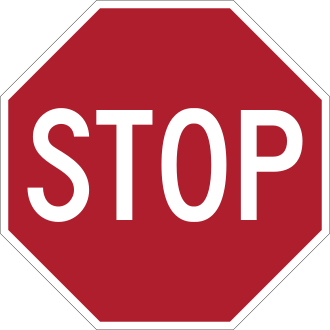
- Stop only if other vehicles are present at the intersection
- Come to a full stop before the stop line or crosswalk, then go only when safe
- Slow down and yield to cross traffic, stopping only if necessary
- Slow to the posted advisory speed and proceed with caution
Answer: B — Come to a full stop before the stop line or crosswalk, then go only when safe
A Stop sign requires coming to a full stop before the stop line or crosswalk and proceeding only when it is safe.
14. What does this sign require a driver to do?
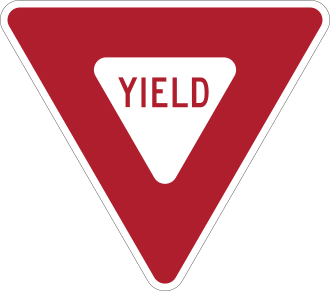
- Merge into the right lane immediately
- Proceed at normal speed since cross traffic must yield
- Come to a complete stop regardless of traffic
- Slow down and give way to traffic on the intersecting road, stopping if necessary
Answer: D — Slow down and give way to traffic on the intersecting road, stopping if necessary
A Yield sign means slow down and give way to traffic on the intersecting road, stopping if necessary.
15. What does this sign prohibit?
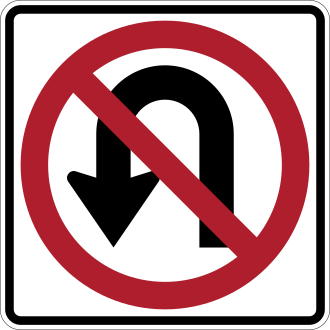
- Making a U-turn at this location
- Making a left turn at this location
- Entering the roadway from this direction
- Passing other vehicles at this location
Answer: A — Making a U-turn at this location
This sign means U-turns are prohibited at this location.
16. What must a driver do when facing this sign?
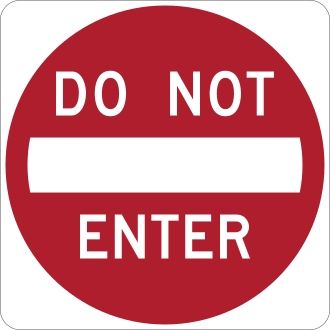
- Yield to oncoming traffic before entering
- Stop and wait for a green light before proceeding
- Merge left before continuing
- Not enter this road or ramp from this direction
Answer: D — Not enter this road or ramp from this direction
This sign means the driver must not enter this road or ramp.
17. What does this sign tell a driver who sees it?
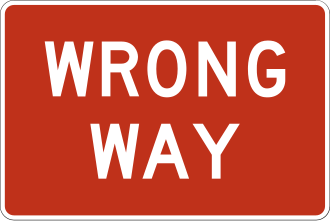
- The driver is going against the flow of traffic and must get out safely
- The driver has entered a one-way street correctly
- The driver must yield to oncoming traffic at a merge point
- The driver is approaching a dead end and must turn around
Answer: A — The driver is going against the flow of traffic and must get out safely
This sign warns that the driver is driving against traffic and must get out safely.
18. What does this sign indicate about the road ahead?
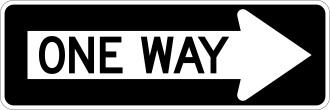
- The road splits into two directions ahead
- The road is closed to all traffic
- Traffic must yield before merging in the direction shown
- Traffic on this road moves only in the direction shown by the arrow
Answer: D — Traffic on this road moves only in the direction shown by the arrow
This sign means traffic moves only in the direction of the arrow.
19. What does this sign prohibit?
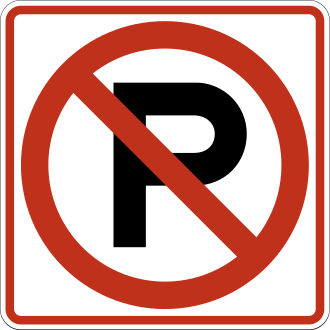
- Making a U-turn at this location
- Parking at this location
- Parking by everyone except vehicles displaying a disability plate or placard
- Driving faster than the posted limit
Answer: B — Parking at this location
This sign means parking is prohibited at this location.
20. What must a driver stopped at a red light do at this intersection?
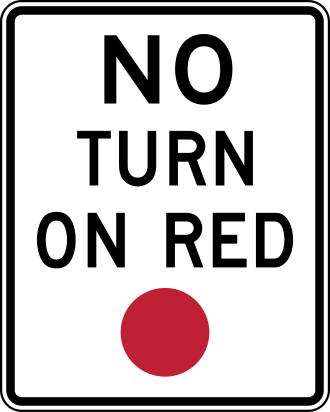
- Proceed straight through if no cross traffic is present
- Turn right after stopping, as usual at a red light
- Wait for a green light; a right turn on red is not allowed here
- Turn left on red after yielding to oncoming traffic
Answer: C — Wait for a green light; a right turn on red is not allowed here
This sign means the driver must wait for green; no right turn on red is permitted at this intersection.
21. What must a driver do when approaching this sign at a railroad crossing?
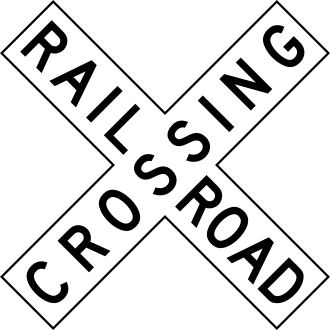
- Only slow down if flashing lights are also active
- Yield to any train, since it means the same as a yield sign
- Cross without slowing, since the crossbuck is only an advance warning of a crossing farther ahead
- Come to a complete stop every time, regardless of a train's presence
Answer: B — Yield to any train, since it means the same as a yield sign
The crossbuck means the same as a yield sign: yield to the train, which cannot swerve.
22. What does this sign warn a driver about the road ahead?
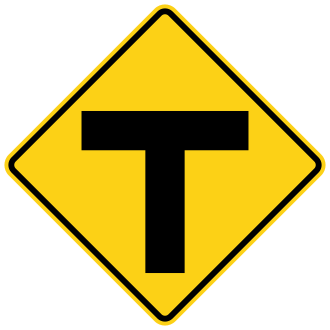
- The road splits into a Y-shaped fork ahead
- A side road joins from the right ahead
- The road narrows to a single lane ahead
- The road ends ahead, requiring a turn left or right
Answer: D — The road ends ahead, requiring a turn left or right
This sign warns that the road ends ahead and the driver must turn left or right.
23. What does this sign warn a driver to expect ahead?
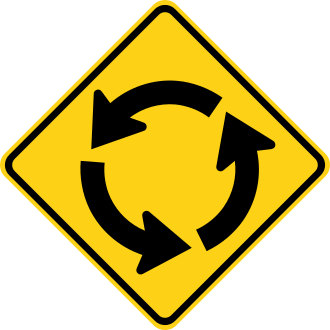
- A divided highway beginning
- A roundabout, entered and exited by right turns
- A four-way stop intersection
- A traffic signal requiring a full stop
Answer: B — A roundabout, entered and exited by right turns
This sign warns of a roundabout ahead, which is entered and exited by right turns.
24. What must a driver do upon seeing this sign?
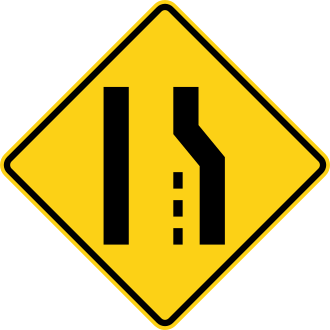
- Stop, since the road ends ahead
- Prepare to merge right as a new lane opens ahead
- Slow down for an upcoming narrow bridge
- Prepare to merge left as the lane ends ahead
Answer: D — Prepare to merge left as the lane ends ahead
This sign warns of a lane reduction ahead and tells the driver to merge left.
25. What should a driver do when approaching this sign?
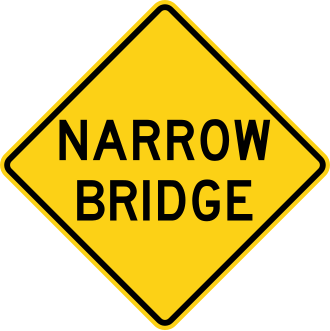
- Slow down for a sharp curve ahead
- Prepare to merge left as a lane ends
- Expect a divided highway to begin ahead
- Avoid passing, since the road narrows at a bridge ahead
Answer: D — Avoid passing, since the road narrows at a bridge ahead
This sign warns that the road narrows at a bridge ahead and the driver should not pass.
26. What should a driver do upon seeing this sign?
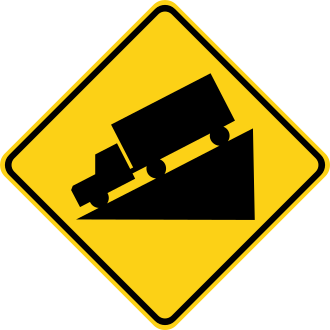
- Expect a soft shoulder along the road ahead
- Watch for deer crossing the road ahead
- Prepare to stop for a stop sign ahead
- Slow down and use a lower gear for the steep hill ahead
Answer: D — Slow down and use a lower gear for the steep hill ahead
This sign warns of a steep hill and tells the driver to slow down and use a lower gear.
27. What does this sign warn a driver about?
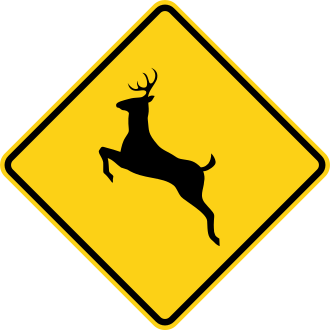
- Deer may cross the road here, so the driver should slow down
- Bicyclists may be sharing the road ahead
- Livestock may be herded across the road ahead
- Pedestrians may be crossing ahead
Answer: A — Deer may cross the road here, so the driver should slow down
This sign warns that deer may cross here and the driver should slow down.
28. What must a driver do when seeing this sign?
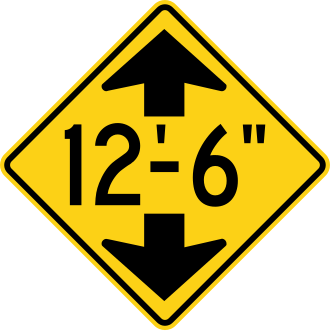
- Stay on the pavement because the shoulder is soft
- Reduce speed because the road surface is uneven ahead
- Watch for a low bridge with no height restriction
- Not enter if the vehicle is taller than the height shown
Answer: D — Not enter if the vehicle is taller than the height shown
This sign warns of low clearance: do not enter if the vehicle is taller than the height shown.
29. What does this sign indicate to a driver, and what should the driver keep in mind about penalties nearby?
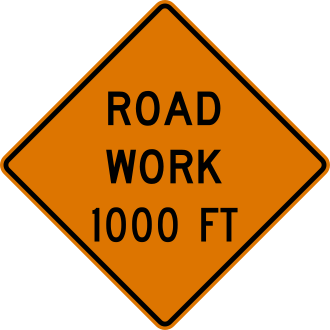
- A work zone is ahead, and fines for violations are doubled there
- A detour is ahead, requiring the driver to take an alternate route
- A bridge is under construction, and passing is prohibited
- A school zone is ahead, and the speed limit is reduced only when lights flash
Answer: A — A work zone is ahead, and fines for violations are doubled there
This orange work zone sign warns of road work ahead, and fines double in work zones.
30. What does this marker identify?
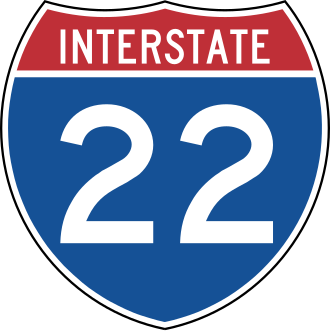
- A scenic byway route
- A state highway route
- An interstate highway route
- A U.S. numbered highway route
Answer: C — An interstate highway route
This marker is the shield used to identify an interstate route.
Take this test interactively
More New Jersey Driver License practice tests