Kentucky Driver License: Right-of-Way, Signals, Signs and Markings
29 questions with the correct answer and an explanation for each.
Topic: Right-of-Way, Signals, Signs and Markings. Free, no account needed.
Take this test interactively
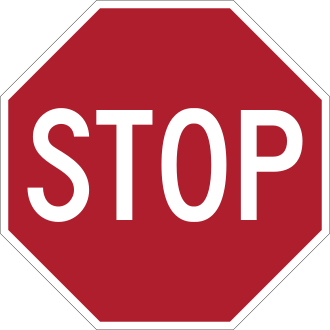
1. What must you do when you see this sign?
- Stop only if another vehicle is already at the intersection
- Slow down and yield if the intersection looks clear
- Yield without stopping if no other traffic is visible
- Come to a complete stop and yield to crossing vehicles and pedestrians in all directions
Answer: D — Come to a complete stop and yield to crossing vehicles and pedestrians in all directions
A stop sign requires a full stop behind the line or crosswalk and yielding to all crossing traffic and pedestrians, not a rolling stop or conditional stop.
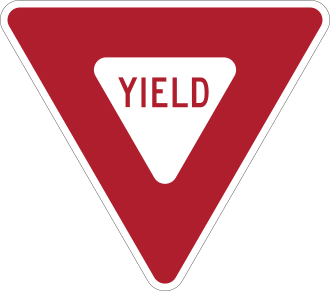
2. What does this sign mean?
- Come to a complete stop before proceeding
- A merge lane is ending ahead
- Slow down and let traffic with the right-of-way cross before entering
- You are entering a one-way street
Answer: C — Slow down and let traffic with the right-of-way cross before entering
A yield sign calls for slowing and letting crossing traffic pass, not a mandatory stop like an octagonal sign.
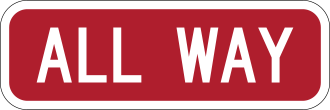
3. You reach an intersection where every approach has a stop sign and another car arrives at the same instant as you. What do you do?
- Whoever signals first may go first
- Proceed first since you arrived on a major road
- Stop, then yield to the driver on your right
- Stop, then yield to the driver on your left
Answer: C — Stop, then yield to the driver on your right
At a four-way stop, drivers arriving together yield to the vehicle on their right.
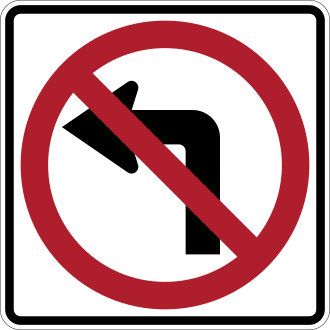
4. What does this sign prohibit?
- Right turns and U-turns
- Passing on the left
- U-turns only
- Left turns and U-turns
Answer: D — Left turns and U-turns
The sign bans left turns, and U-turns are prohibited too since a U-turn counts as two left turns.
5. What is the center lane marked by this sign reserved for?
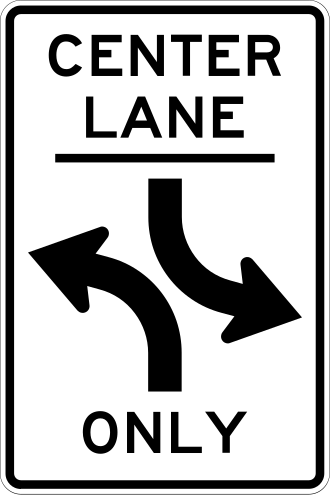
- Passing slower vehicles
- Right turns from either direction of travel
- Left turns from either direction of travel
- Through traffic traveling in both directions
Answer: C — Left turns from either direction of travel
This lane is reserved only for vehicles turning left from either direction, not for through driving or passing.
6. What does this sign require of a driver?
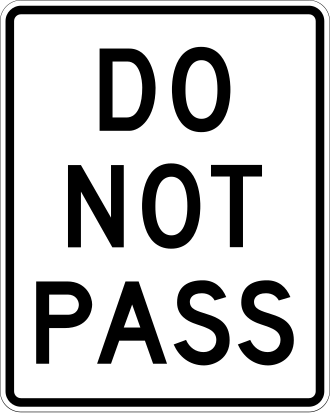
- Merge left because a lane is ending
- Do not pass; this is the start of a no-passing zone
- Slow for an upcoming narrow bridge
- A passing zone begins here
Answer: B — Do not pass; this is the start of a no-passing zone
This marks the start of a no-passing zone, and passing is prohibited regardless of how clear the road looks.
7. What does this sign tell a driver?
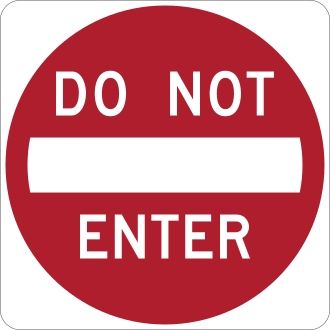
- The road ahead is closed for construction
- You must turn around at the next intersection
- Trucks are prohibited on this roadway
- You may not drive in this direction on this street
Answer: D — You may not drive in this direction on this street
This sign forbids entering the roadway in that direction, commonly posted at exit ramps and one-way street entrances.
8. What should a driver do upon seeing this sign?
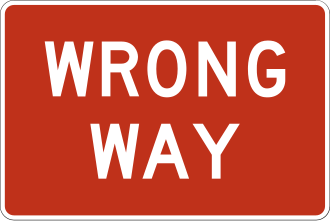
- Slow down, pull over and turn around carefully
- Do not enter, because this roadway is closed to trucks
- Keep right, because a traffic island or median is ahead
- Continue ahead, because traffic flows in the arrow's direction
Answer: A — Slow down, pull over and turn around carefully
This sign tells a driver they are traveling the wrong way, and calls for slowing down, pulling over and turning around carefully.
9. You face a red light at an intersection posted with this sign. What must you do?
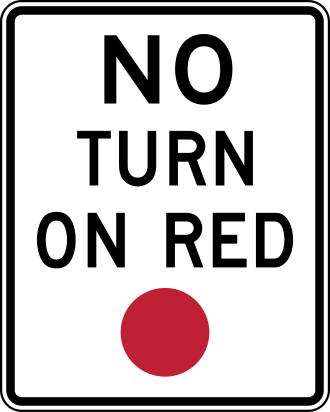
- Proceed straight through on the red light
- Wait for a green light before turning
- Turn left only, since right turns are restricted
- Turn right after stopping if the road is clear
Answer: B — Wait for a green light before turning
This sign overrides the normal allowance to turn right on red, so a driver must wait for green.
10. What does this sign require of a driver approaching railroad tracks?
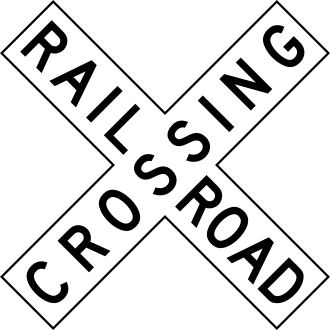
- Always come to a full stop, whether or not a train is near
- Proceed at normal speed since gates will warn if needed
- Slow down only if a train whistle is heard
- Look, listen, slow down and be ready to stop for trains from either direction
Answer: D — Look, listen, slow down and be ready to stop for trains from either direction
The crossbuck marks the crossing itself and calls for looking, listening, slowing, and being ready to stop for a train approaching from either direction.
11. What must a driver do at this intersection?
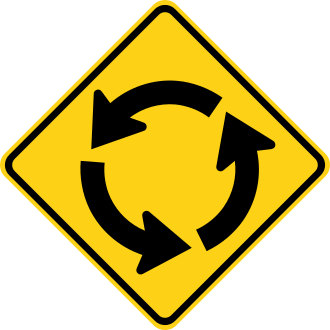
- Travel clockwise around the circle
- Stop completely before entering, regardless of circulating traffic
- Proceed first since entering traffic has the right-of-way
- Yield to traffic already in the circle and travel counterclockwise
Answer: D — Yield to traffic already in the circle and travel counterclockwise
At a roundabout, entering drivers yield to traffic already circulating and travel counterclockwise around it.
12. What does this sign warn of?
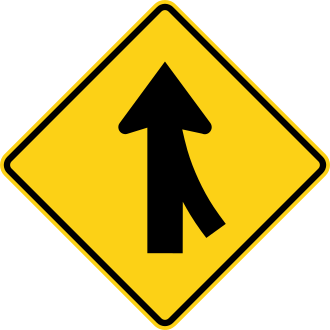
- A narrow bridge ahead
- The right lane ending, with right-lane drivers merging left
- An added lane that requires no merging
- Two lanes becoming one, requiring drivers in both to merge safely
Answer: D — Two lanes becoming one, requiring drivers in both to merge safely
This sign warns that two lanes are combining into one and drivers in both lanes must merge safely, unlike a one-sided lane-ends situation.
13. What does this sign indicate is ahead?
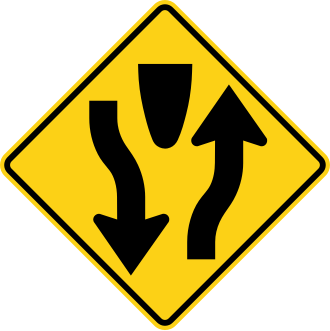
- A narrow bridge crossing a median
- The median ends and traffic will travel both ways
- The highway splits into two one-way roadways; keep right
- Two-way traffic on an undivided road
Answer: C — The highway splits into two one-way roadways; keep right
This sign marks where a highway splits into two separate one-way roadways, with drivers told to keep right.
14. What should a driver do upon seeing this sign in rainy weather?
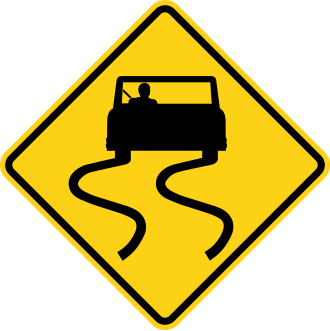
- Brake hard early to shed speed before the wet pavement
- Turn on hazard lights and pull over
- Reduce speed and avoid hard braking or sudden turns
- Ignore it, since it applies only to icy roads
Answer: C — Reduce speed and avoid hard braking or sudden turns
This sign warns the road is slippery when wet, calling for reduced speed and avoiding sudden braking or steering.
15. What does this sign mean?
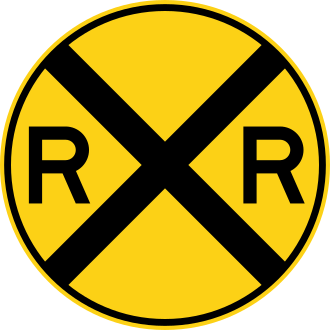
- A railroad crossing is at this exact spot; stop now
- The crossing ahead is closed for maintenance
- An advance warning that a railroad crossing is ahead; slow, look, listen and be ready to stop
- Trains only run when signals are flashing
Answer: C — An advance warning that a railroad crossing is ahead; slow, look, listen and be ready to stop
This is the advance warning sign placed before a crossing, not the crossing itself, prompting drivers to slow and be ready to stop.
16. What should a driver do upon seeing this sign?
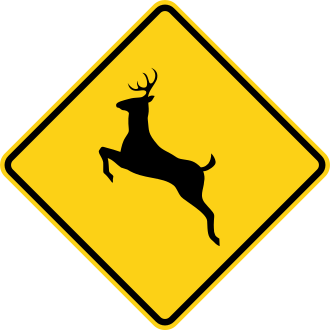
- Slow down, stay alert and be ready to stop for animals crossing
- Keep your speed and watch the shoulders as you pass
- Stop at the sign and wait until the crossing is clear
- Watch for animals only after dark
Answer: A — Slow down, stay alert and be ready to stop for animals crossing
This sign warns of deer crossing and calls for slowing down, staying alert and being ready to stop.
17. What must a driver do upon seeing this sign?
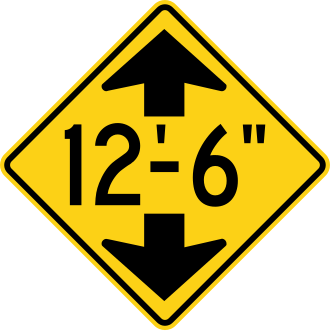
- Use the left lane only when passing beneath
- Stop and wait for a pilot vehicle to guide them through
- Not proceed if the vehicle is taller than the height shown
- Reduce speed only; vehicle height does not matter
Answer: C — Not proceed if the vehicle is taller than the height shown
This sign warns of a height restriction ahead, and a vehicle taller than the posted clearance must not proceed.
18. What does this sign mean?
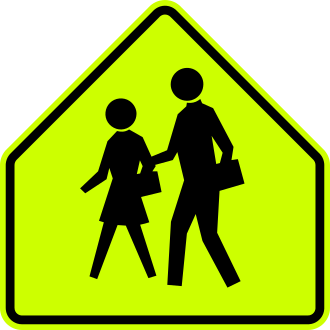
- A hospital zone is ahead
- A railroad crossing near a school
- A school zone or crossing; watch for children and obey crossing guards
- A playground area with no traffic restrictions
Answer: C — A school zone or crossing; watch for children and obey crossing guards
The pentagon shape marks a school zone or crossing, requiring drivers to watch for children and obey crossing guards.
19. You are pulling out of a private driveway onto a public street. Who must you yield to?
- Only pedestrians, not vehicles
- Drivers already on the public street
- Only vehicles that are turning left
- No one, since driveway traffic has the right-of-way
Answer: B — Drivers already on the public street
A driver entering a public road from a driveway or private road must yield to drivers already on that road.
20. You are entering an interstate highway from an acceleration ramp. Who has the right-of-way?
- Drivers already on the interstate highway
- Whichever vehicle is traveling faster
- Only vehicles in the left lane
- You, because ramp traffic merges first
Answer: A — Drivers already on the interstate highway
Entering drivers must yield to vehicles already on a limited-access or interstate highway.
21. You are stopped at a red light in the correct lane and the road is clear of vehicles and pedestrians. No sign restricts turns. What may you do?
- Wait for green regardless of how clear the road is
- Turn right without stopping first
- Turn right after stopping
- Turn left as well since the road is clear
Answer: C — Turn right after stopping
A right turn on red is allowed after stopping, from the proper lane, when the road is clear, unless a sign prohibits it.
22. You are stopped at a red light on a one-way street and want to turn left. When is this allowed?
- After stopping, when turning into the nearest lane of another one-way street running that direction and the way is clear
- Only if the street you are turning onto carries two-way traffic
- Never; left turns on red are always illegal
- Any time the way is clear, without stopping first
Answer: A — After stopping, when turning into the nearest lane of another one-way street running that direction and the way is clear
Left turns on red are permitted only from a one-way street into the nearest lane of another one-way street running that direction, after stopping and when clear.
23. What does a flashing yellow traffic signal mean?
- Come to a full stop and wait for a green light
- Yield only to pedestrians, not other vehicles
- Stop completely, then proceed when clear
- Slow down and watch for other traffic while proceeding
Answer: D — Slow down and watch for other traffic while proceeding
A flashing yellow light means slow down and watch for others, unlike a flashing red which requires a full stop.
24. Your car stalls on a railroad crossing and a train is approaching. What should you do?
- Try to push the car off the tracks before running
- Run in the direction the train is heading
- Stay in the vehicle and try to restart it
- Abandon the car immediately and run away from the tracks in the direction the train is coming from
Answer: D — Abandon the car immediately and run away from the tracks in the direction the train is coming from
A stalled or boxed-in vehicle should be abandoned immediately, running away from the tracks toward the direction the train is coming from to avoid flying debris.
25. About how much distance can an average freight train traveling 55 mph need to come to a stop?
- About a quarter mile
- A few hundred feet
- It can stop almost instantly
- A mile or more
Answer: D — A mile or more
An average freight train at 55 mph may need a mile or more to stop, far more than drivers typically expect.
26. You are driving through a work zone and a person with a sign is directing traffic to stop. What must you do?
- Slow down but keep moving unless a barrier blocks the lane
- Follow the posted work zone signs and treat the flagger as advisory
- Follow the flagger's directions
- Stop only if workers are visible on the roadway
Answer: C — Follow the flagger's directions
A person with a sign or flag directs traffic in a work zone, and drivers must obey their directions.
27. What happens to fines for speeding in a work zone?
- They are doubled
- They apply only when workers are visibly present
- They stay the same as elsewhere
- They are waived for a first offense
Answer: A — They are doubled
Fines for speeding in a work zone are doubled.
28. You see a broken yellow line on your side separating you from oncoming traffic. What does this allow?
- This marks a shared center turn lane
- Passing is not permitted on your side
- Passing is permitted on that side
- The lane ahead is closed
Answer: C — Passing is permitted on that side
A broken yellow line on a driver's side of the centerline means passing is permitted on that side.
29. A sign is shaped like an equilateral triangle. What kind of sign is this?
- A regulatory speed sign
- A guide sign
- A yield sign
- A railroad advance warning sign
Answer: C — A yield sign
The equilateral triangle shape is used exclusively for the yield sign among standard sign shapes.
Take this test interactively
More Kentucky Driver License practice tests
- Kentucky Driver License: Pedestrians, Bicycles, Trucks, Emergency Vehicles, Night and Trailers — 30 questions
- Kentucky Driver License: Registration, Insurance, Fitness to Drive, Alcohol and DUI — 30 questions
- Kentucky Driver License: Speed, Space, Communicating, Skids, Collisions and Breakdowns — 30 questions
- Kentucky Driver License: The License, the GDL, Tests, Renewal and Points — 30 questions
- Kentucky Driver License: Tires, Belts, Air Bags, Child Seats and Basic Driving — 26 questions
- Kentucky Driver License: Turns, Intersections, School Buses, Parking, Lanes and Passing — 30 questions