Minnesota Driver License: Signs, Signals and Pavement Markings
30 questions with the correct answer and an explanation for each.
Topic: Signs, Signals and Pavement Markings. Free, no account needed.
Take this test interactively
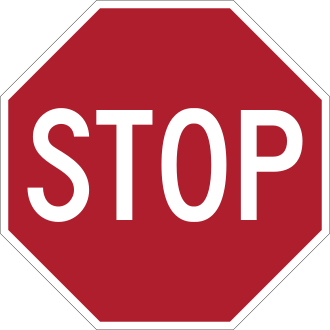
1. What must a driver do at this sign?
- Slow down and yield to crossing traffic without stopping
- Stop only if other vehicles are present
- Come to a rolling stop if the intersection is clear
- Stop completely and wait for pedestrians and vehicles with the right-of-way to clear, then proceed with caution
Answer: D — Stop completely and wait for pedestrians and vehicles with the right-of-way to clear, then proceed with caution
A stop sign requires a complete stop and waiting for the right-of-way to clear, not just slowing or yielding.
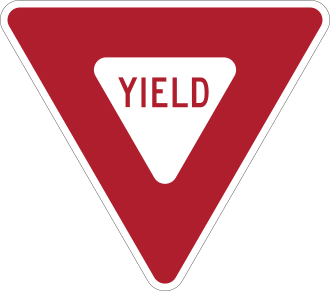
2. What does this sign require?
- Come to a complete stop every time regardless of traffic
- Merge into the left lane immediately
- Proceed at reduced speed without yielding to anyone
- Slow or stop as needed and give the right-of-way to everyone
Answer: D — Slow or stop as needed and give the right-of-way to everyone
A yield sign only requires stopping if needed, unlike a stop sign which always requires a full stop.
3. What does this plaque, mounted below a stop sign, mean?
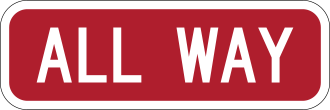
- Every approach to the intersection has a stop sign, and drivers arriving together yield to the driver on their right
- Traffic must stop only during school hours
- The intersection is a roundabout with yield-only entry
- Only the road it is posted on must stop
Answer: A — Every approach to the intersection has a stop sign, and drivers arriving together yield to the driver on their right
The plaque marks an all-way stop, where drivers arriving at the same time yield to the driver on their right.
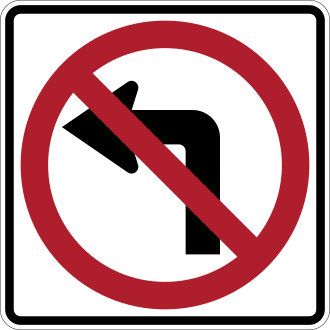
4. What is prohibited at this sign?
- Passing other vehicles
- Right turns only
- Entering the roadway in either direction
- Left turns and U-turns, since a U-turn counts as two left turns
Answer: D — Left turns and U-turns, since a U-turn counts as two left turns
This sign forbids left turns, and U-turns are barred along with them because a U-turn is treated as two left turns.
5. What must a driver not do at this sign?
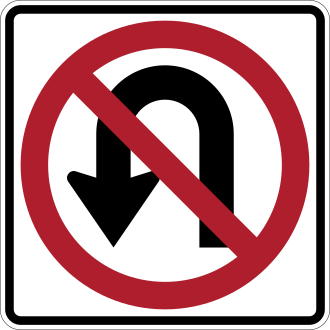
- Turn right
- Make a U-turn
- Turn left
- Pass another vehicle
Answer: B — Make a U-turn
This sign specifically prohibits U-turns at that location.
6. A driver is in the right lane approaching this sign. What must they do?
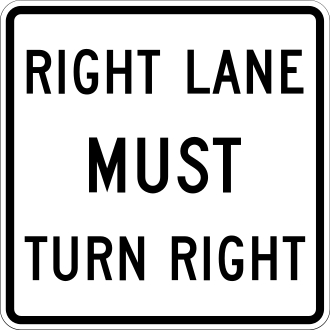
- Turn left only
- Continue straight or turn right, driver's choice
- Merge left before the intersection
- Turn right from that lane
Answer: D — Turn right from that lane
The sign designates the right lane as mandatory for right turns only.
7. What does this sign mark?
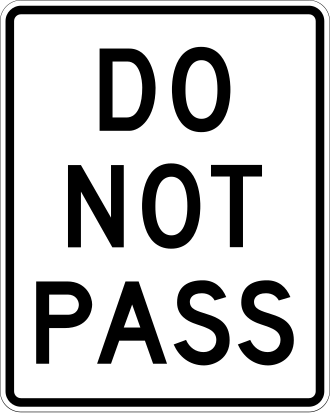
- The end of a no-passing zone
- A speed limit reduction ahead
- A merging lane ahead
- The start of a no-passing zone, where passing is prohibited even with a clear road
Answer: D — The start of a no-passing zone, where passing is prohibited even with a clear road
This sign marks where a no-passing zone begins, and passing is not allowed there even if the road looks clear.
8. What does this sign indicate?
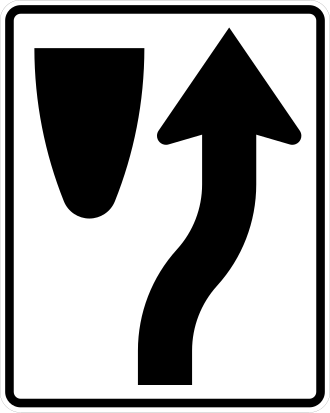
- The left lane is closed ahead
- Slower traffic should move to the right lane to let others pass
- A traffic island, median or barrier is ahead, and drivers should keep to the side shown
- A one-way street begins
Answer: C — A traffic island, median or barrier is ahead, and drivers should keep to the side shown
This sign warns of an obstruction such as an island or median and tells drivers which side to pass it on.
9. What should a driver do on seeing this sign?
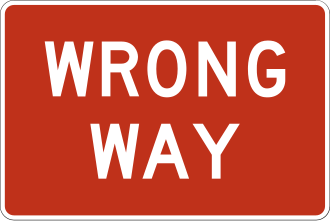
- Yield to oncoming traffic before proceeding
- Prepare to stop for a railroad crossing
- Continue, since the sign only warns of a one-way street ahead
- Recognize they are traveling against traffic, slow down, pull over and turn around carefully
Answer: D — Recognize they are traveling against traffic, slow down, pull over and turn around carefully
This sign means the driver has entered a lane of oncoming traffic and must correct course safely.
10. What does this sign tell a driver about the road ahead?
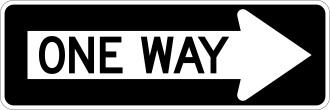
- The road becomes two-way ahead
- Entry is prohibited in that direction
- Traffic flows only in the direction of the arrow
- The lane is reserved for carpools
Answer: C — Traffic flows only in the direction of the arrow
This sign marks a one-way street where all traffic moves in the direction the arrow shows.
11. Who may legally park in a space marked with this sign?
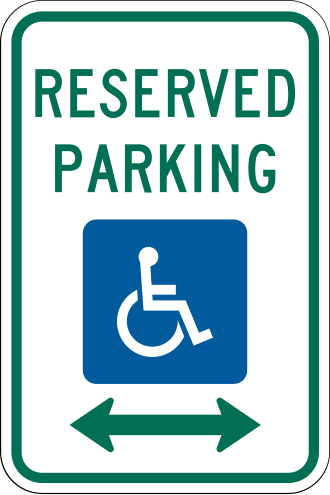
- Emergency vehicles only
- Carpool vehicles with two or more occupants
- Any vehicle for up to 15 minutes
- Vehicles displaying disability plates or a permit
Answer: D — Vehicles displaying disability plates or a permit
These spaces are reserved specifically for vehicles with disability plates or a permit.
12. What must a driver do at a red light posted with this sign?
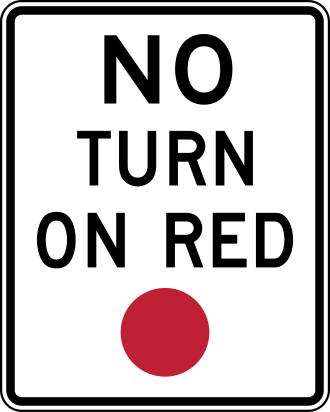
- Turn right after a complete stop if the way is clear
- Wait for a green light before turning
- Turn left only after yielding to oncoming traffic
- Treat the signal as a flashing red and proceed when clear
Answer: B — Wait for a green light before turning
This sign overrides the normal right-turn-on-red allowance, requiring drivers to wait for green.
13. What must a driver do on approaching this sign?
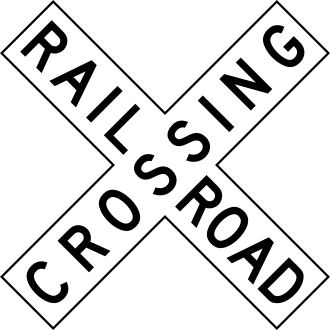
- Yield only to trains approaching from the left
- Stop only if the crossing gates are down
- Proceed without stopping if no train whistle is heard
- Look, listen, slow down and be ready to stop for trains from either direction
Answer: D — Look, listen, slow down and be ready to stop for trains from either direction
This crossbuck marks an active railroad crossing, where drivers must watch and listen for trains from both directions.
14. What does this sign warn a driver about?
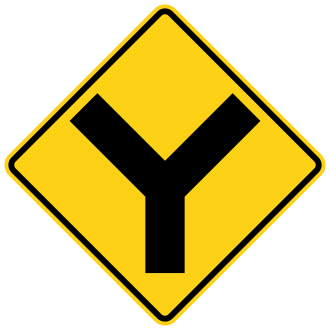
- The road splits ahead, and the driver must bear right or left
- A side road enters from the right
- The road ends ahead at a stop sign
- A sharp bend to the right is ahead
Answer: A — The road splits ahead, and the driver must bear right or left
This sign warns of a fork in the road where the driver must choose to bear right or left.
15. What must a driver do on approaching this sign?
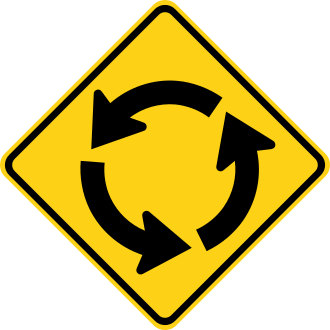
- Merge left immediately, since the road divides ahead
- Slow to the advisory speed, yield to traffic already in the circle and travel counterclockwise
- Proceed straight through without yielding
- Stop completely before entering regardless of traffic
Answer: B — Slow to the advisory speed, yield to traffic already in the circle and travel counterclockwise
This sign warns of a roundabout ahead, where drivers must slow, yield to circulating traffic and go counterclockwise.
16. A driver is in the right lane and sees this sign. What should they do?
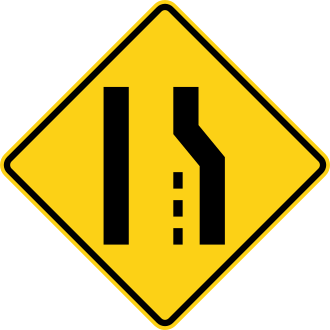
- Move right, since the left lane is ending
- Prepare to merge left, since the right lane ends and must yield
- Speed up to pass vehicles merging from the left
- Continue in the right lane, since it becomes a new through lane
Answer: B — Prepare to merge left, since the right lane ends and must yield
This sign warns that the right lane is ending, so drivers in it must merge left and yield to lane traffic.
17. What does this sign indicate about the road ahead?
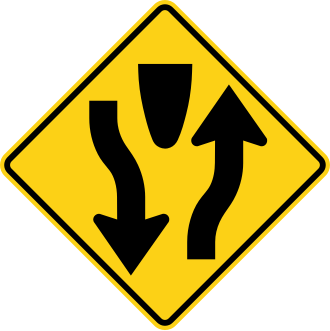
- Traffic must merge left because the right lane ends
- The highway splits into two one-way roadways separated by a median; keep right
- The median ends and two-way traffic resumes
- A single lane merges into a divided highway
Answer: B — The highway splits into two one-way roadways separated by a median; keep right
This sign marks where a divided highway begins, splitting into separated one-way roadways.
18. What must a driver do on seeing this sign?
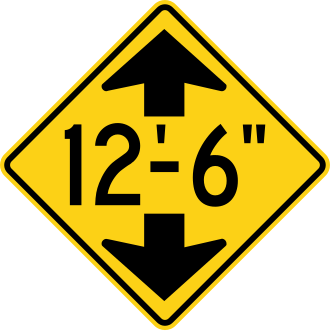
- Reduce speed for a narrow bridge ahead
- Not proceed if their vehicle is taller than the height shown
- Reduce speed but continue, since the posted height is only advisory
- Watch for a steep downgrade and check their brakes
Answer: B — Not proceed if their vehicle is taller than the height shown
This sign warns of limited overhead clearance, and vehicles taller than the posted height must not proceed.
19. What does this sign mark?
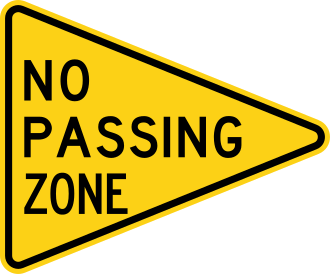
- A school zone ahead
- A merging lane ahead
- The end of a no-passing zone
- The start of a no-passing zone
Answer: D — The start of a no-passing zone
The pennant-shaped sign is posted where a no-passing zone begins.
20. What does this sign mark?
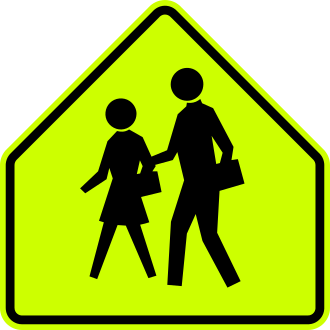
- A school zone or school crossing ahead, requiring watchfulness for children and obedience to crossing guards
- A reduced speed zone for road construction
- A pedestrian crosswalk unrelated to a school
- A playground with no roadway crossing
Answer: A — A school zone or school crossing ahead, requiring watchfulness for children and obedience to crossing guards
The pentagon shape uniquely marks a school zone or school crosswalk.
21. What kind of message is conveyed by a fluorescent yellow-green sign posted near a school?
- A regulatory command that must be obeyed
- Information about nearby motorist services
- A warning related to pedestrians, bicycles or school areas
- A guide to historic or recreational sites
Answer: C — A warning related to pedestrians, bicycles or school areas
Yellow-green is used specifically for warnings at pedestrian, bicycle and school areas.
22. A posted minimum speed applies on a controlled-access interstate. When may a driver go below it?
- Only during construction
- When weather or road conditions require it
- Never, regardless of conditions
- Whenever traffic is heavy
Answer: B — When weather or road conditions require it
The minimum speed may be disregarded only when weather or road conditions make it unsafe to maintain.
23. All disability parking spaces in a lot are full, but a driver holds a valid disability permit. What may they do?
- Park where a No Parking sign is posted, since the permit overrides it
- Park at an angle across two standard spaces
- Park across two standard spaces only if the lot has no reserved spaces at all
- Wait for a reserved space to open, since no other option is permitted
Answer: B — Park at an angle across two standard spaces
When disability spaces are full, a permit holder is allowed to park at an angle across two standard spaces.
24. A farm implement cannot travel faster than 25 mph. What must it display?
- Nothing, since the emblem is required only of animal-drawn vehicles
- A light visible within 500 feet, day and night
- The slow-moving vehicle emblem
- An orange flag, which replaces the emblem at speeds below 30 mph
Answer: C — The slow-moving vehicle emblem
Vehicles traveling 30 mph or less, such as farm implements, must display the slow-moving vehicle emblem.
25. An animal-drawn vehicle is traveling after sunset. How far away must its light be visible?
- 100 feet
- 500 feet
- 1,000 feet
- 200 feet
Answer: B — 500 feet
Animal-drawn vehicles must show a light visible within 500 feet from sunset to sunrise or in poor visibility.
26. A school bus reaches a railroad crossing posted with an Exempt sign. What does that sign mean?
- The bus must stop even though other vehicles do not have to
- The crossing has no active train traffic and warning signs can be ignored
- The bus may proceed without the usual stop, though the driver still looks both ways
- Only vehicles under a certain weight are exempt from stopping
Answer: C — The bus may proceed without the usual stop, though the driver still looks both ways
An Exempt sign lets buses and trucks that normally must stop proceed instead, though everyone still looks both ways.
27. A driver is caught speeding in a work zone where workers are present. What is the fine?
- $300
- There is no special fine; the normal speeding penalty applies
- $500
- $100
Answer: A — $300
Speeding in a work zone with workers present carries a specific $300 fine.
28. A driver stopped at a steady red light wants to turn left from a one-way street onto another one-way street. What must they do before turning?
- Come to a complete stop, make sure the intersection is clear, yield to pedestrians and vehicles, and turn only into the direction traffic travels
- Wait for a green arrow before turning left
- Turn left only if a "No Turn on Red" sign is not posted for right turns
- Turn immediately without stopping, since one-way-to-one-way left turns are always permitted on red
Answer: A — Come to a complete stop, make sure the intersection is clear, yield to pedestrians and vehicles, and turn only into the direction traffic travels
A left turn on red from a one-way onto a one-way is allowed only after a complete stop, a clear intersection, and yielding, and only into the direction of travel.
29. A driver faces a flashing yellow arrow while waiting to turn left. What must they do?
- Proceed with caution, yielding to oncoming vehicles close enough to be a hazard
- Treat it as a flashing red and come to a complete stop first
- Stop and wait, since a flashing yellow arrow means the same as a steady red arrow
- Turn immediately, since oncoming traffic has already stopped
Answer: A — Proceed with caution, yielding to oncoming vehicles close enough to be a hazard
A flashing yellow arrow allows a left turn with caution, yielding to oncoming vehicles close enough to be a hazard.
30. A traffic officer raises a palm toward a driver and gives a long whistle blast. What does this mean?
- Go
- Turn right only
- Stop
- Proceed with caution
Answer: C — Stop
A raised palm with a long whistle blast is the officer's signal to stop.
Take this test interactively
More Minnesota Driver License practice tests
- Minnesota Driver License: Belts, Child Seats, Crashes, Insurance and Losing Your License — 28 questions
- Minnesota Driver License: Bicyclists, Motorcyclists, Trucks, Railroads and Work Zones — 30 questions
- Minnesota Driver License: Driving Under the Influence — 30 questions
- Minnesota Driver License: SIPDE, Night, Freeways, Distraction, Trailers and Winter — 30 questions
- Minnesota Driver License: Skids, Vehicle Failures, Deer, Floods and Carbon Monoxide — 28 questions
- Minnesota Driver License: Stopping, School Buses, Right-of-Way and Pedestrians — 30 questions
- Minnesota Driver License: Your License to Drive — 30 questions
- Minnesota Driver License: Your Vehicle, Speed, Turns, Passing and Parking — 30 questions